Why Where Your Code Runs Matters as Much as How
You build an app in San Francisco. Your users are in Mumbai. Every request travels 13,000 kilometers across undersea cables, about 130ms of network one way. Add processing time, database queries, and the return trip, and your users are staring at a spinner for 400-600ms on every interaction.
Move your infrastructure to AWS Mumbai (ap-south-1), and that same request takes 5ms. You've just improved perceived performance by 100x without changing a single line of code.
Regions aren't just about latency. Data sovereignty laws like GDPR require European user data to stay in Europe. India's data localization rules require certain financial data to remain in India. Picking the wrong region can make your product literally illegal in certain markets.
Every cloud provider. AWS, Azure, GCP, operates dozens of regions worldwide. Choosing which regions to deploy in is one of the first architectural decisions you'll make, and it affects latency, compliance, cost, and disaster recovery.
Understanding Cloud Regions
A region is a geographic area containing one or more data centers (called Availability Zones). Each region is fully independent, its own power, networking, and infrastructure.
AWS regions (as of 2026): 33+ regions across North America, South America, Europe, Asia Pacific, Middle East, and Africa.
| Factor | How It Affects Region Choice |
|---|---|
| Deploy close to your users | |
| Compliance | GDPR, data residency laws |
| Cost | Prices vary 10-30% between regions |
| Service availability | Not all AWS services are in all regions |
| Disaster recovery | Secondary region for failover |
Cost differences are real:
| Service | us-east-1 | ap-south-1 | eu-west-1 |
|---|---|---|---|
| t3.medium | $0.0416/hr | $0.0456/hr | $0.0464/hr |
| S3 (per GB) | $0.023 | $0.025 | $0.024 |
| Data out (per GB) | $0.09 | $0.109 | $0.09 |
us-east-1 (N. Virginia) is typically the cheapest and has every service first. But if your users are in India, the latency savings from ap-south-1 far outweigh the cost premium.
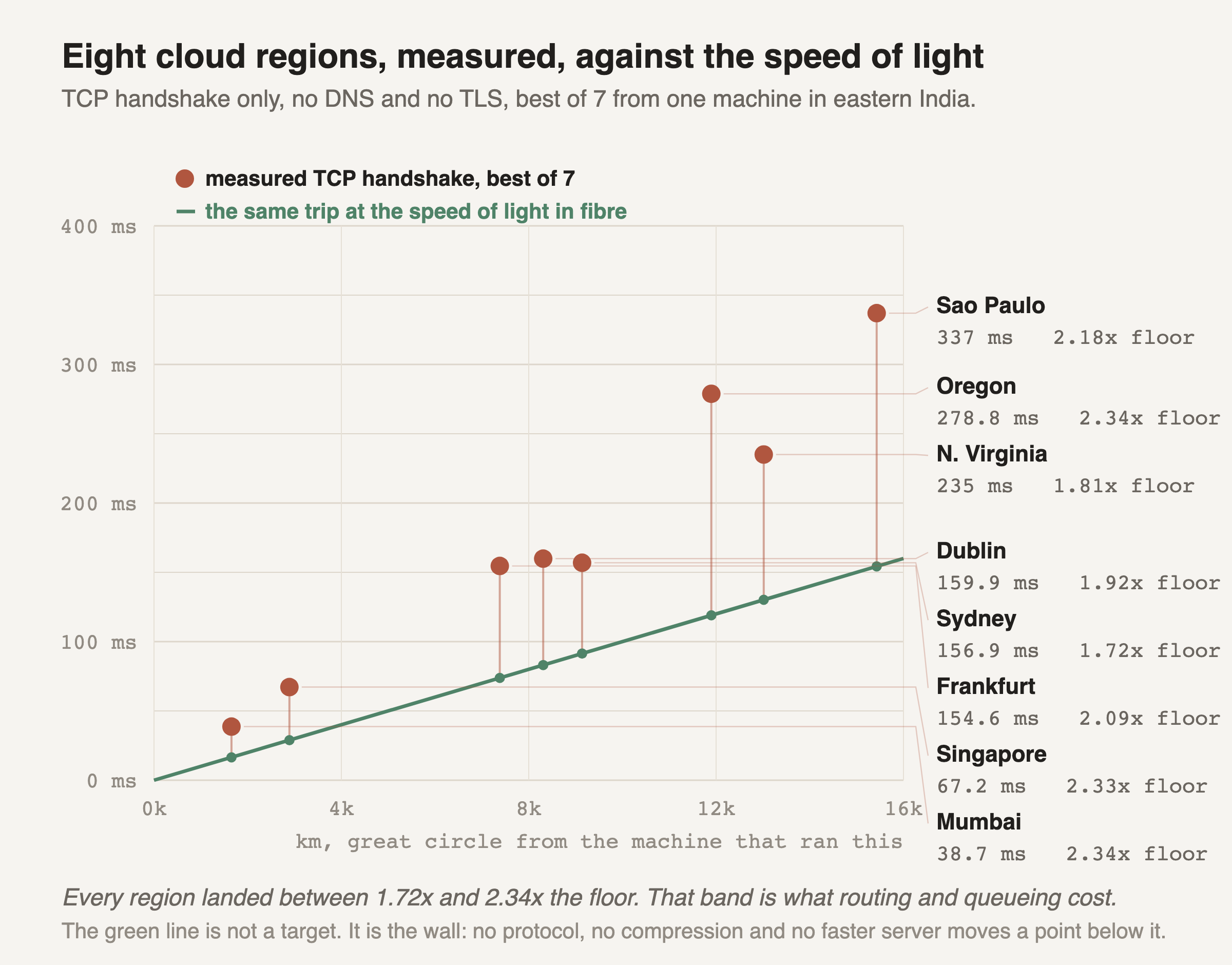
Two things are plotted. The red dots are what a real handshake actually cost. The green line is what the same journey would cost if the packet travelled at the speed of light through fibre on a perfectly straight path.
That green line is a wall, not a target. Light in glass moves at about two thirds of light in vacuum, which works out to roughly 5 microseconds per kilometre each way, and nothing you deploy changes it. Sao Paulo is 15,428 km away, so the round trip cannot be faster than 154 ms no matter what you do.
The gap between a dot and the line is everything else: routers, switches, queues, and the fact that fibre follows roads and seabeds instead of great circles. Measured here, that overhead put every region between 1.72 and 2.34 times the floor, which is a surprisingly narrow band across four continents.
Look at Oregon and N. Virginia. Oregon is 1,100 km closer and measured 44 ms slower. Distance sets the floor; the route decides how far above it you land. This is the effect a private backbone like Global Accelerator or Cloudflare Argo is sold to fix, and it is the only part of this chart engineering can move.
Which settles the region question. If your users are in India, a server in ap-south-1 answers in 38.7 ms and one in us-east-1 answers in 235 ms before your code runs a single line. No cache, no faster instance and no protocol upgrade closes a 196 ms gap. You close it by moving the data.