You Have Four Categories. Do Not Build Four Metrics.
The is finished. Forty traces were read, ten of them failed, and the thirteen codes those failures carried were merged into four categories. Each category is named after a repair somebody could actually make.
The obvious next step is to put all four on a dashboard and watch them weekly. That is how you end up with a dashboard nobody looks at.
Not because the categories are wrong. They are real, they are well named, and the work that produced them was worth doing. They are just not big enough to carry a weekly number. And there is a one-line piece of arithmetic that says so, before you spend a sprint building the charts.
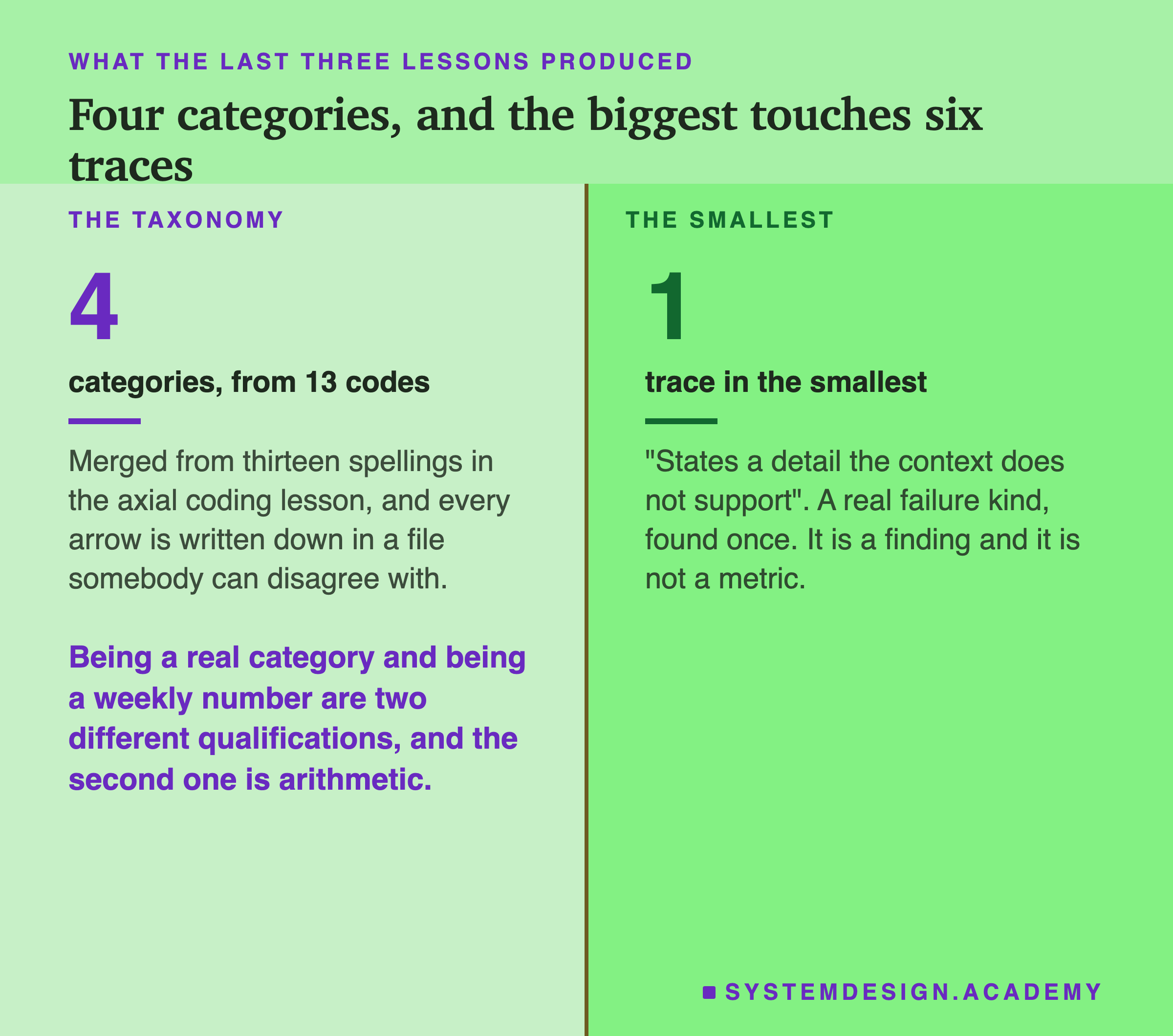
That closing line is the whole lesson. Being a real category and being a weekly number are two separate qualifications. The first one is a judgement about the failures. The second one is mostly arithmetic, and you can run it in about a second.
Here it is, run on the labels from grader A over the forty traces.
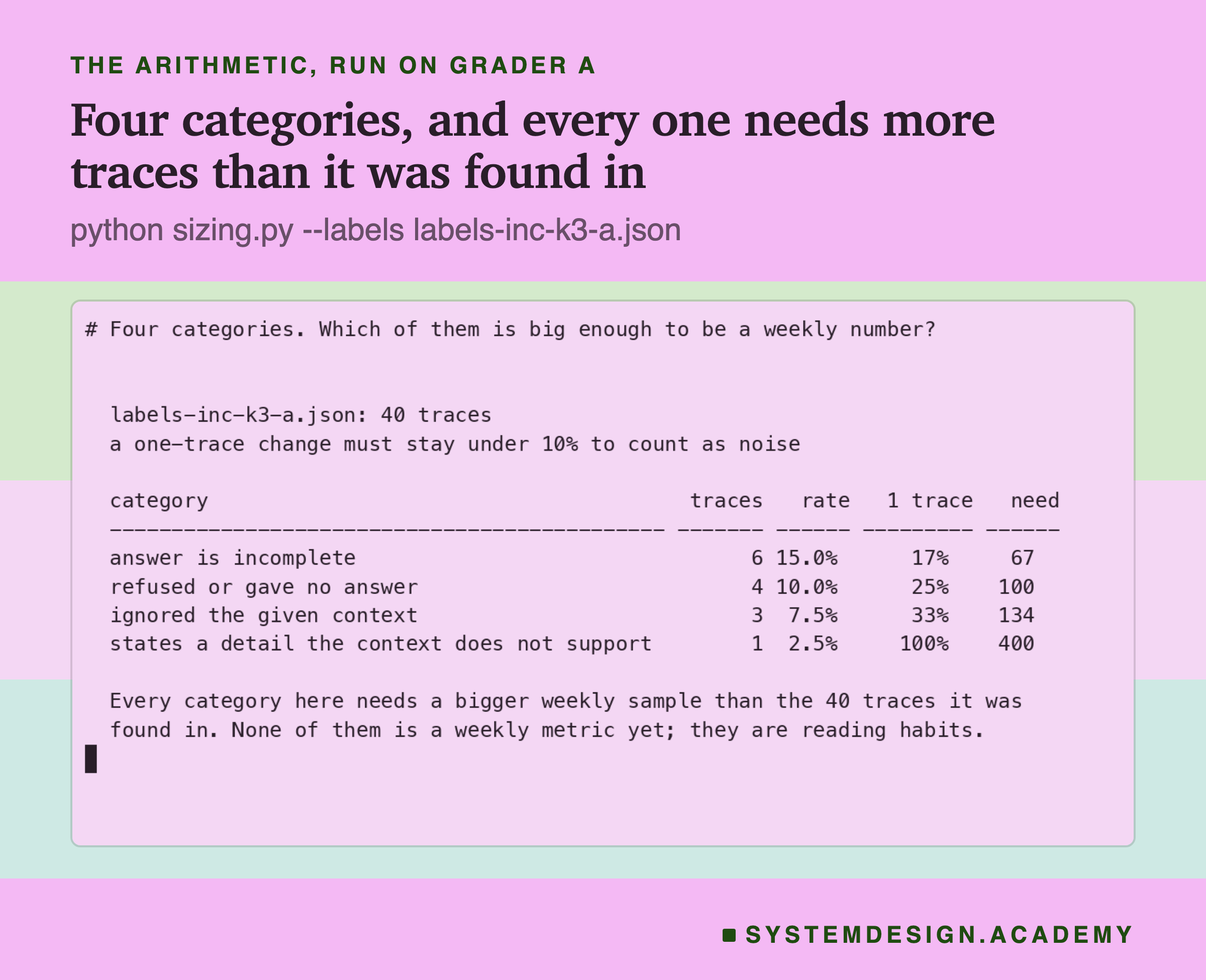
Read the last column. To watch "answer is incomplete" weekly you would need to read 67 traces every week. For the smallest category you would need 400. All four numbers are bigger than the forty traces the categories were found in.
That is a genuinely useful finding, and it is worth saying plainly instead of dressing it up. Keep the categories. Keep reading traces. Build the metrics later, when the counts can carry one.