An LLM Product Can Be Down in a Way No Dashboard Shows
Availability 99.97 percent. p95 1.4 seconds. Error rate 0.02 percent. Every panel green, and the support queue is filling with users who were told, politely and in perfect JSON, that a refund policy exists which does not.
That gap is not a monitoring bug. It is a definitional mismatch. Classic reliability engineering was built for systems where a request is either served correctly or fails in a way the infrastructure can see: a 500, a timeout, a refused connection. Google's SRE book defines the whole discipline on that assumption, availability as good requests over total requests, counted from signals the serving stack emits (Embracing Risk). An LLM violates the assumption at its core. Its characteristic failure is a request that succeeds by every infrastructure measure and is wrong in its content. The 200 arrives on time, parses cleanly, reads confidently, and misinforms.
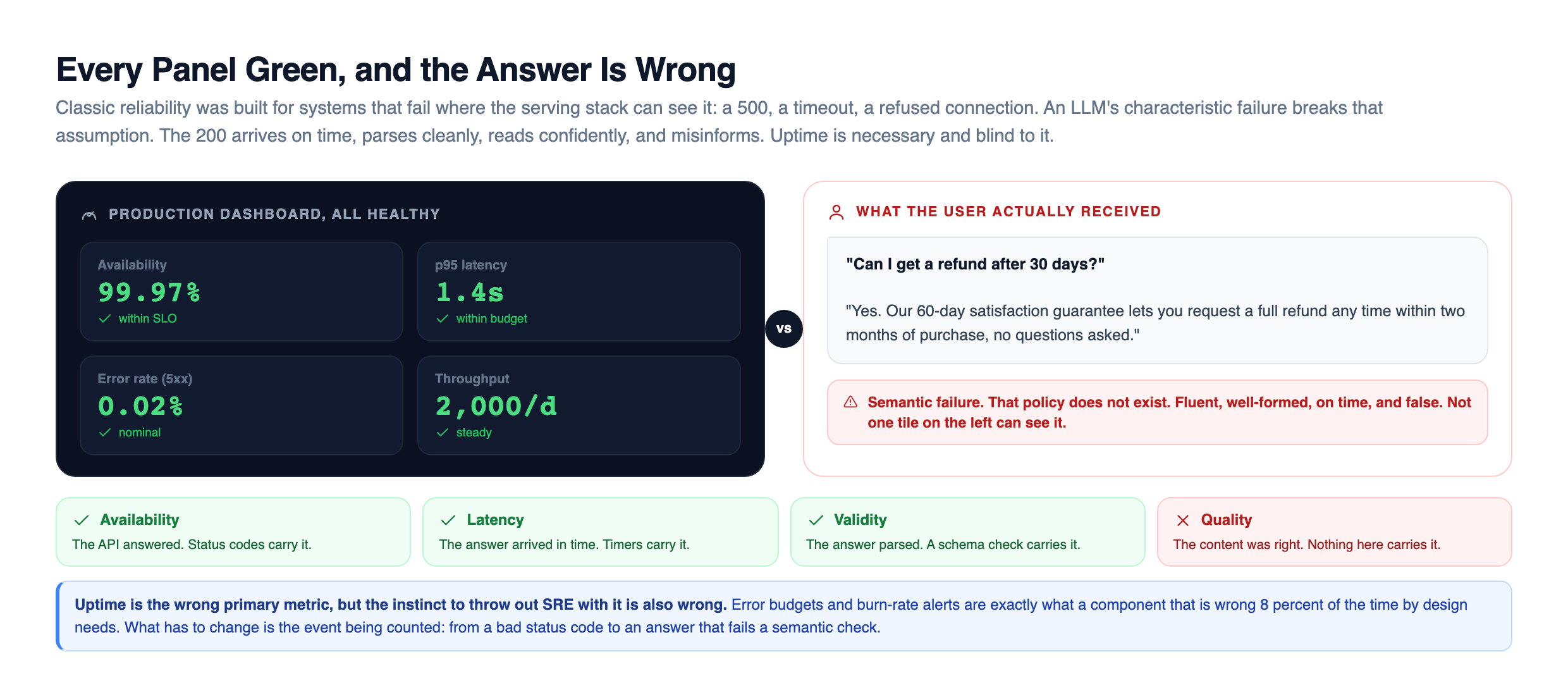
So uptime is the wrong metric, but the instinct to throw out SRE with it is also wrong. Error budgets, burn-rate alerts, and pre-agreed consequences are exactly the machinery a probabilistic component needs, arguably more than a deterministic one, because a component that is wrong 8 percent of the time by design needs a formal answer to the question "how wrong, for how long, before we act." What has to change is the event being counted. This lesson rebuilds the SRE stack on a new unit of failure: the answer that fails a semantic check.
The rate limits lesson handled the layer below this one, whether the API answers at all. This lesson assumes that layer holds and asks the question that remains when it does: the system is up, fast, and well-formed. Is it right often enough, and what happens when it is not?