systemdesign.academyAI EngineeringFree lessonsSign inGet the course
  1. Home
  2. AI Engineering: Evaluation, LLM Ops and Security

Where this shows up in interviews

This idea carries a full system design question on its own. Each walks through the full answer.

  • →Design a Fraud Detection System
Previous lessonEvaluating RAG and Agents: One Score Detects, Components LocalizeNext lessonPrompt CI and Benchmark Integrity: Catch the Silent Break

System Design

  • Foundation
  • Intermediate
  • Advanced
  • Capstone

AI Engineering

  • Foundation
  • Data, RAG and Agents
  • Evaluation, LLM Ops and Security

systemdesign.academy

  • Home
  • Glossary
  • Interview prep
  • Reviews
  • About
  • Pricing
  • Privacy
  • Terms
  • Refunds
  • Delivery
  • Contact
  • LLM Evaluation and Error Analysis
  • Offline vs Online: Evals Verify, Experiments Validate
  • AI Engineering · Evals

    Offline vs Online: Evals Verify, Experiments Validate

    Free preview: the first part of this 12-part lesson.

    Already bought the course? Sign in to read the whole lesson.

    this lesson is part of

    AI Engineering

    Unlock this lesson and the 199 other paid lessons

    • 210 lessons in 16 chapters
    • 118 lessons built on a lab that really ran
    • An AI tutor beside every lesson that answers and draws
    • Lifetime access, every new lesson included

    $49 once, by PayPal

    See the AI Engineering course

    The rest of this lesson

    1. Two Questions, Not Two Grades
    2. What Offline Eval Actually Buys You
    3. What Only Live Traffic Can Tell You
    4. Why a Better Offline Score Is a Promise
    5. Watch an Offline Win Die Online
    6. The Win That Quietly Costs You
    7. Why You Cannot A/B Every Prompt Tweak
    8. Letting Offline Carry the Load
    9. What Each One Costs You
    10. How Mature Teams Actually Wire This
    11. Knowledge Check

    read the rest of this lesson in

    AI Engineering

    Unlock this lesson and the 199 other paid lessons

    • 210 lessons in 16 chapters
    • 118 lessons built on a lab that really ran
    • An AI tutor beside every lesson that answers and draws
    • Lifetime access, every new lesson included

    $49 once, by PayPal

    See the AI Engineering course

    Continue this lesson

    in Evals

    This lesson is part of the AI Engineering course. Unlock the full course, a separate one-time payment, for lifetime access.

    One-time payment. Lifetime access. No subscription.
    Global
    $49/lifetime

    One-time payment by card or PayPal

    Get Lifetime Access
    Foundation lessons free, try before you buy
    India Special
    India
    ₹999/lifetime

    One-time payment: UPI, card or netbanking

    Get Lifetime Access
    Foundation lessons free, try before you buy
    Every ML Platform lesson, Foundation to Advanced
    Real architecture diagrams with real tool logos
    MLOps, LLMOps, and data engineering in depth
    Quizzes with instant feedback
    Built and reviewed by senior engineers
    Lifetime access, all future content included

    Foundation lessons of this course are free, no payment needed. Try them now

    The Green Dashboard That Meant Nothing Online

    Your retrieval change lifted the offline faithfulness score by six points, cleanly above the noise band. The eval gate went green. You shipped it to half of live traffic. Fourteen days later the conversion difference between the two arms was 0.2 points, and the confidence interval ran from slightly negative to slightly positive. The stats tool called it not significant. Nothing had crashed, the offline number was real arithmetic on a real dataset, and yet the metric that pays the team did not move.

    This is not a bug and it is not a bad change. It is the most common way engineers new to shipping AI features get burned. They treat a better offline score as a result, when it is only a promise. The offline eval did its job. It told you the change did not regress a metric you already knew how to measure. It never claimed, and cannot claim, that users would behave differently.
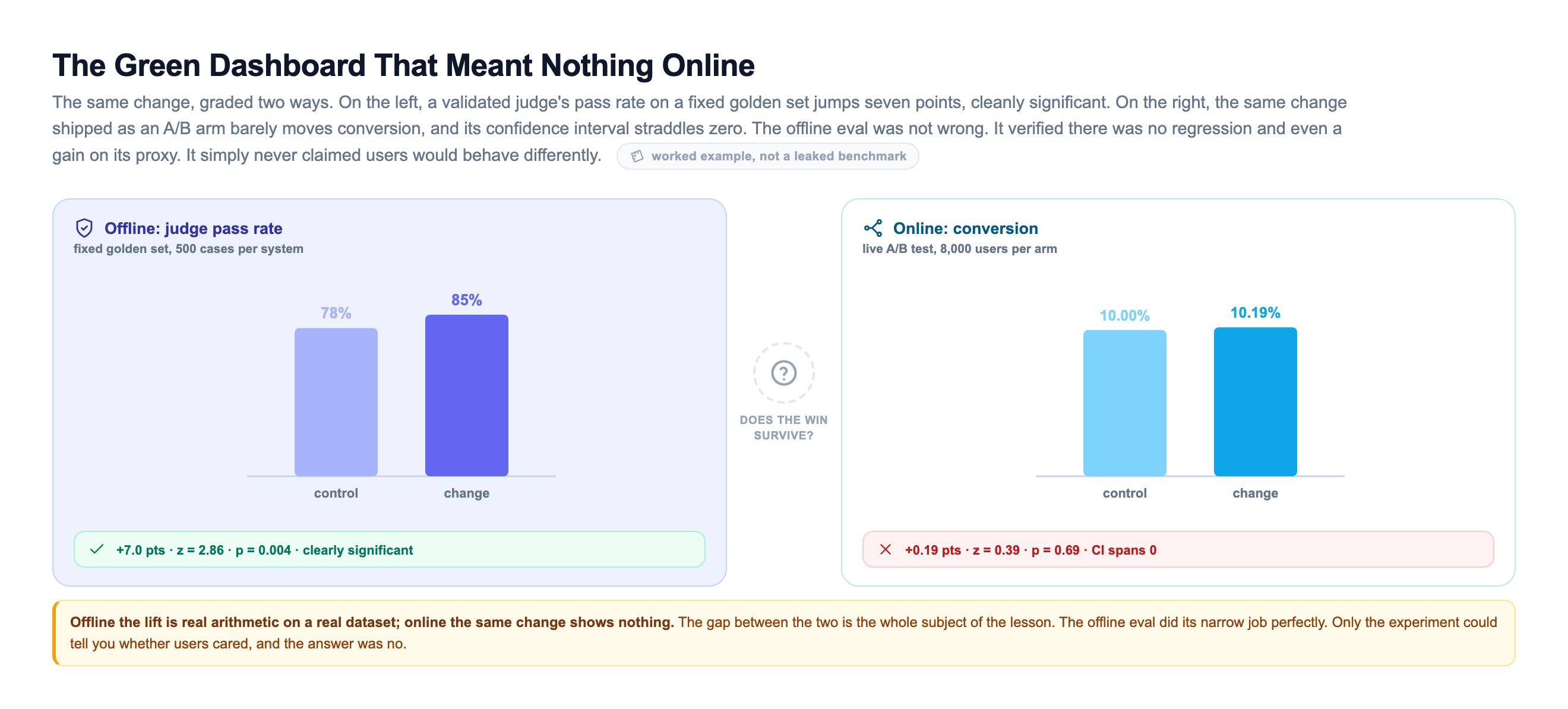
    Two bar charts side by side for the same change, graded two ways. On the left, offline judge pass rate on a fixed golden set of 500 cases rises from 78 percent control to 85 percent for the change, a plus 7.0 point lift with z equals 2.86 and p equals 0.004, marked clearly significant in green. On the right, online conversion in a live A/B test of 8,000 users per arm is 10.00 percent control versus 10.19 percent for the change, a plus 0.19 point lift with z equals 0.39, p equals 0.69, and a confidence interval that spans zero, marked not significant in red. A dashed circle with a question mark between them asks whether the win survives.

    The gap between that green dashboard and the flat conversion line is the whole subject of this lesson. Offline evals and online experiments feel like two grades on the same test, so people expect them to agree, and are surprised when they do not. They are not two grades. They answer different questions, they cost different amounts, and a serious team runs both because neither one can do the other's job.