Eight Servers Attached, Ten Thousand Tokens Gone Before the User Types
Attach eight servers to an agent and roughly ten thousand tokens of tool descriptions ride in the context window on every request, before the user has said a word. In a loop that runs ten model calls to finish a task, you pay that ten times. Nobody put that line in the budget.
This is the part the Model Context Protocol pitch skips. The pitch is real: MCP standardizes how models discover and call tools, and it collapses a pile of bespoke integrations into a clean protocol. What the pitch leaves out is that every server you attach has a running cost that shows up on every request, and that cost is easy to rack up because attaching a server is one line of config that looks free.
The contract lesson earlier in this chapter covered how a single call is validated and why the model breaks it. That lesson stands whether or not you use MCP. This one is about the layer above: what MCP actually is, what standardizing tool access buys you, and the bill that arrives with it. By the end you will be able to price an MCP setup in tokens and latency, and decide when it earns its keep versus when a plain function call is the better engineering.
What MCP Actually Standardizes
Strip away the branding and is a client-server protocol for one job: letting a model discover what tools exist and call them, in a format that any compatible client and any compatible server agree on.
The value is an integration-effort argument. Picture N agent surfaces (a coding agent, an internal ops bot, a support assistant) and M capabilities (GitHub, a Postgres database, a payments API). Without a shared protocol, each surface wires up each capability in that provider's own way, which is N times M pieces of glue. Add a capability and you re-plumb it into every surface. Change one tool's arguments and you edit it in N places.
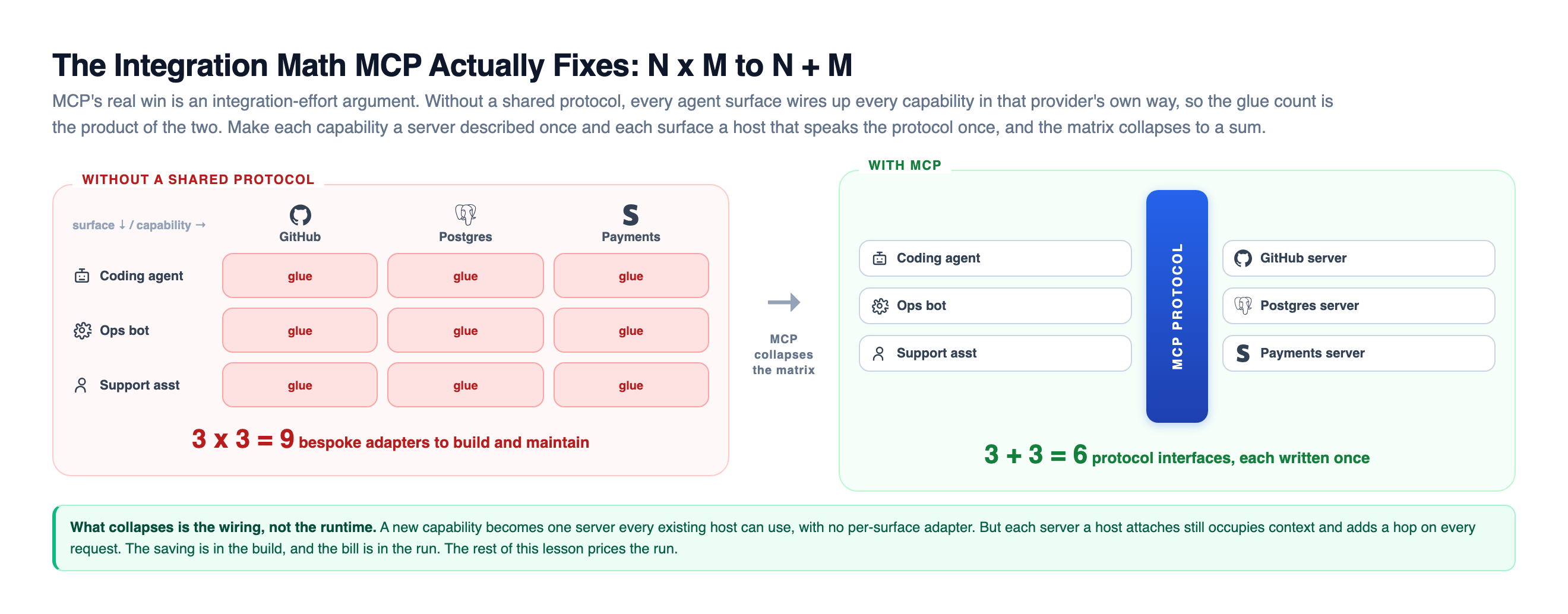
MCP makes each capability a server, described once, and each surface a host that speaks the protocol once. The matrix collapses from N times M pairwise adapters to N plus M interfaces. A new capability is one new server that every existing host can use, with no per-surface adapter.
That collapse is genuine, and on a large matrix it is a real saving. Hold onto one thing though: the reduction is in the work of wiring things together, not in what each server costs at runtime. Every server a host attaches still occupies context and adds a hop on every request, which is the bill the rest of this lesson makes you look at.