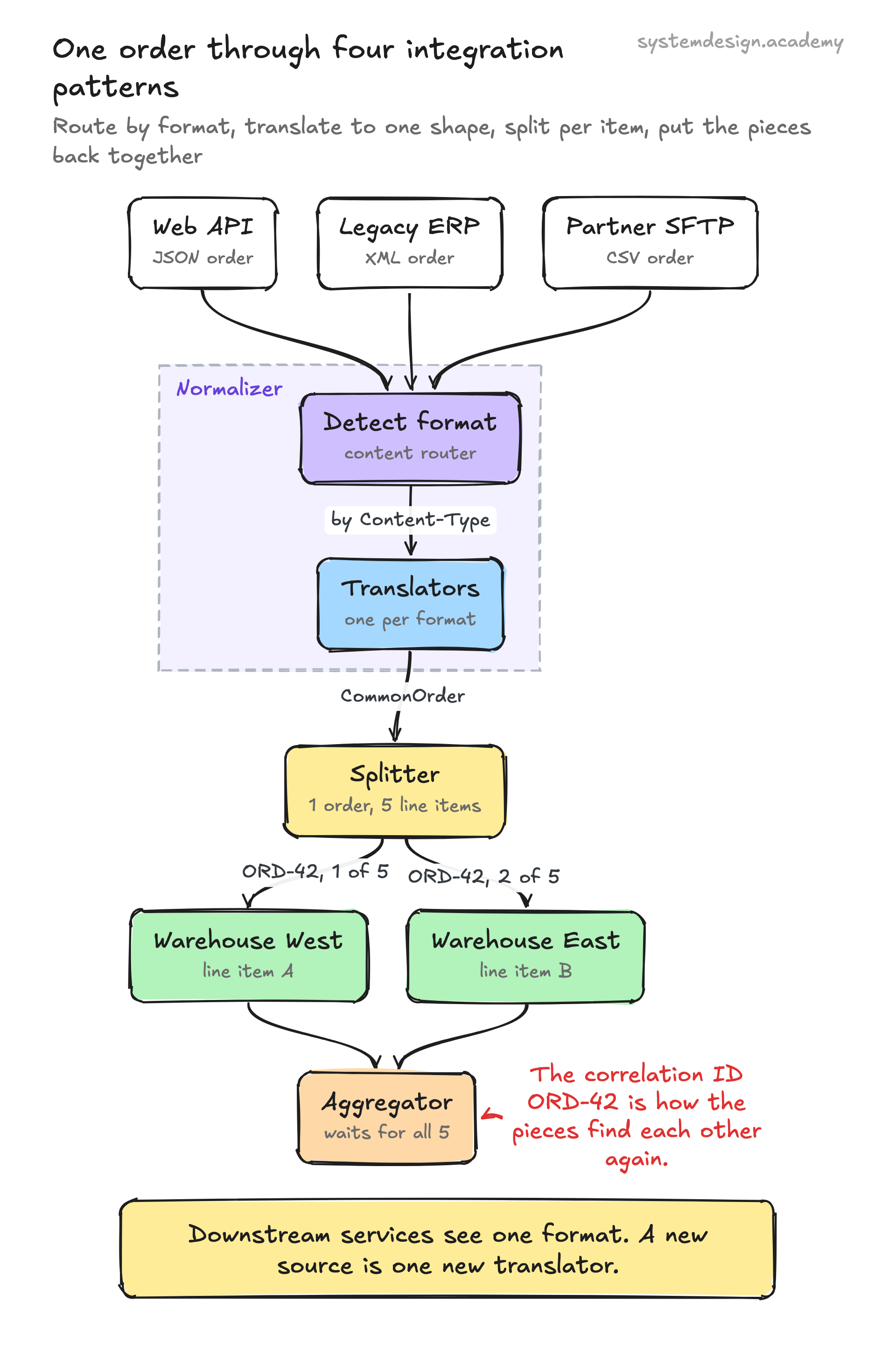
Most companies run many systems that were never built to talk to each other. A web shop, an old ERP system, a partner's file drop, a payment provider. Integration is the work of making them exchange data reliably.
The common way to do it is messaging. One system puts a message on a channel, such as a message queue or a topic in a message broker, and another system reads it later. Neither has to be online at the same time, and neither needs to know how the other works inside.
Messaging raises the same questions again and again. Where should this message go? What if it holds five items that need different handling? What if three sources send the same thing in three formats? Integration design patterns are named, tested answers to those questions.
The standard catalog is the book Enterprise Integration Patterns by Gregor Hohpe and Bobby Woolf, published in 2003. Its site describes it as a pattern language of 65 integration patterns. These are different from the 23 design patterns of the Gang of Four. Those describe how classes inside one program work together. Integration patterns describe how whole systems work together through messages.