AI Engineer Roadmap: What to Learn, Step by Step
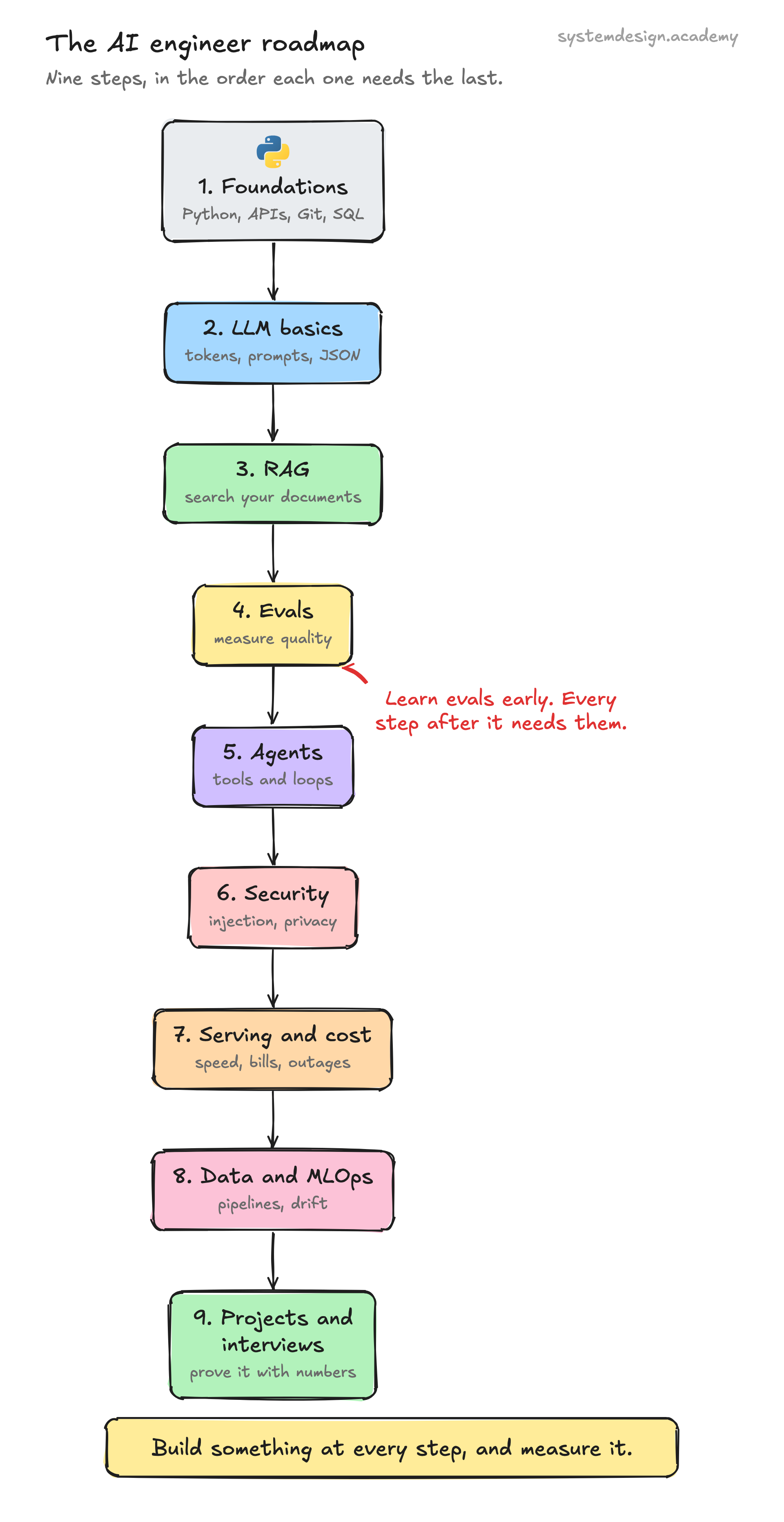
An AI engineer builds products on top of large language models: chat tools, search over documents, and agents that take actions. This roadmap shows how to become one in nine steps. Each step says what to learn, why it matters, and a small project that proves you can do it.

What does an AI engineer do?
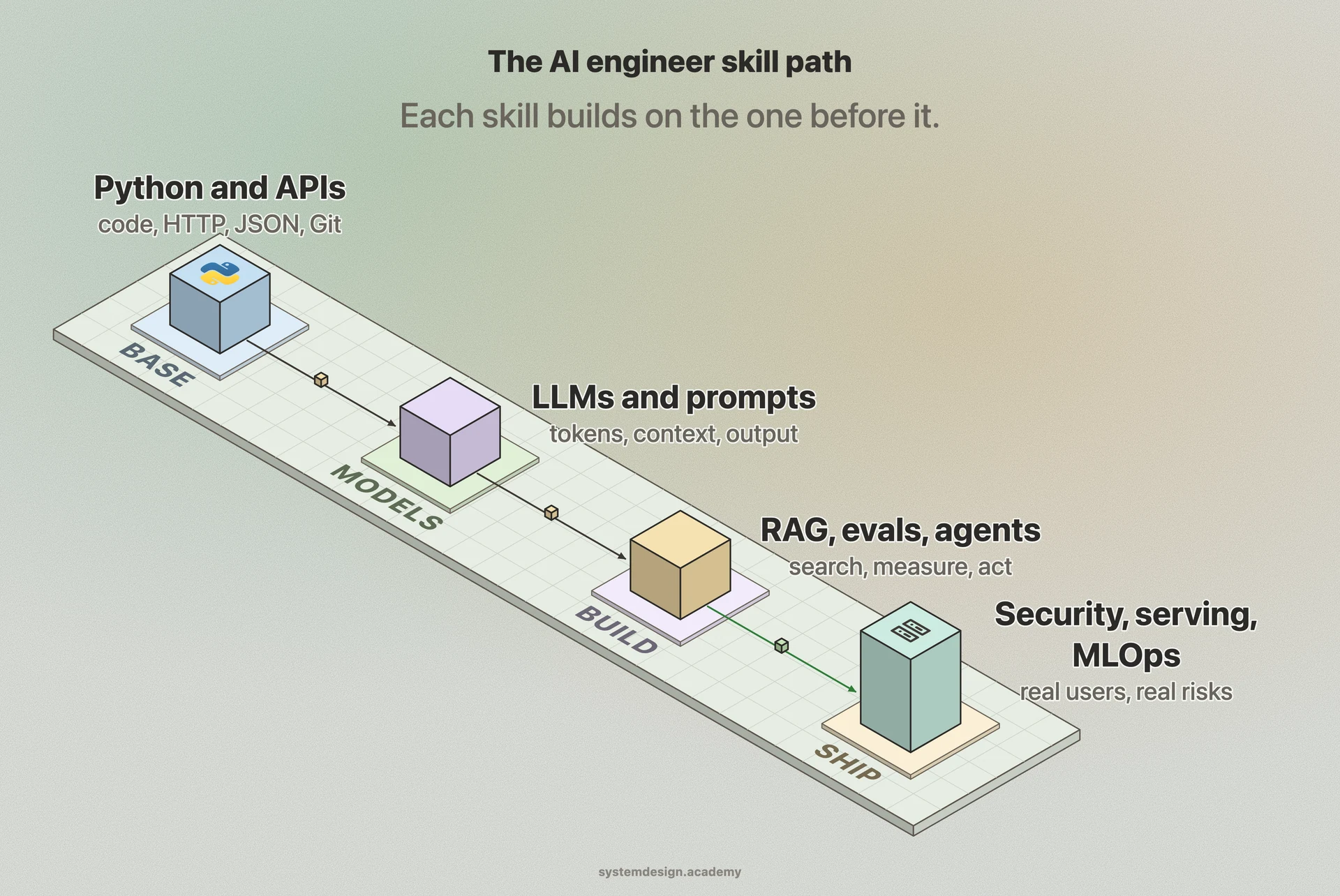
Most AI engineers do not train large models from zero. They choose a model, connect it to the right data and tools, measure how good the answers are, and run it safely for real users. The job is part software engineering and part careful testing.
The roadmap
The times below are rough guides for part-time study. Go faster where you already have the skill, and slower where you do not.
Step 1
Foundations you need first
2 to 6 weeks, if these are new to you
An AI engineer is a software engineer first. Most of the work is normal code around a model. If you already work as a developer, skim this step.
What to learn
- Python: functions, classes, virtual environments, and reading other people's code.
- HTTP APIs and JSON: calling a web service and reading its reply.
- Git, the command line, and basic SQL.
- Basic machine learning words: training data, test data, overfitting, accuracy.
Prove it: Write a small Python script that calls a public API and saves the results to a file.
Step 2
LLM basics and prompting
1 to 2 weeks
You need a clear picture of what a model does before you build on it.
What to learn
- Tokens, the context window and temperature.
- How to read a model name: its size, its number format, and how much memory it needs.
- Choosing a model: quality, price, speed and privacy, for closed APIs and open models.
- Calling an LLM API, writing clear prompts, and getting reliable JSON back.
- Why models hallucinate, and the first ways to reduce it.
- When to use a better prompt, when to use RAG, and when to fine-tune.
Prove it: Build a small tool that turns messy text, such as an email, into clean JSON. Check every result in code.
Step 3
RAG: answering from your own documents
2 to 3 weeks
RAG is one of the most common designs in AI products. It lets a model answer from data it was never trained on.
What to learn
- Embeddings, chunking and vector search.
- Keyword search, hybrid search (both kinds together) and reranking (a second, careful sort of the results).
- Why RAG gets worse as the number of documents grows, and what to do about it.
- How to tell a search problem from an answer problem.
Prove it: Build a question-answering tool over a set of documents you know well, and test whether search finds the right chunk.
Step 4
Evals: measuring if it works
2 to 3 weeks
An eval is a repeatable test of answer quality. Without one, you cannot tell if a change helped or hurt.
What to learn
- Reading real failures before choosing a metric.
- Building a fixed test set that catches regressions, changes that make things worse.
- Using an LLM as a judge, and checking the judge against people.
- How big a test set must be before a difference is real. This needs only basic statistics, taught in the lessons.
Prove it: Write 50 test questions for your RAG tool, score it, change one thing, and score it again.
Step 5
Agents and tool calling
2 to 3 weeks
An agent is a model that can call tools, such as a search or a database. It can act, so its mistakes cost more.
What to learn
- The agent loop: decide, call a tool, read the result, repeat.
- Tool calling, schemas, and checking every call before it runs.
- Why reliability drops as tasks get longer.
- MCP (Model Context Protocol), a standard way to connect tools, and when one agent is better than many.
Prove it: Build an agent with two or three tools, log every step, and measure how often it finishes the task.
Step 6
Security and safety
1 to 2 weeks
An agent reads text from outside and can take actions. So someone can hide instructions in that text. Learn this right after agents.
What to learn
- Prompt injection, and why it has no complete fix.
- The lethal trifecta: an agent with private data, untrusted text and a way to send data out.
- Treating model output as untrusted input.
- Keeping personal data out of prompts and logs.
Prove it: Hide an instruction in a document and see if your agent follows it. Then remove one of the three, for example the way to send data out.
Step 7
Serving, cost and reliability
1 to 2 weeks
With real users come heavy traffic, bills and outages. This step is about handling all three.
What to learn
- How models are served: batching requests together, the KV cache (saved work from earlier tokens), and GPU memory.
- Where the token bill comes from, and how to cut it.
- Routing easy requests to cheaper models.
- Rate limits, fallbacks, and logging prompts, replies and scores so you can find bad answers.
Prove it: Add cost and time logging to your RAG tool, then cut the cost per question without lowering its eval score.
Step 8
Data and MLOps
2 to 3 weeks
Many AI engineer roles also cover traditional models, such as fraud or price models. Bad data can make them worse without any error.
What to learn
- Packaging and serving a trained model.
- Training pipelines, feature stores and model versions.
- Data leakage (test data sneaking into training), drift (live data changing), and rare classes.
Prove it: Train a small model and serve it behind an API. Add a check that alerts you when its input data changes.
Step 9
Projects and interviews
Ongoing
Employers want proof you can build and measure a real system, not a list of courses.
What to learn
- Two or three finished projects, each with an eval score and a short write-up of what you changed and why.
- Clear answers to common interview questions, backed by numbers from your own projects.
Prove it: Publish your best project with its test set and its score before and after your changes. Say what you would do next.
Common questions
How long does it take to become an AI engineer?
It depends on where you start. A working software developer can cover this roadmap in about four to six months of steady part-time study. Someone new to programming should add several months for the foundations. These are rough guides, not promises.
Do I need a lot of maths or a PhD?
No, not for AI engineering. You build on models that others trained, so strong coding and clear thinking matter more. Basic statistics helps a lot when you measure quality.
What is the difference between an AI engineer, an ML engineer and a data scientist?
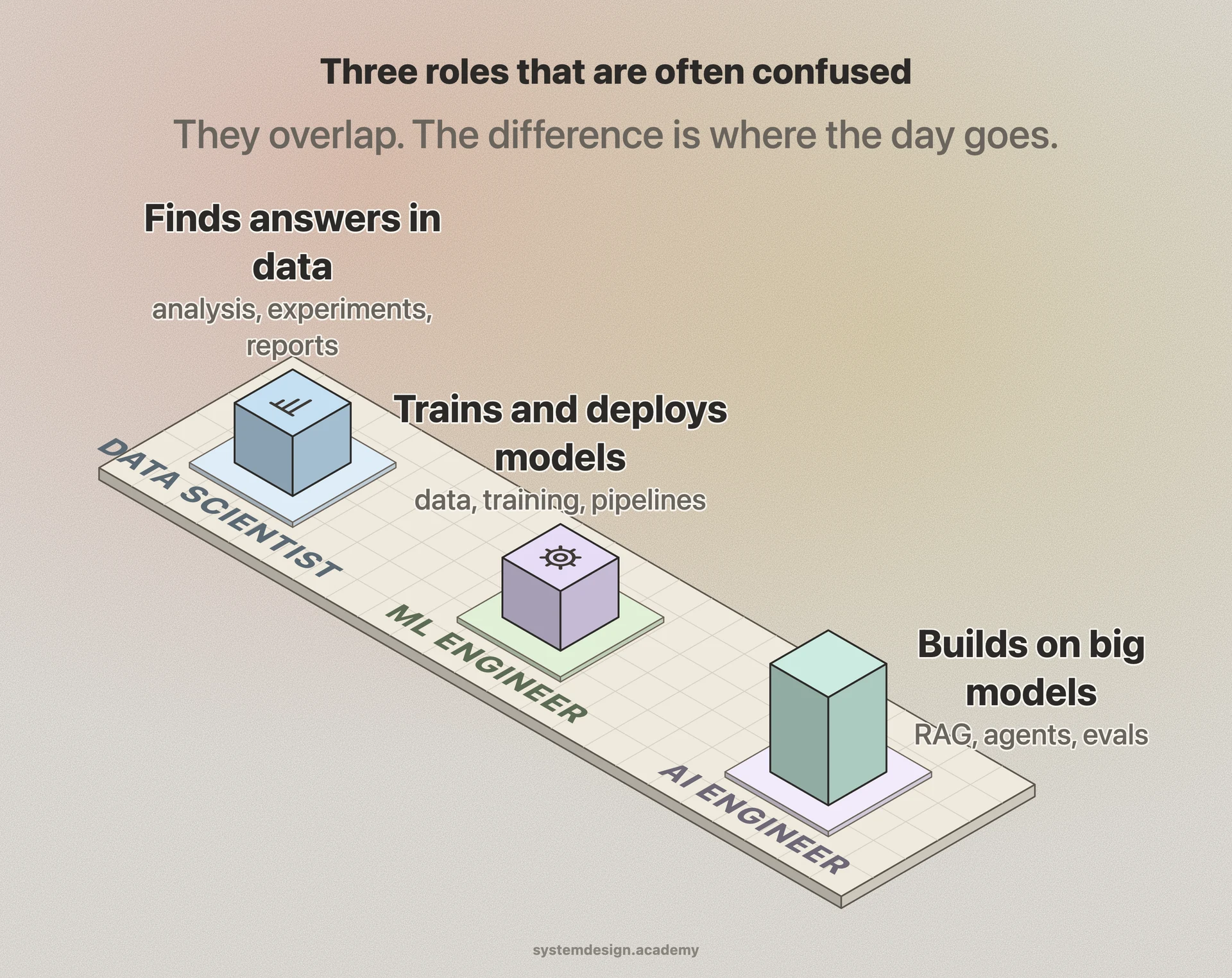
A data scientist mainly finds answers in data. An ML engineer mainly trains models and runs them in production. An AI engineer mainly builds products on top of large pre-trained models, such as chat, RAG and agents. Many jobs mix these roles.
Which programming language should I learn?
Python first. Almost all AI libraries and examples use it. TypeScript is useful too if you build the web side of AI products.
Do I need an expensive GPU to learn?
No. You can learn most of this with model APIs. You can also run small open models on an ordinary laptop with Ollama, a free tool. Several of our course labs ran that way.
How much will API calls cost while I learn?
Usually little, if you are careful. Use small, cheap models for practice. Set a monthly spending limit in your provider's dashboard. For free practice, run small models on your own laptop.
Is this roadmap free?
Yes. The roadmap is free, and most steps start with a free lesson. The full AI Engineering course is a one-time payment of ₹999 in India or $20 elsewhere.
Follow the roadmap with one course
Our AI Engineering course follows these steps in 112 lessons. Many of them are built around a real experiment, so you learn how to measure, not only what to build. 10 lessons are free to read, with no card needed.