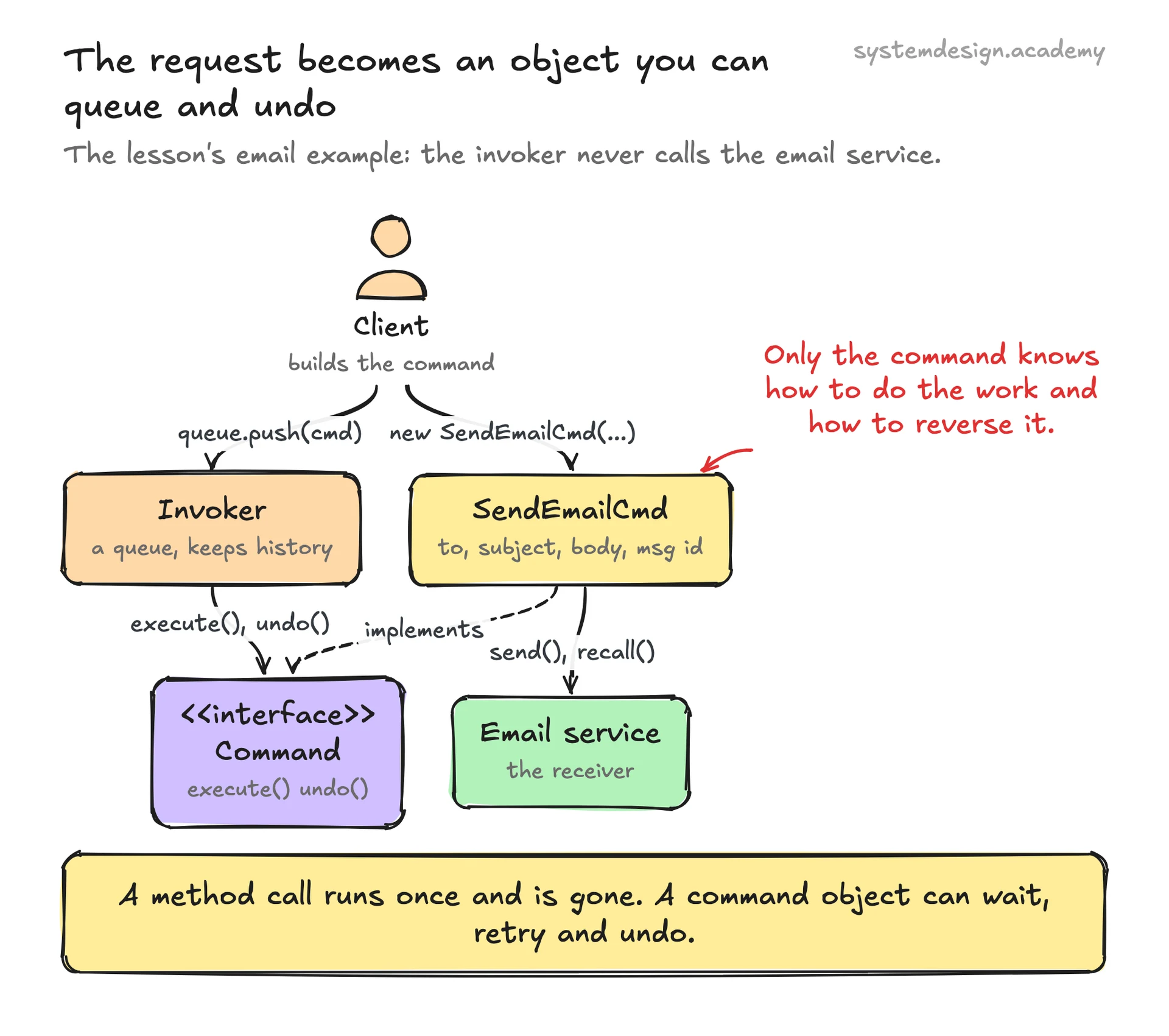
The lesson calls every task queue the Command pattern at scale. A job in a message queue such as SQS, RabbitMQ or Bull is a serialized command. It names the work to do and carries the arguments. Workers take jobs off the queue and run them.
Redis persistence is another case. With the append-only file turned on, Redis appends every write command it receives, such as SET, to a log on disk. After a restart, it replays the log to rebuild the data. The commands, written down in order, are the durable record.
In CQRS, the C stands for Command. Writes are modelled as command objects, sent to a handler, checked and run. Reads use a separate path, so the two sides can scale on their own.
Event sourcing is a close cousin, and the lesson treats it as one. To be precise, event sourcing stores events, which are facts that already happened, such as OrderPlaced. A command is a request that may still be refused, such as PlaceOrder. A command handler checks the command and, if it is valid, records one or more events.