The short answerREST is a style for web APIs where each URL is a thing and HTTP methods like GET and POST act on it, usually with small JSON bodies, while SOAP is a strict protocol where every call is an XML envelope posted to one address and described by a WSDL contract, so choose REST for most new APIs and SOAP when a partner system, often in banking, insurance or government, already speaks it.
This page is the free part.
The course goes deeper on REST and SOAP
₹499 in India/$49 everywhere elseonce, for the whole course
The System Design course covers REST and SOAP across a run of lessons, not one page. These 4 alone are about 90 minutes of step-by-step reading, 1 of them with code you run in the browser, all with a quiz.
Ive started this course by accident - LLM advised me this site. When I passed few free lessons, I had no doubt - this course should be bought. And I did it with special pleasent price and it was best decision of the month. Content is great, interesting to read and with a lot of practial cases (what makes it different from other souces and books) I hope to teach all the lessons, that will be my supergoal. Glad that I found this resource and speacial Thank You to Roni Das - Great Job!
Oleksander, Backend Engineer · System Design Masterclass · read 15 lessons · all reviews
Each thing has a URL: /users/1. HTTP methods say what to do.
Usually JSON. Any format is allowed.
Errors use HTTP status codes like 404 and 401.
vs
Simple Object Access Protocol
SOAP
the formal letter
A W3C protocol with exact rules for every message.
Every call is an XML envelope, usually POSTed to one URL.
A WSDL file describes every operation and every type.
Errors come back as a SOAP Fault inside the envelope.
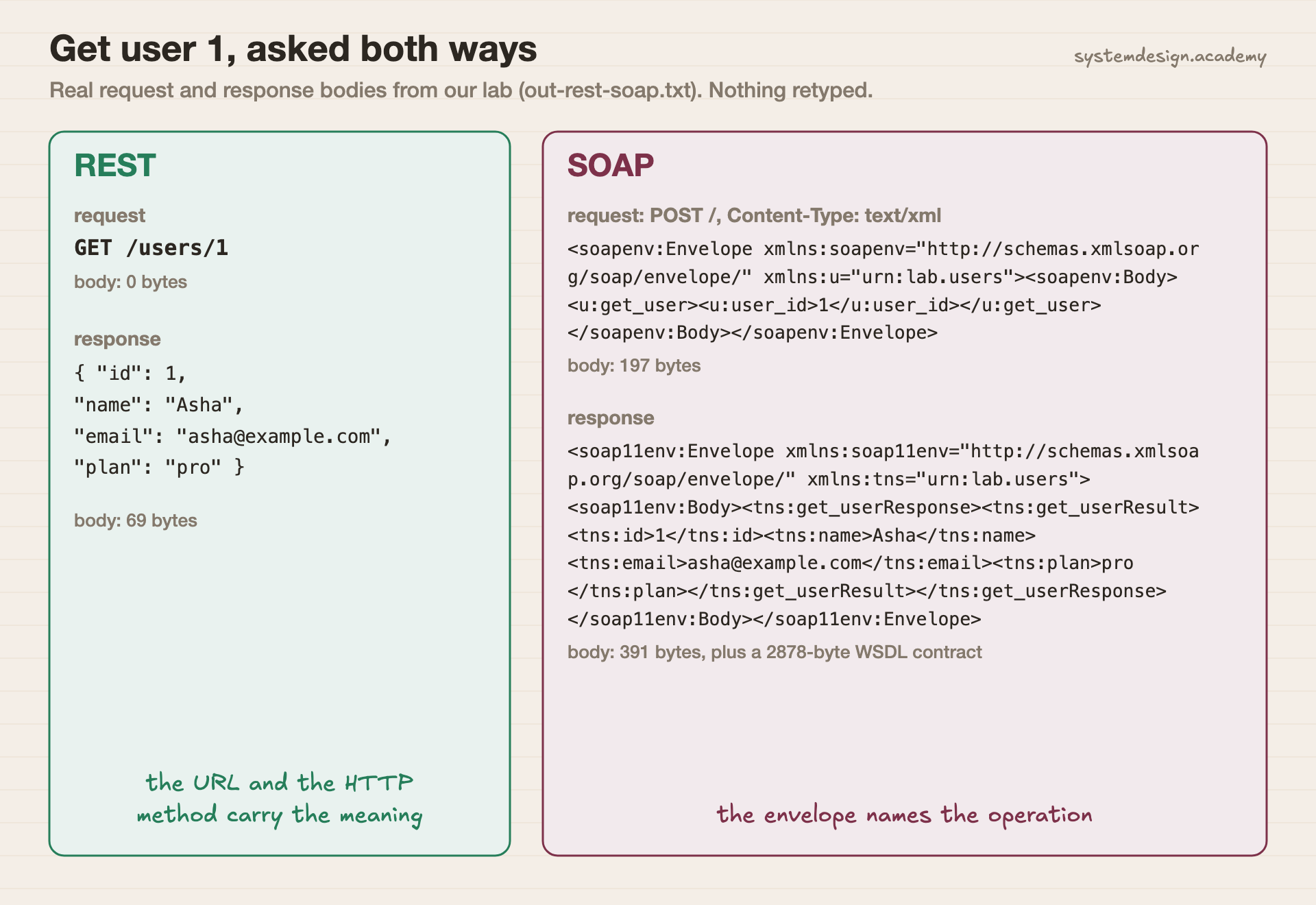
Get user 1, asked both waysSame user, same four fields. REST puts the meaning in the URL and method; SOAP puts it in the XML envelope, and wraps every value in named tags.
REST vs SOAP, side by side
Read across a row to compare one thing. Every word that may be new is explained just below the table.
REST compared with SOAP
Aspect
REST
SOAP
What it is
An architectural style (Fielding, 2000).
A protocol with a written standard (W3C SOAP 1.1 note, 2000; SOAP 1.2, 2007).
Message format
Any. Usually JSON. Ours: 69 bytes for one user.
XML only, inside an Envelope. Ours: 391 bytes for the same user.
How a call is addressed
By URL and method: GET /users/1.
By operation name inside the body: <get_user>, POSTed to one URL.
Contract
Optional (OpenAPI). Our REST endpoint had none.
WSDL, usually required. Ours was 2,878 bytes.
Errors
HTTP status codes. Ours: 404 with a small JSON body.
A SOAP Fault. Ours: HTTP 500 with a Fault code and reason.
Type checking
Up to your code or your OpenAPI tooling.
Built in through the XML Schema in the WSDL. Ours rejected 'one' as not an integer.
Caching
GET responses can be cached by browsers and CDNs.
Usually POST, so standard HTTP caches do not help.
Security
HTTPS plus tokens (OAuth, API keys).
HTTPS, plus optional WS-Security for signing or encrypting the message itself.
Where you meet it
Public web and mobile APIs, most new services.
Banks, insurers, airlines, payment networks, government systems, older enterprise software.
Words on this page, in plain English
API
Application Programming Interface: the agreed way one program asks another program for data or actions.
REST
A set of design rules for APIs, described by Roy Fielding in 2000: things have addresses (URLs) and you use standard HTTP methods on them.
SOAP
A protocol for sending structured messages as XML. Each message is an envelope with a header and a body.
XML
A text format that wraps every value in named tags, such as <name>Asha</name>.
JSON
A lighter text format for data, such as {"name": "Asha"}. Most REST APIs use it.
Envelope
The outer XML element of every SOAP message. It holds an optional Header and a required Body.
WSDL
Web Services Description Language: an XML file listing a SOAP service's operations, their inputs and outputs, and where to send them.
SOAP Fault
SOAP's standard error message: a Fault element in the Body with a fault code and a human-readable reason.
OpenAPI
An optional, widely used format for describing a REST API, roughly what WSDL is for SOAP.
When to use REST, when to use SOAP
Real situations, and the pick we would make in each one.
Pick REST
A new public API for web and mobile apps.
Small JSON, cacheable GETs, and every language has easy HTTP tools. This is where REST is the default.
Pick SOAP
Connecting to a bank, airline or government system that publishes a WSDL.
You speak the language the other side speaks. Tools like zeep read the WSDL and build the calls for you.
Pick SOAP
A message must stay signed even after it passes through several middle systems.
WS-Security signs and encrypts the XML message itself, not just the connection. HTTPS protects only one hop at a time.
Pick REST
Mobile apps on slow networks.
In our test the same user cost 69 bytes as JSON and 391 bytes as a SOAP envelope.
Pick Both
Your own app must use a partner's SOAP service.
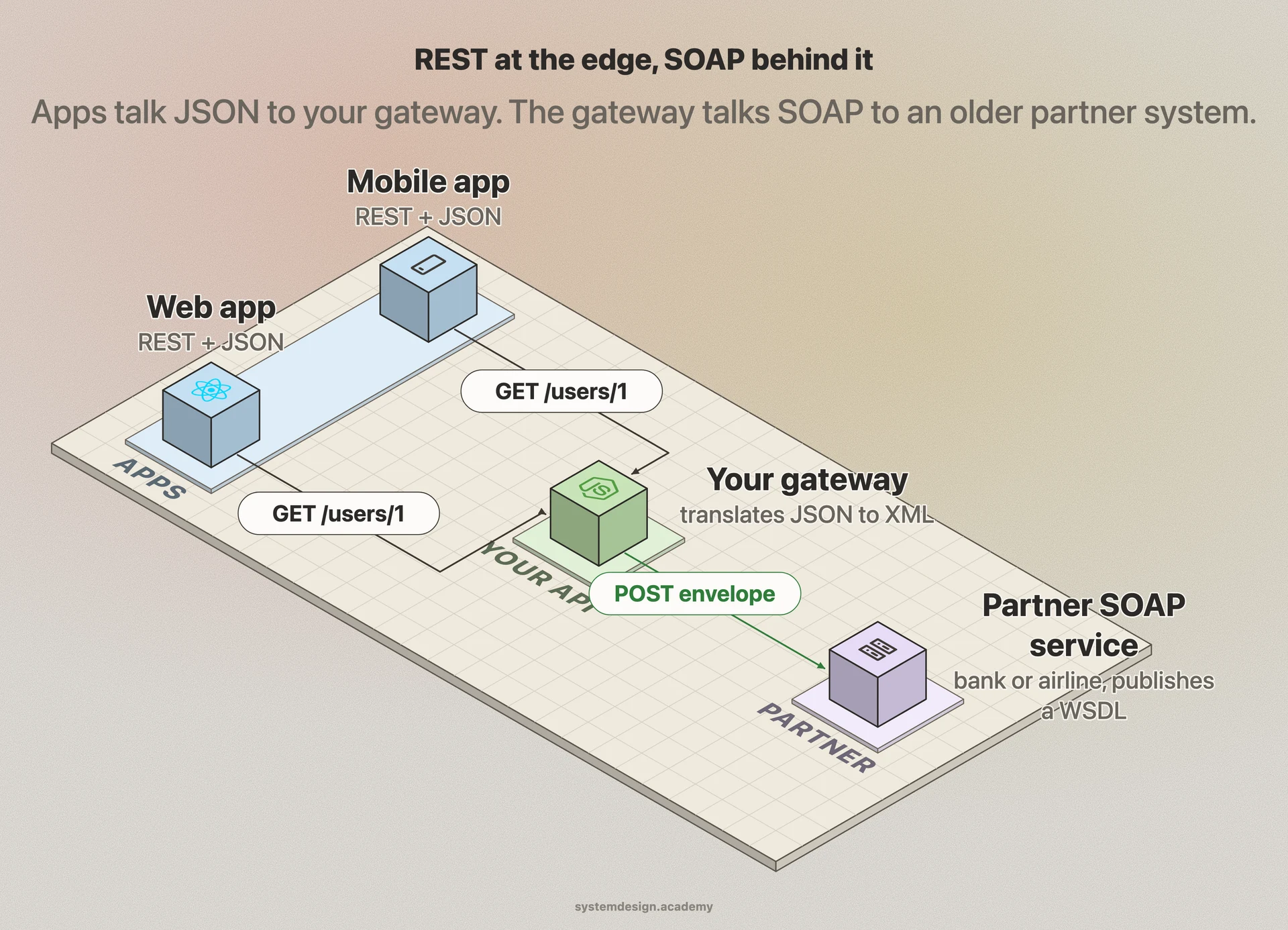
Keep REST for your apps and let one gateway translate to SOAP behind it, so the XML lives in one place.
Pick Both
Internal service-to-service calls where speed matters most.
Neither is the usual pick here. Teams often choose gRPC, which sends compact binary messages over HTTP/2.
REST at the edge, SOAP behind itA common real design: your apps never see XML. One gateway speaks SOAP to the partner.
we ran this, here is what happened
Hands-on: We asked for the same user both ways
Comparisons usually say SOAP is "heavier". We wanted to know by how much, with real messages.
We wrote one tiny service with one user in it and offered it two ways on one laptop: a REST endpoint (GET /users/1, JSON) and a real SOAP service built with the Python library spyne, which also publishes a WSDL. Then we called both with curl and kept the raw bodies.
We also asked each for a user that does not exist, used the zeep SOAP client to read the WSDL and make the call, and called a public SOAP service (the DNE Online calculator) to show a real one in the wild.
Where it ran: Apple M4, macOS 15.6, Python 3.11 with spyne 2.14.0 (it does not import on 3.12 or newer), lxml, zeep 4.3.1, curl 8.7.1. Local services on 127.0.0.1, plus www.dneonline.com. One run on 4 October 2026.
The lines that matter from scripts/labs/compare/rest_vs_soap.sh. The SOAP service itself is about 20 lines of spyne in rest_vs_soap_app.py.
real output
$ curl -si http://127.0.0.1:8792/users/1
HTTP/1.0 200 OK
Content-Type: application/json
Content-Length: 69

{"id": 1, "name": "Asha", "email": "asha@example.com", "plan": "pro"}

HTTP/1.0 200 OK
Content-Type: text/xml; charset=utf-8
Content-Length: 391

<?xml version='1.0' encoding='UTF-8'?>
<soap11env:Envelope xmlns:soap11env="http://schemas.xmlsoap.org/soap/envelope/" xmlns:tns="urn:lab.users"><soap11env:Body><tns:get_userResponse><tns:get_userResult><tns:id>1</tns:id><tns:name>Asha</tns:name><tns:email>asha@example.com</tns:email><tns:plan>pro</tns:plan></tns:get_userResult></tns:get_userResponse></soap11env:Body></soap11env:Envelope>

$ curl -si http://127.0.0.1:8792/users/99
HTTP/1.0 404 Not Found
{"error": "not_found", "message": "no user with that id"}

$ (SOAP get_user(99))
HTTP/1.0 500 Internal Server Error
<soap11env:Envelope xmlns:soap11env="http://schemas.xmlsoap.org/soap/envelope/"><soap11env:Body><soap11env:Fault><faultcode>soap11env:Client.NotFound</faultcode><faultstring>no user with id 99</faultstring><faultactor></faultactor></soap11env:Fault></soap11env:Body></soap11env:Envelope>

## 4. sizes, in bytes
rest_request_body 0
rest_response_body 69
soap_request_body 197
soap_response_body 391
soap_wsdl 2878

## 6. a SOAP client that reads that contract: zeep
operations the WSDL lists: ['get_user']
get_user(1) -> {'id': 1, 'name': 'Asha', 'email': 'asha@example.com', 'plan': 'pro'}
get_user('one') -> Fault: :2:0:ERROR:SCHEMASV:SCHEMAV_CVC_DATATYPE_VALID_1_2_1: Element '{urn:lab.users}user_id': 'one' is not a valid value of the atomic type 'xs:integer'.
get_user(99) -> zeep.exceptions.Fault: soap11env:Client.NotFound / no user with id 99

## 7. a public SOAP service: DNE Online calculator (http://www.dneonline.com/calculator.asmx)
operations: ['Add', 'Divide', 'Multiply', 'Subtract']
Add(2, 3) -> 5
Real output (out-rest-soap.txt), shortened only by removing lines such as repeated headers and the full WSDL.
The results
What we measured
REST
SOAP
Request body for get user 1the SOAP envelope names the operation
0 bytes (GET)
197 bytes
Response body for the same user5.7 times larger, uncompressed
69 bytes
391 bytes
Contract the client reads firstREST can add OpenAPI, optionally
none needed
2,878-byte WSDL
Unknown userSOAP 1.1 uses 500 for faults
HTTP 404 + JSON
HTTP 500 + SOAP Fault
Wrong type ('one' for an integer)spyne validated against the WSDL types
not tested
rejected by the schema
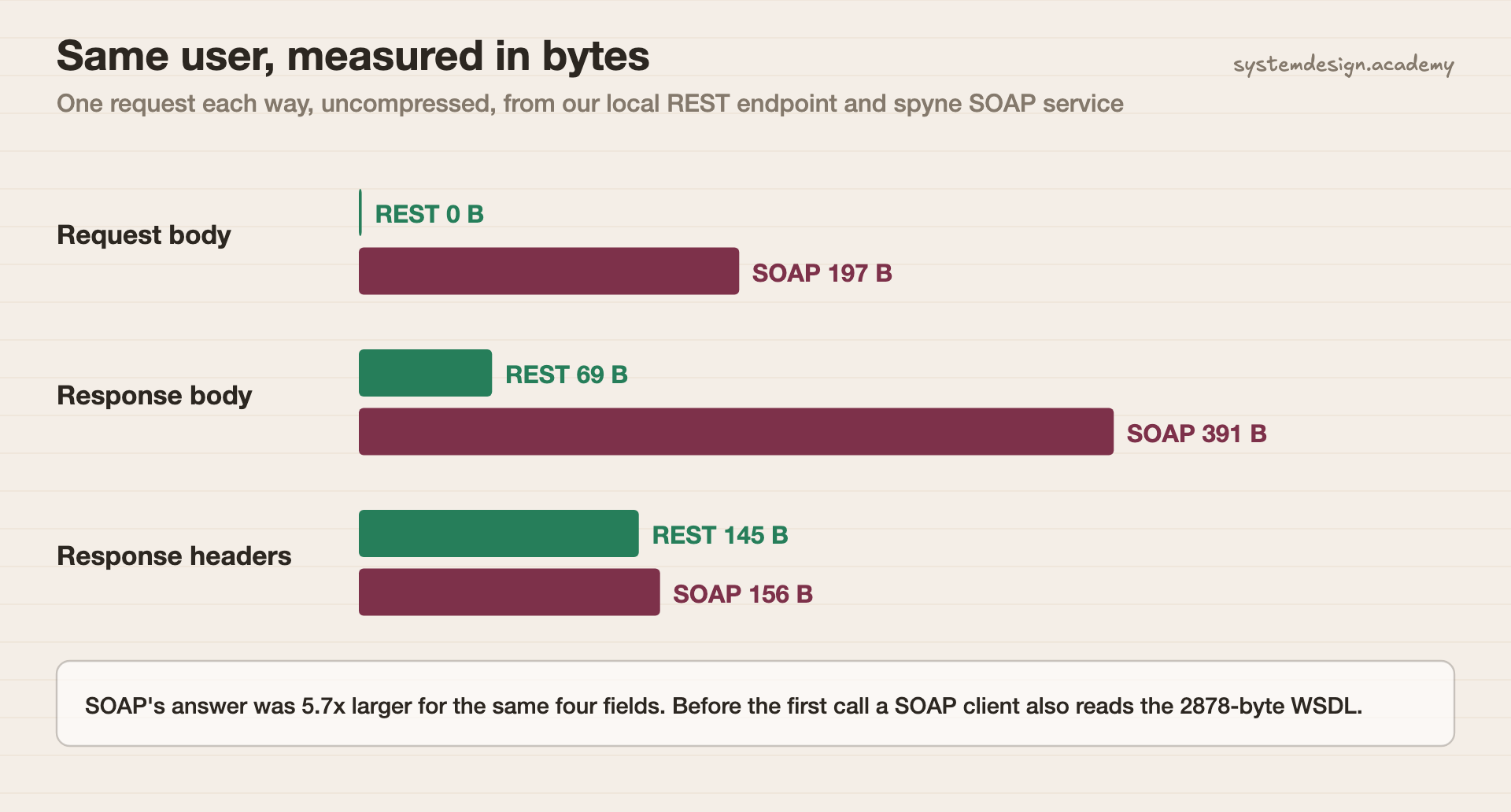
Same user, measured in bytesThe envelope and the named tags cost bytes. The headers were about the same size.
What this shows
For the same four fields SOAP sent 5.7 times more bytes, and a client first had to read a 2,878-byte contract. In return that contract let zeep build the call with no hand-written XML, and the server refused a wrong type before our code ever ran. REST was smaller and simpler; SOAP was stricter. That is the real trade.
What this test does not show: One small record, uncompressed. With gzip both shrink and the gap narrows. Byte size is rarely the reason to choose; contracts, partners and tooling usually are. We did not test WS-Security. The script is scripts/labs/compare/rest_vs_soap.sh in our repository.
Common mistakes
"REST is a protocol, like SOAP."
REST is a style of design. SOAP is a protocol with a written standard. A REST API can use JSON, XML or anything else; SOAP always uses an XML envelope.
"SOAP is more secure than REST."
Both normally run over HTTPS. SOAP adds an option, WS-Security, to sign or encrypt the message itself. If you do not use it, SOAP is no more secure than REST.
Building SOAP XML by hand with string templates.
Use a client that reads the WSDL, such as zeep for Python. It builds valid envelopes and turns Faults into exceptions, as our lab shows.
Calling any JSON over HTTP "REST".
An API where everything is POST /doThing with a JSON body is closer to remote procedure calls. REST means resources with URLs and the right HTTP methods.
Rewriting a partner's working SOAP integration in REST for fashion.
If the other side only speaks SOAP, you cannot change that. Wrap it once behind your own REST gateway instead.
Questions people ask
Is SOAP safer than REST?
Not by default. Both usually run over HTTPS, which encrypts the connection. SOAP has an extra standard, WS-Security (OASIS, version 1.1.1 in 2012), that can sign or encrypt the message itself so it stays protected across several middle systems. Only that option adds security.
When should I use SOAP instead of REST?
When the system you must talk to already offers SOAP, such as many bank, insurance, airline and government services, or when a contract requires message-level signing. For a new API you control, REST is usually simpler.
Why is REST preferred over SOAP?
REST messages are smaller (69 bytes against 391 in our test), GET responses can be cached, every language has simple HTTP tools, and JSON is easy to read in a browser. There is no required contract file to generate first.
Is SOAP outdated?
It is older and rarely chosen for new public APIs, but it is not gone. Plenty of live systems still publish WSDLs; we called one, the DNE Online calculator, on 4 October 2026 and got Add(2, 3) = 5.
Can REST use XML?
Yes. REST does not fix a format. Most REST APIs use JSON because it is smaller and easier to work with, but XML, CSV or images are all allowed.
What is a WSDL file?
An XML document that describes a SOAP service: its operations, the exact type of every input and output, and the address to send calls to. Our tiny service's WSDL was 2,878 bytes; tools like zeep read it and build the calls for you.
Lessons that go deeper
From the System Design course, in the order we would read them.
REST vs SOAP is one row in a much bigger table. Our System Design course has 770 lessons on networks, databases, caching, scaling, messaging, security and reliability, each drawn step by step, so you can explain the trade-off in an interview and pick right at work. 18 lessons are free to read, with no card needed.
the hands-on parts are real runs, like this one
course 1
System Design Masterclass
From absolute beginner to principal engineer, drawn step by step.