The short answerAuthentication checks who you are (a password, a passkey, a login token) and authorization checks what you are allowed to do (read this file, open the admin page), so authentication always comes first, a failed one returns 401, and a failed authorization returns 403.
This page is the free part.
The course goes deeper on Authentication and Authorization
₹499 in India/$49 everywhere elseonce, for the whole course
The System Design course covers Authentication and Authorization across a run of lessons, not one page. These 4 alone are about 65 minutes of step-by-step reading, every one with a quiz.
The material has been designed with a lot of effort and dedication. It has covered vast range of topic with sufficient content and diagrams wherever required. It complements well with other system design materials.
Som · System Design Masterclass · read 75 lessons · all reviews
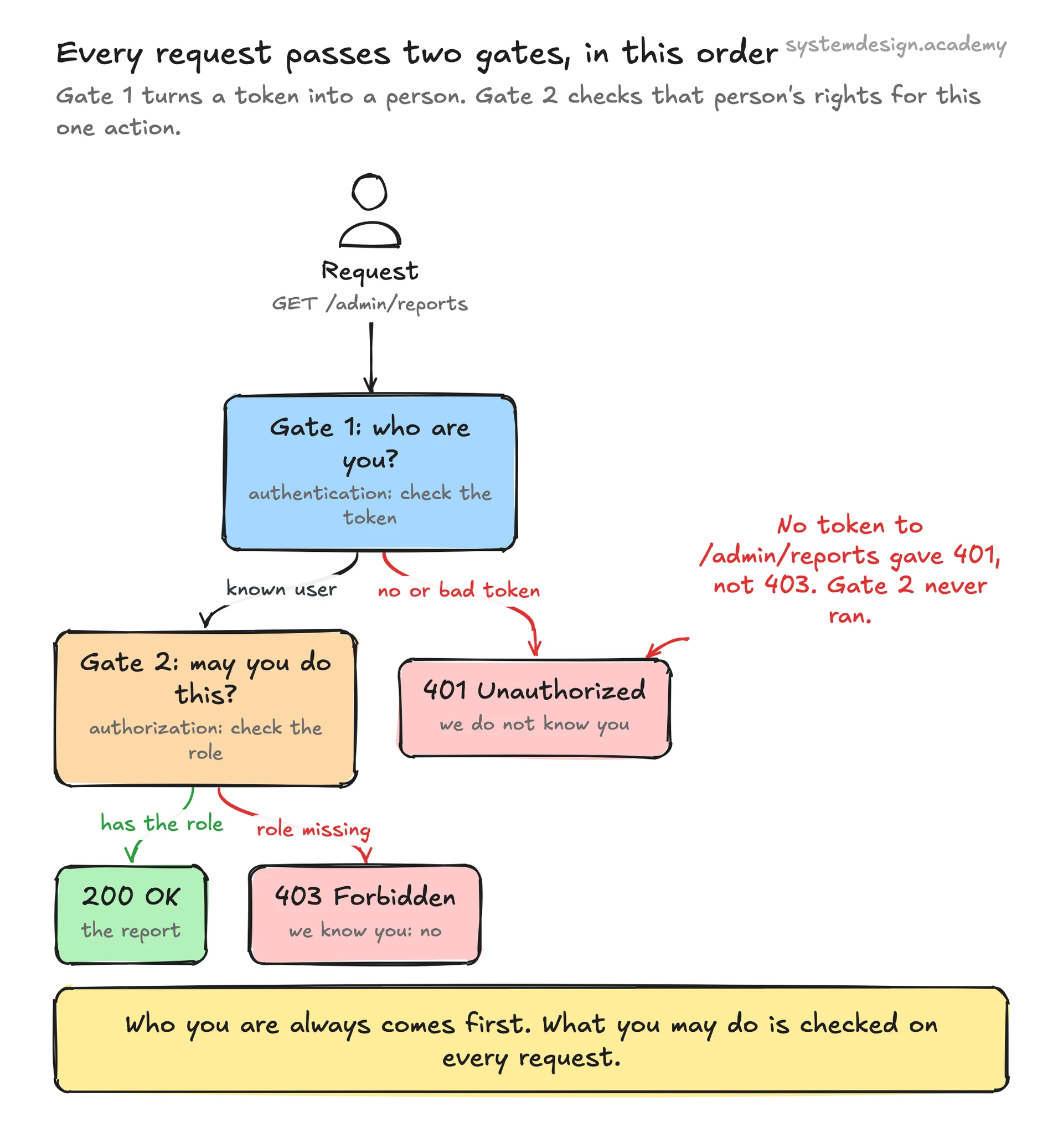
Fails with 403 Forbidden: "we know you, and the answer is no".
Every request passes two gates, in this orderGate 1 turns a token into a person. Gate 2 checks that person's rights for this one action. A request that fails gate 1 never reaches gate 2.
Authentication vs Authorization, side by side
Read across a row to compare one thing. Every word that may be new is explained just below the table.
Authentication compared with Authorization
Aspect
Authentication
Authorization
Question it answers
Who are you?
What are you allowed to do?
Order
Always first.
Always second. You cannot decide rights for an unknown caller.
How it works
Checks a credential: password, passkey, one-time code, certificate.
Logging in to your bank with a password and an SMS code.
The bank letting you see your own account but not your neighbour's.
Typical bug
Weak passwords, no MFA, tokens that never expire.
Forgetting the check: change the id in the URL and see someone else's data.
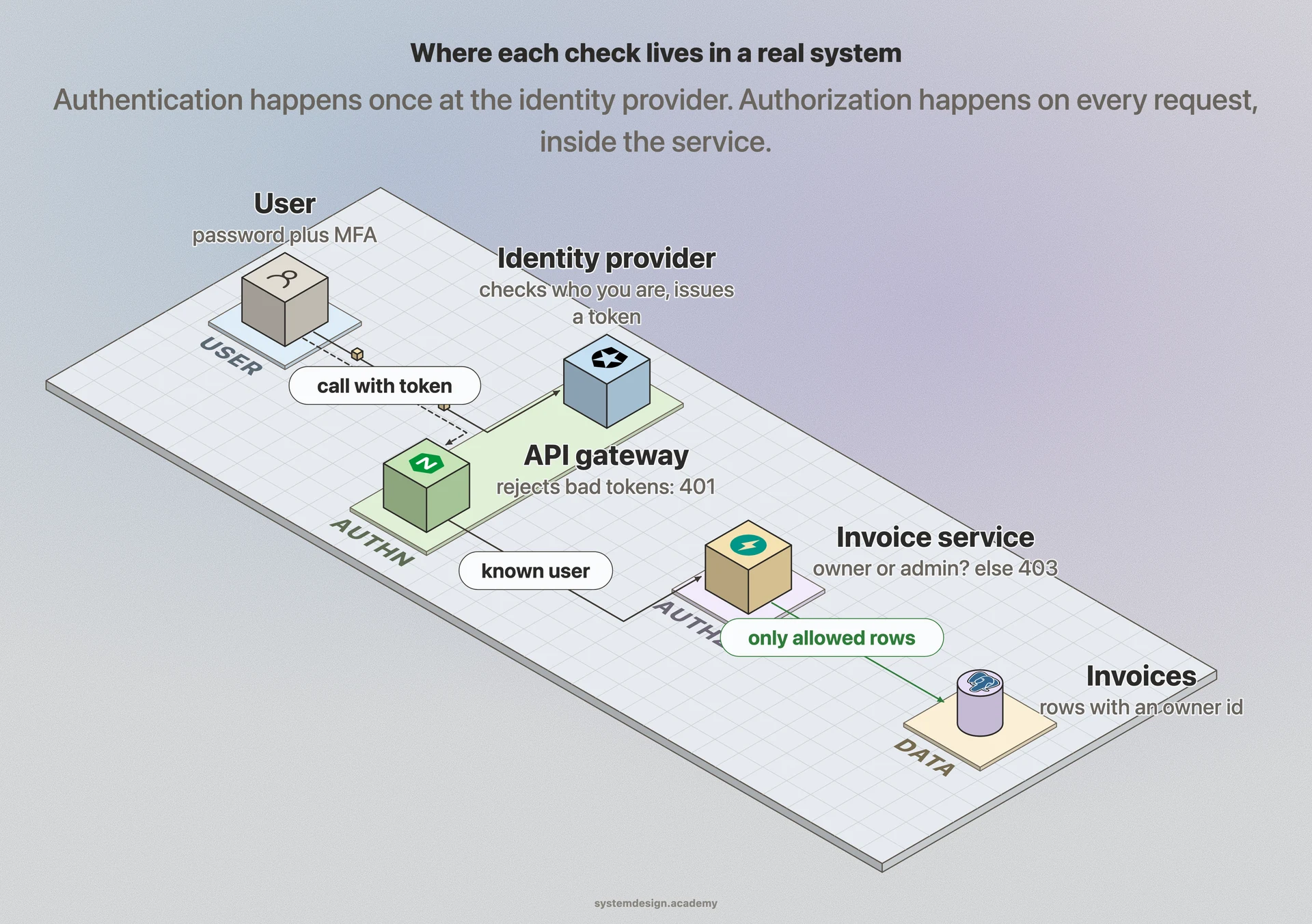
Where each check lives in a real systemAuthentication usually happens at an identity provider. The token is checked at the edge. Authorization happens deep inside the service, because only the service knows who owns invoice 1043.
Words on this page, in plain English
Identity
Who a user or a program is, for example the account asha@example.org.
Credential
The proof you show to log in: a password, a passkey, a code from your phone.
MFA
Multi-factor authentication: two or more different proofs, such as a password plus a phone code.
Token
A string the server gives you after login. You send it with each request so you do not log in again. A JWT is one common kind.
Role
A named group of permissions, such as viewer or admin. RBAC (role-based access control) grants access by role.
Permission
One allowed action, such as read invoices or delete users.
401 Unauthorized
The HTTP status for a failed or missing authentication. The name is old and confusing: it really means unauthenticated.
403 Forbidden
The HTTP status for a failed authorization: the server knows who you are and refuses.
OAuth 2.0
A standard for giving an app limited access to your data on another service. It is an authorization framework.
OpenID Connect
A login layer built on top of OAuth 2.0. It adds authentication: who the user is.
When to use Authentication, when to use Authorization
Real situations, and the pick we would make in each one.
Pick Authentication
A user types a password on your login page.
This proves identity. Add MFA, and never store the password itself, only a slow hash of it.
Pick Authorization
A logged-in user opens /admin.
You already know who they are. Now check their role. A missing admin role is a 403.
Pick Authorization
A user opens /invoices/1043.
Being logged in is not enough. Check that invoice 1043 belongs to this user. This is the most common place apps forget.
Pick Authentication
A request arrives with an expired token.
The server can no longer trust who sent it. Return 401 so the app asks the user to log in again.
Pick Both
"Log in with Google" on your site.
OpenID Connect tells you who the user is (authentication). OAuth scopes limit what your app may read from Google (authorization).
Pick Both
One microservice calling another.
Machines need both checks too: prove which service is calling (for example with mTLS), then check it may call this endpoint.
we ran this, here is what happened
Hands-on: A 40-line app that returns 401 and 403
We wrote the smallest app we could that shows both checks. It is written in FastAPI, a Python web framework. It has two users: asha is a viewer, and ravi is a viewer and an admin.
GET /me needs only a valid token. GET /admin/reports needs a valid token and the admin role. Then we sent six real requests with curl, a command-line tool that sends web requests, and copied what came back.
Where it ran: FastAPI 0.142.2 on uvicorn, Python 3.12.14, Apple M4, macOS 15.6. Run on 4 October 2026 by scripts/labs/compare/authn_authz.sh.
def current_user(creds: HTTPAuthorizationCredentials | None = Depends(bearer)) -> dict:
    """Authentication: who is calling? No token, or a token we do not know, is a 401."""
    user = USERS.get(creds.credentials) if creds else None
    if user is None:
        raise HTTPException(
            status_code=status.HTTP_401_UNAUTHORIZED,
            detail="Not authenticated: send a valid token",
            headers={"WWW-Authenticate": "Bearer"},
        )
    return user


def require_role(role: str):
    """Authorization: is this known caller allowed? A missing role is a 403."""

    def check(user: dict = Depends(current_user)) -> dict:
        if role not in user["roles"]:
            raise HTTPException(status_code=status.HTTP_403_FORBIDDEN, detail=f"{user['name']} lacks role '{role}'")
        return user

    return check
The two checks from scripts/labs/compare/authn_authz_app.py. require_role depends on current_user, so authorization can never run before authentication.
Real output from out-authn-authz.txt: the status line, the WWW-Authenticate header when present, and the body. Nothing else was removed.
The results
What we measured
Authentication
Authorization
No token, or a token we do not knowauthentication failed, so authorization never ran
401 Unauthorized
never reached
asha (viewer) asks for /me200 OK
passes
passes
asha (viewer) asks for /admin/reportswe know her; she lacks the admin role
passes
403 Forbidden
ravi (admin) asks for /admin/reports200 OK
passes
passes
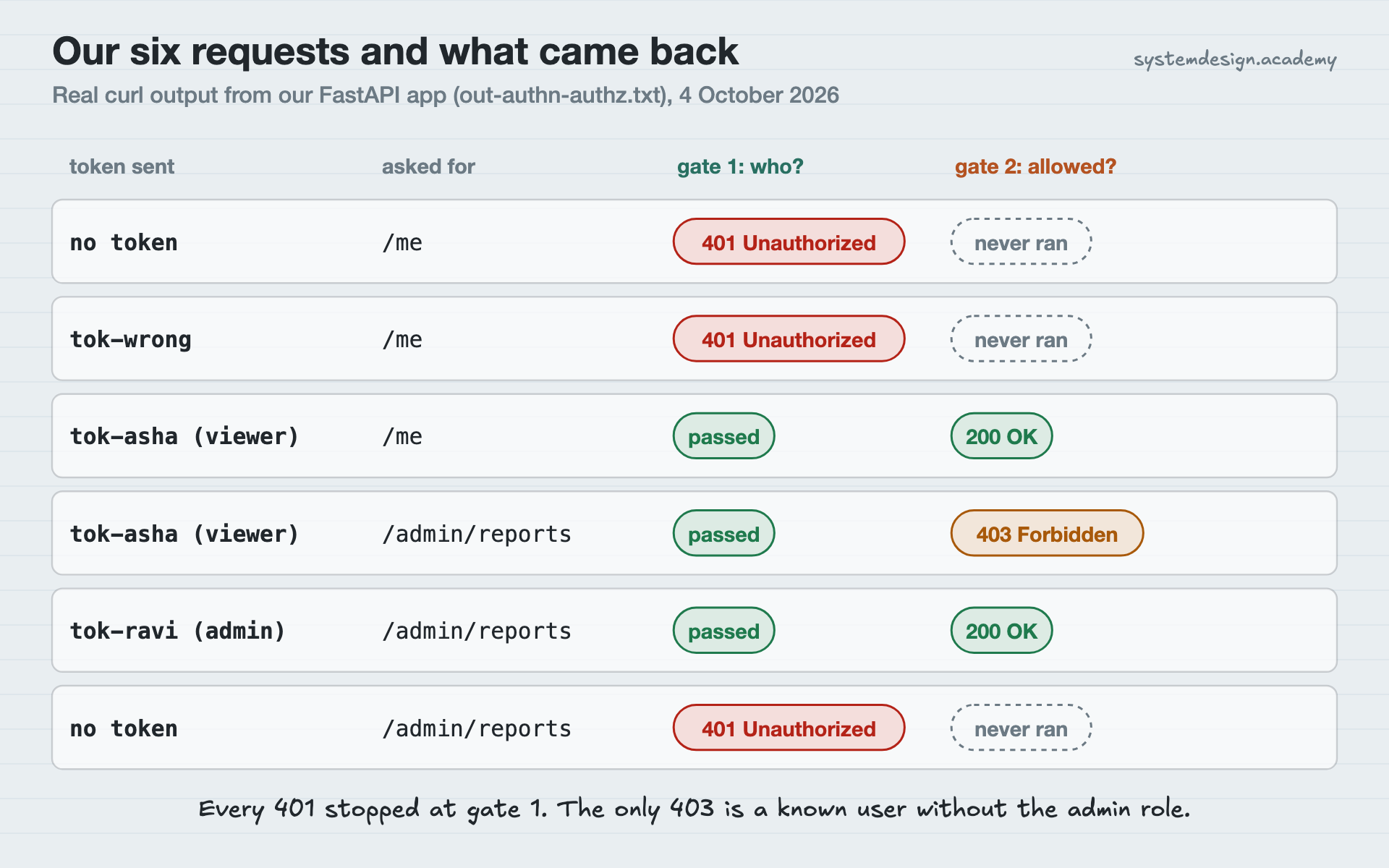
Our six requests and what came backEvery 401 is a failed first gate. The only 403 is a known user without the admin role.
What this shows
The last request is the one to remember. With no token, /admin/reports returned 401, not 403. The app could not ask "is this person an admin?" before it knew who the person was. Who you are always comes first.
What this test does not show: The tokens are fixed strings so the code stays short. A real app would check a signed JWT or a session cookie, with expiry. The 401 and 403 decisions stay exactly the same. The script is scripts/labs/compare/authn_authz.sh in our repository.
Common mistakes
Returning 403 when the user is not logged in.
Send 401 with a WWW-Authenticate header, as RFC 9110 requires. The client then knows to log in, not to give up.
Checking only that the user is logged in.
Logged in is not allowed. Check ownership on every object: does invoice 1043 belong to this user? OWASP calls this validating permissions on every request.
Hiding the admin button and calling it security.
The browser is not a lock. Anyone can send the request with curl, like we did. The check must run on the server.
Allowing by default.
OWASP's advice is deny by default: if no rule says yes, the answer is no. New endpoints then start safe.
Treating OAuth 2.0 as a login system.
OAuth 2.0 grants access to an API. To know who the user is, use OpenID Connect on top of it.
Putting roles in a token that never expires.
A removed admin keeps admin rights until the token dies. Keep access tokens short-lived and re-check important rights on the server.
Questions people ask
What is the difference between AuthN and AuthZ?
AuthN is short for authentication: proving who you are. AuthZ is short for authorization: deciding what you may do. AuthN comes first; AuthZ uses its answer.
Is OAuth 2.0 an authentication or authorization protocol?
Authorization. OAuth 2.0 lets an app get limited access to an API for a user, through scopes such as read:calendar. OpenID Connect adds an ID token on top of OAuth 2.0, and that adds authentication.
Is OTP authentication or authorization?
A one-time password (OTP), such as a 6-digit code from an app or an SMS, is authentication. It proves you hold a phone or app. It is often the second factor in MFA. Banks also use OTPs to confirm a payment, but the code itself still proves who you are.
Why is 401 called Unauthorized if it is about authentication?
It is a historical naming mistake. RFC 9110 defines 401 as a request that lacks valid authentication credentials, and 403 as a request the server understood but refuses. Read 401 as unauthenticated.
What are the three types of authorization?
People usually mean three ways to write the rules: role-based (RBAC, rights come from your role), attribute-based (ABAC, rights come from facts like department or time, described in NIST SP 800-162), and relationship-based (ReBAC, rights come from links such as owner of this document).
What is the difference between authentication and authorization in cloud computing?
The same split. In AWS, Google Cloud or Azure, an identity service first authenticates a user or a program. Then access policies (IAM, identity and access management) decide which resources that identity may touch.
Lessons that go deeper
From the System Design course, in the order we would read them.
OpenID Connect Core 1.0OpenID Foundation · incorporating errata set 2, December 2023 · opened 2026-10-04
Know why, not just which
Authentication vs Authorization is one row in a much bigger table. Our System Design course has 769 lessons on networks, databases, caching, scaling, messaging, security and reliability, each drawn step by step, so you can explain the trade-off in an interview and pick right at work. 18 lessons are free to read, with no card needed.
the hands-on parts are real runs, like this one
course 1
System Design Masterclass
From absolute beginner to principal engineer, drawn step by step.