Complete AI + System Design Handwritten Notes
Revision notes that read like a friend's notebook: RAG, agents, MCP, LLMs, caching, Kafka and more, plus the top 50 interview questions.: RAG, agents, MCP, LangGraph, how LLMs work, inference and the KV cache, vector databases, caching, databases, Kafka, and the top 50 interview questions with short answers.
- Plain, simple English, every term explained first
- Diagrams with real product names on every topic
- A cheat sheet and 5 interview questions in every PDF
- Download right after paying, and keep the files
What every PDF has
same recipe, fifteen topics
A cover with what is inside, then one numbered section per page
Diagrams with real product names: Postgres, Redis, Kafka, Qdrant, OpenAI, nginx and more
Numbers from our own labs where we have them, labelled as ours
A mini cheat sheet table
5 interview questions with short answers
A last page that links the matching lessons, if you want to go deeper
the shelf
15 notebooks, 149 pages
Turn any notebook over to see its real cover page and every section inside. The sections are the pages.
PDF 110 pages
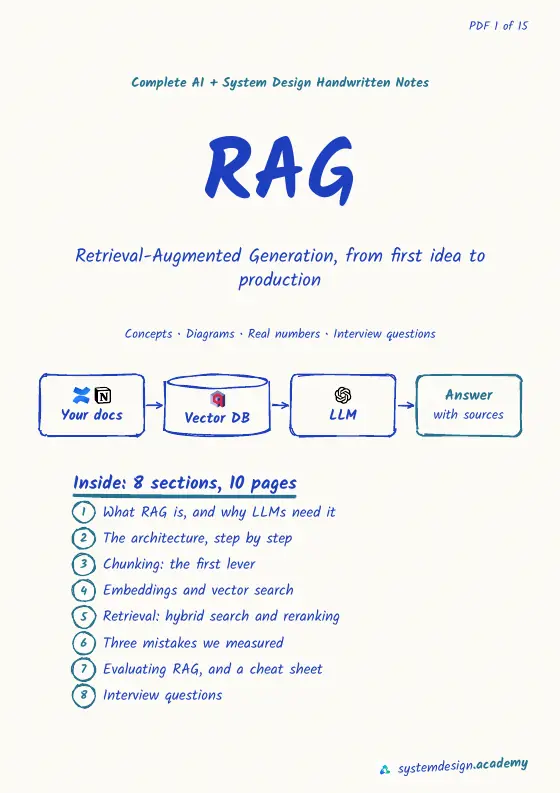
Inside
- What RAG is, and why LLMs need it
- The architecture, step by step
- Chunking: the first lever
- Embeddings and vector search
- Retrieval: hybrid search and reranking
- Three mistakes we measured
- Evaluating RAG, and a cheat sheet
- Interview questions
PDF 210 pages
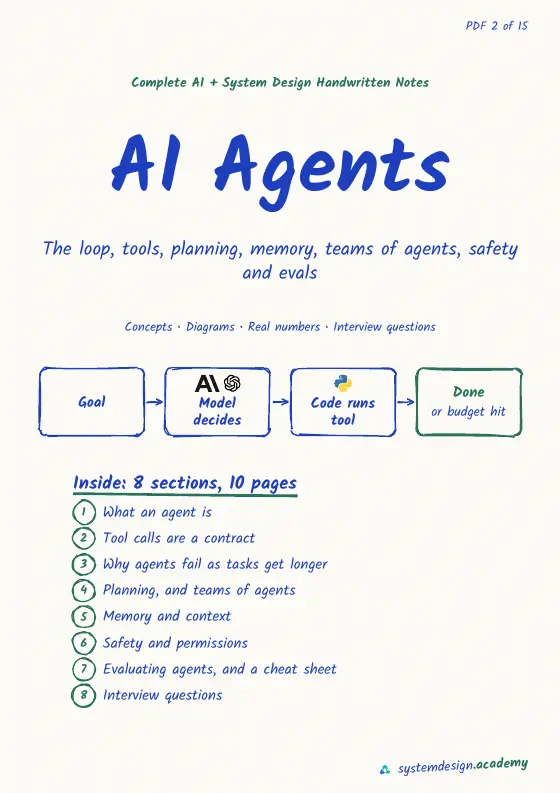
Inside
- What an agent is
- Tool calls are a contract
- Why agents fail as tasks get longer
- Planning, and teams of agents
- Memory and context
- Safety and permissions
- Evaluating agents, and a cheat sheet
- Interview questions
PDF 310 pages
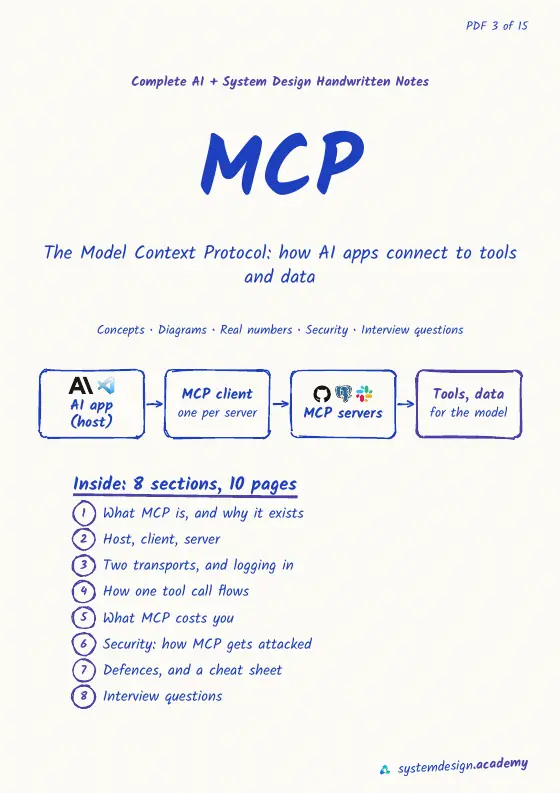
Inside
- What MCP is, and why it exists
- Host, client, server
- Two transports, and logging in
- How one tool call flows
- What MCP costs you
- Security: how MCP gets attacked
- Defences, and a cheat sheet
- Interview questions
PDF 49 pages
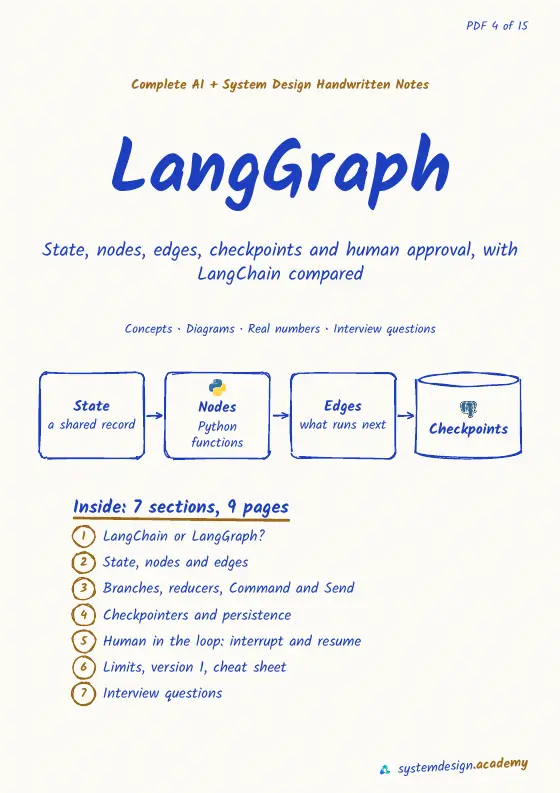
Inside
- LangChain or LangGraph?
- State, nodes and edges
- Branches, reducers, Command and Send
- Checkpointers and persistence
- Human in the loop: interrupt and resume
- Limits, version 1, cheat sheet
- Interview questions
PDF 510 pages
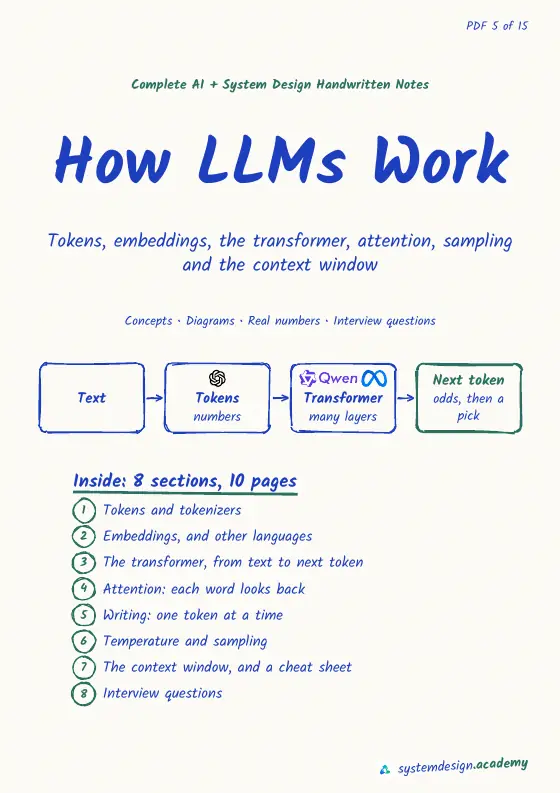
Inside
- Tokens and tokenizers
- Embeddings, and other languages
- The transformer, from text to next token
- Attention: each word looks back
- Writing: one token at a time
- Temperature and sampling
- The context window, and a cheat sheet
- Interview questions
PDF 610 pages
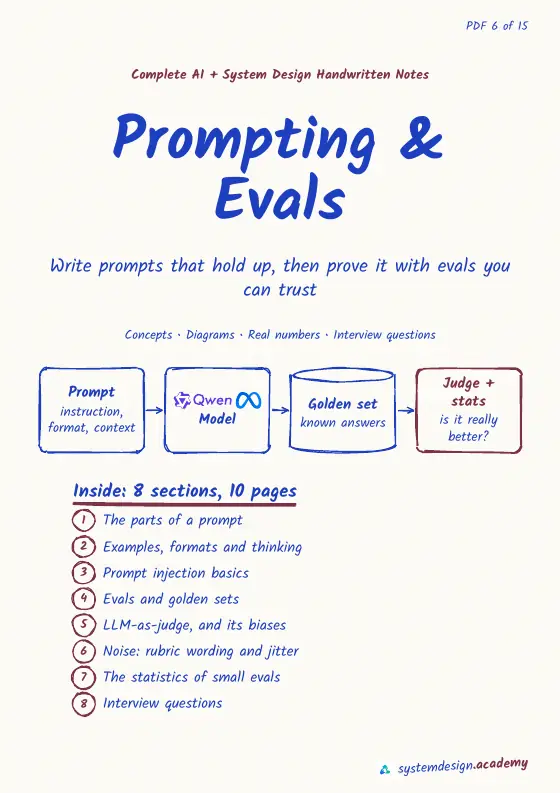
Inside
- The parts of a prompt
- Examples, formats and thinking
- Prompt injection basics
- Evals and golden sets
- LLM-as-judge, and its biases
- Noise: rubric wording and jitter
- The statistics of small evals
- Interview questions
PDF 710 pages
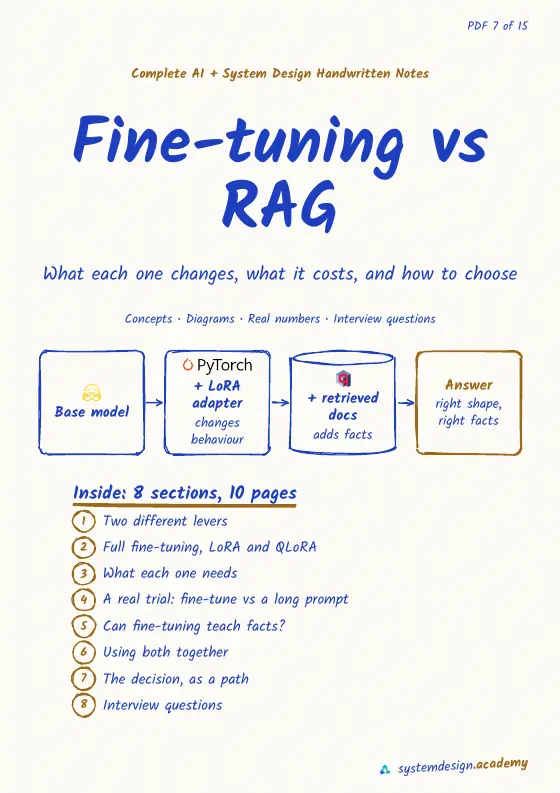
Inside
- Two different levers
- Full fine-tuning, LoRA and QLoRA
- What each one needs
- A real trial: fine-tune vs a long prompt
- Can fine-tuning teach facts?
- Using both together
- The decision, as a path
- Interview questions
PDF 810 pages
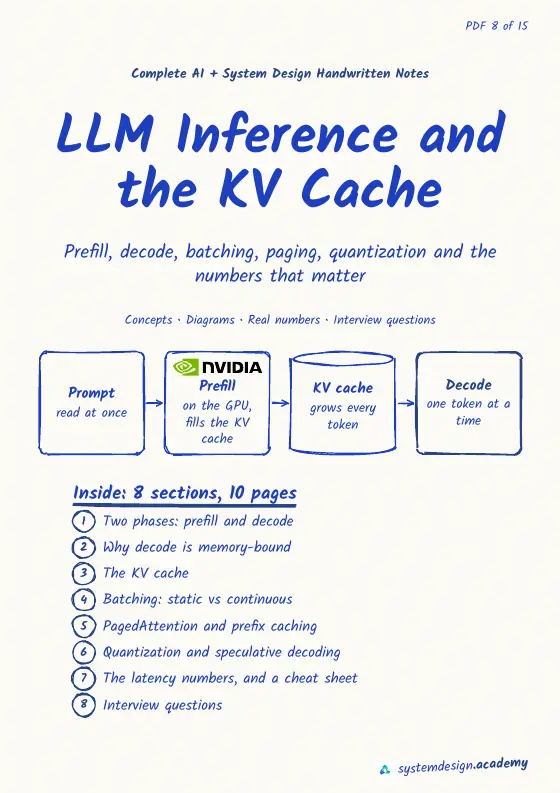
Inside
- Two phases: prefill and decode
- Why decode is memory-bound
- The KV cache
- Batching: static vs continuous
- PagedAttention and prefix caching
- Quantization and speculative decoding
- The latency numbers, and a cheat sheet
- Interview questions
PDF 910 pages
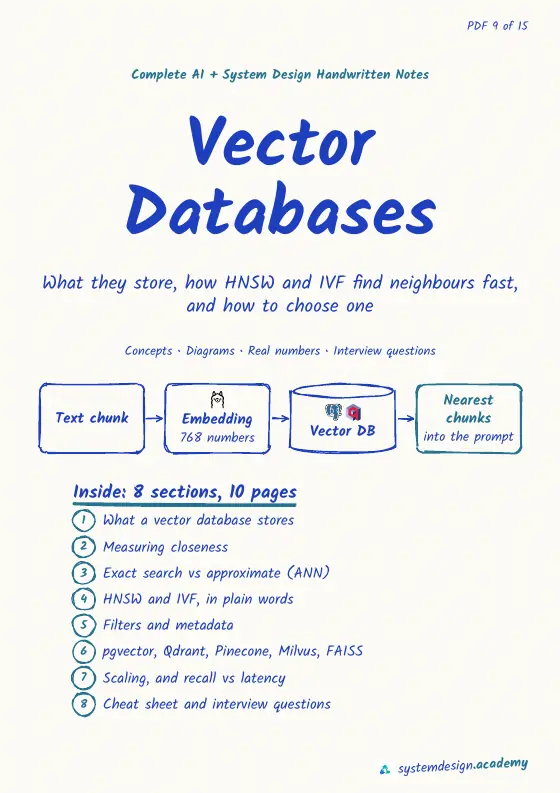
Inside
- What a vector database stores
- Measuring closeness
- Exact search vs approximate (ANN)
- HNSW and IVF, in plain words
- Filters and metadata
- pgvector, Qdrant, Pinecone, Milvus, FAISS
- Scaling, and recall vs latency
- Cheat sheet and interview questions
PDF 1010 pages
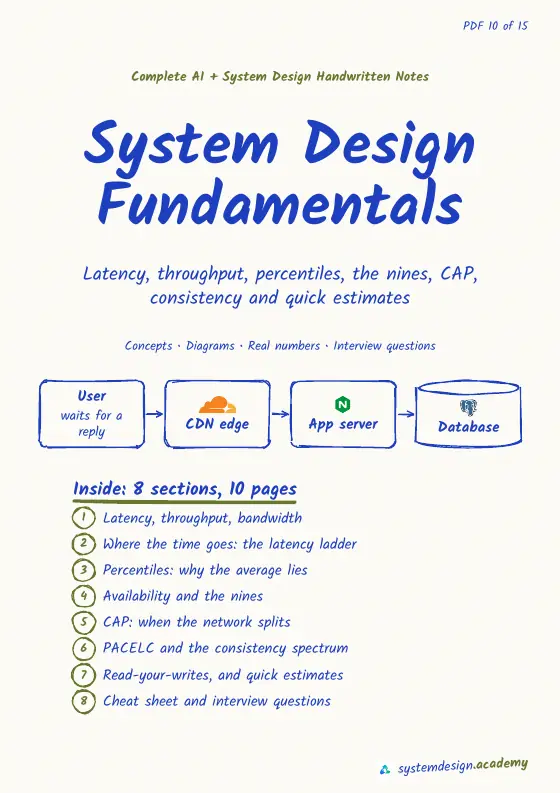
Inside
- Latency, throughput, bandwidth
- Where the time goes: the latency ladder
- Percentiles: why the average lies
- Availability and the nines
- CAP: when the network splits
- PACELC and the consistency spectrum
- Read-your-writes, and quick estimates
- Cheat sheet and interview questions
PDF 1110 pages
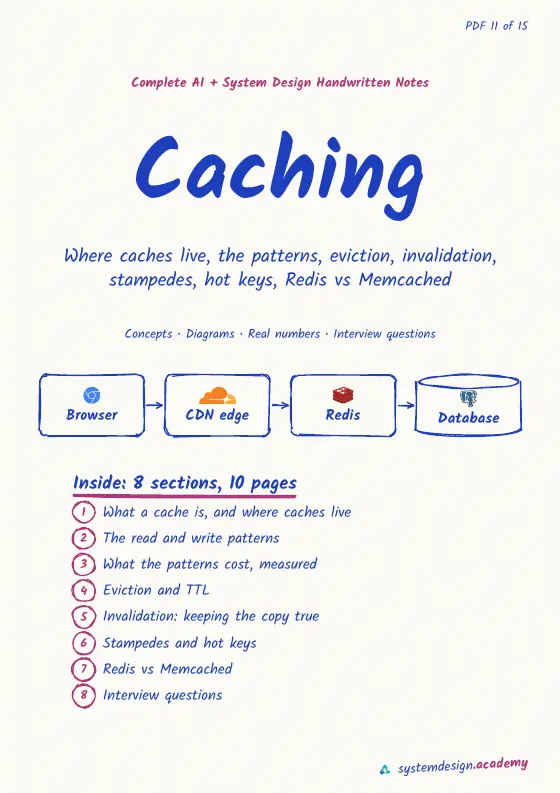
Inside
- What a cache is, and where caches live
- The read and write patterns
- What the patterns cost, measured
- Eviction and TTL
- Invalidation: keeping the copy true
- Stampedes and hot keys
- Redis vs Memcached
- Interview questions
PDF 1210 pages
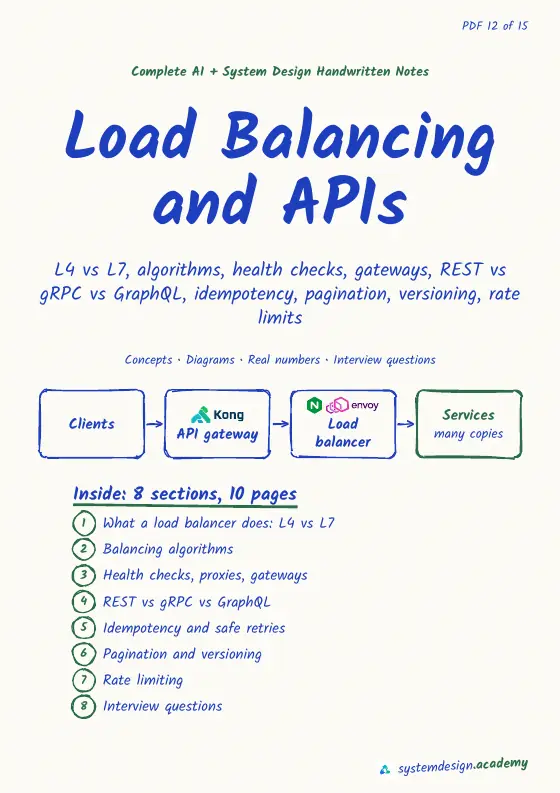
Inside
- What a load balancer does: L4 vs L7
- Balancing algorithms
- Health checks, proxies, gateways
- REST vs gRPC vs GraphQL
- Idempotency and safe retries
- Pagination and versioning
- Rate limiting
- Interview questions
PDF 1310 pages
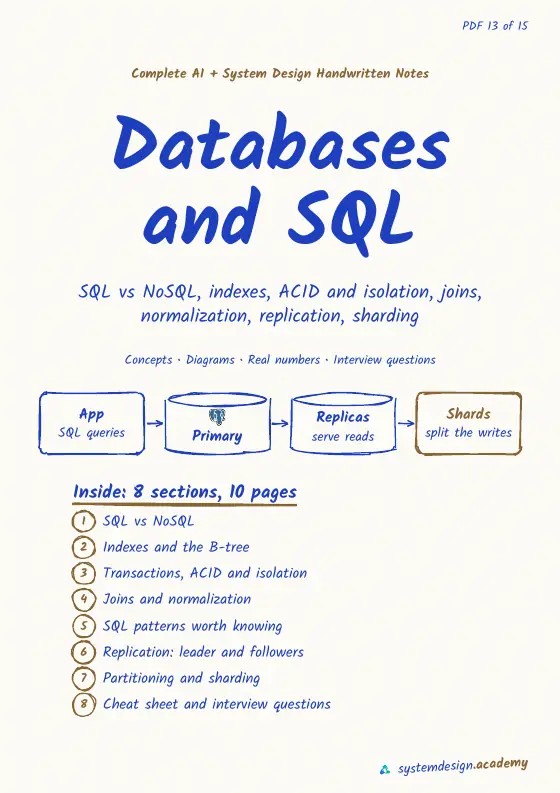
Inside
- SQL vs NoSQL
- Indexes and the B-tree
- Transactions, ACID and isolation
- Joins and normalization
- SQL patterns worth knowing
- Replication: leader and followers
- Partitioning and sharding
- Cheat sheet and interview questions
PDF 1410 pages
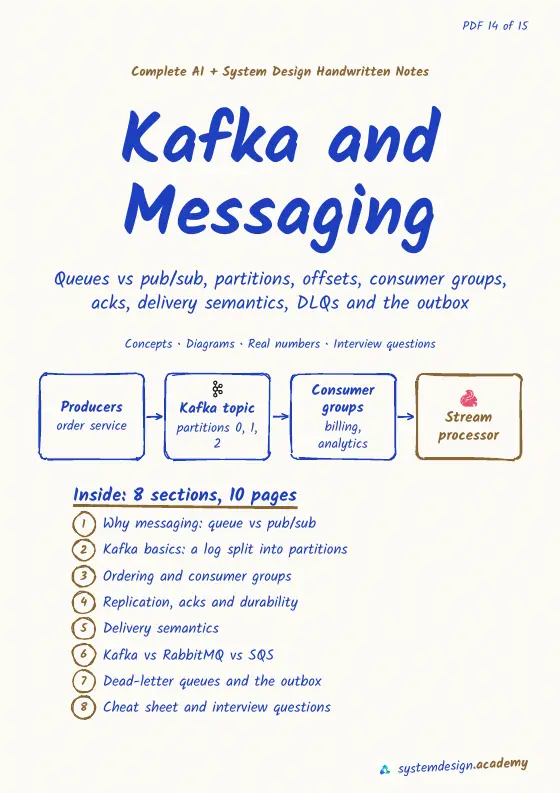
Inside
- Why messaging: queue vs pub/sub
- Kafka basics: a log split into partitions
- Ordering and consumer groups
- Replication, acks and durability
- Delivery semantics
- Kafka vs RabbitMQ vs SQS
- Dead-letter queues and the outbox
- Cheat sheet and interview questions
PDF 1510 pages
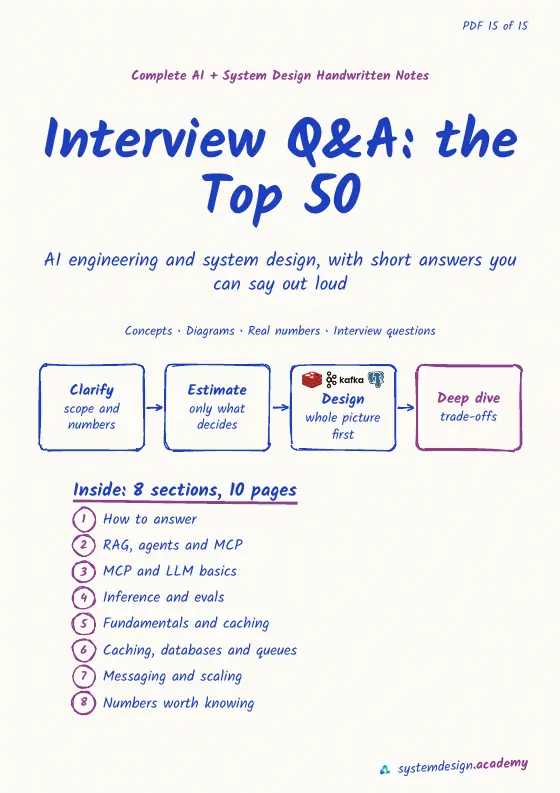
Inside
- How to answer
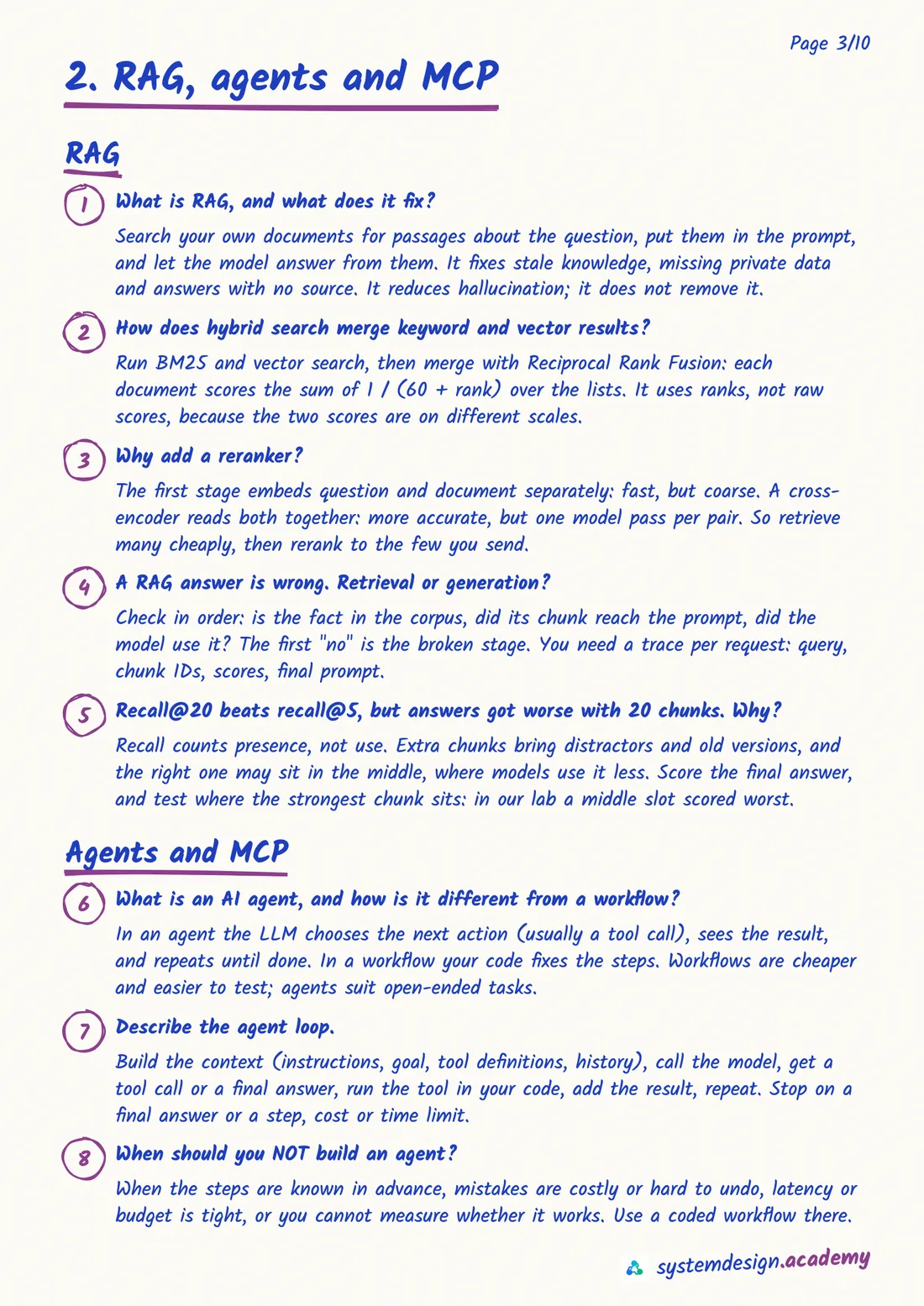
- RAG, agents and MCP
- MCP and LLM basics
- Inference and evals
- Fundamentals and caching
- Caching, databases and queues
- Messaging and scaling
- Numbers worth knowing
All 15 notebooks, one payment of ₹399 · $6
Get all 15 PDFsunder the lamp
What's inside a page
One PDF, Kafka and Messaging, followed through three real pages. Scroll, and each page zooms to the part that matters.

PDF 14, page 4, as printed 1 · The diagramEvery topic is drawn, with real names
Page 4 draws a consumer group: each partition goes to exactly one consumer. The note under it says what a fourth consumer would do: nothing. It would sit idle.

PDF 14, page 9, as printed 2 · The cheat sheetA cheat sheet you can revise in a minute
Each PDF ends its topic with a small table: the need on the left, what to use on the right. Need order for one user? Key by the user id, so all of that user's events land in one partition.
PDF 14, page 9, as printed 3 · The interview questionsQuestions with answers you can say out loud
Five per PDF, fifty in the last one. A topic has 6 partitions and your group has 8 consumers: what happens? Two consumers sit idle, because each partition is read by one member of a group at a time.
Six real pages
Exactly as they are in the PDFs, each a full A4 page. Tap one to open it full size.
pinned up from six different PDFs
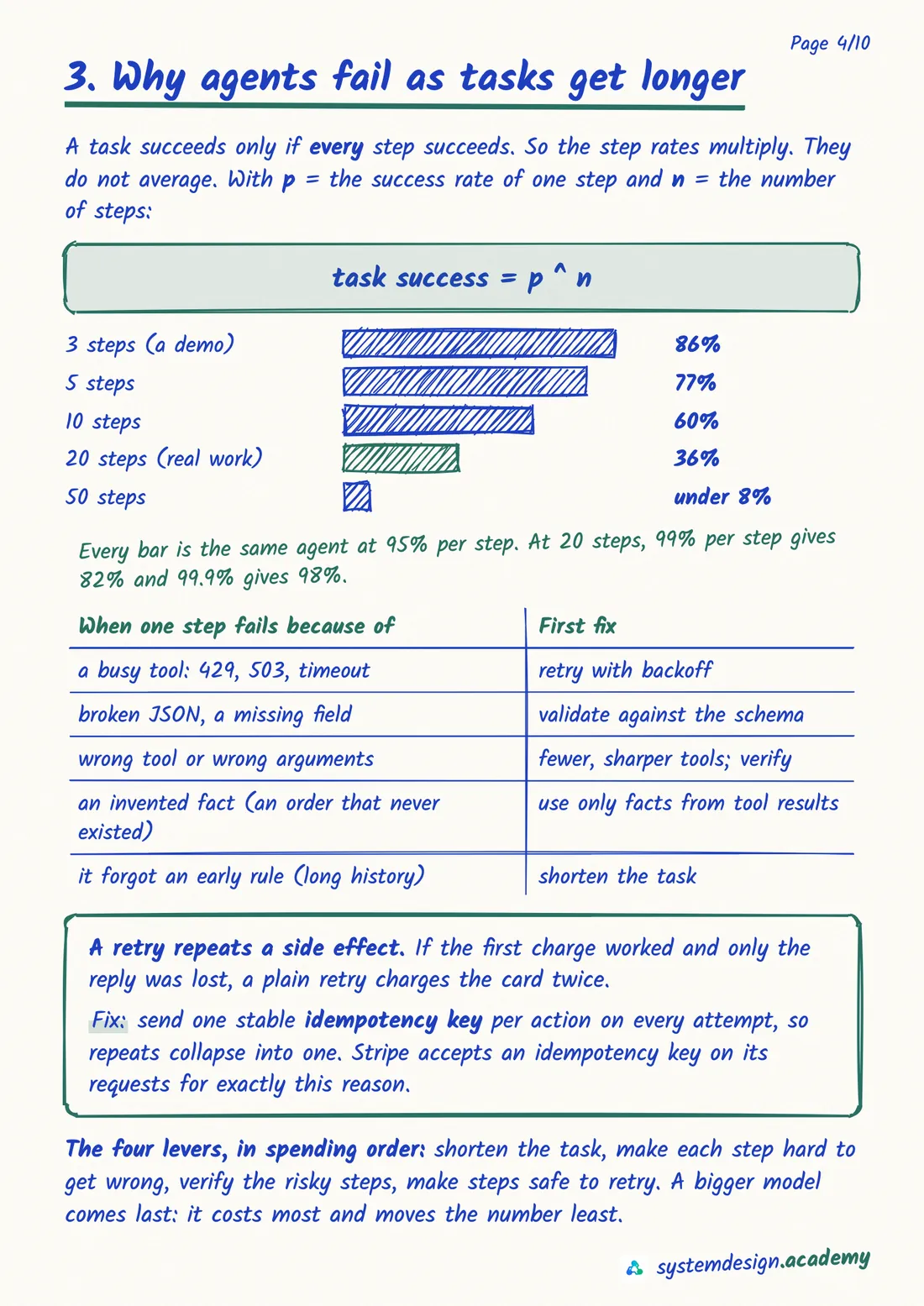
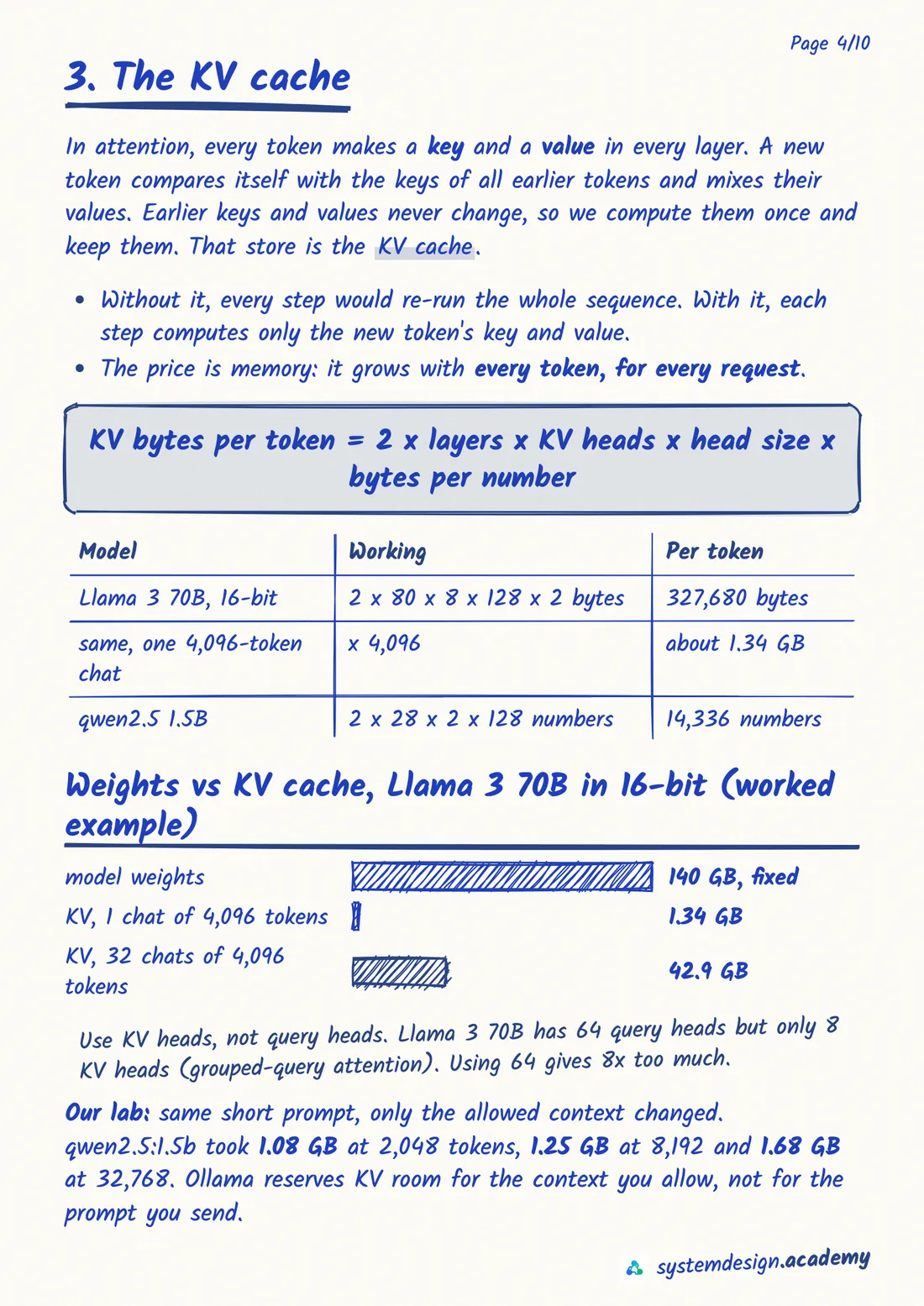
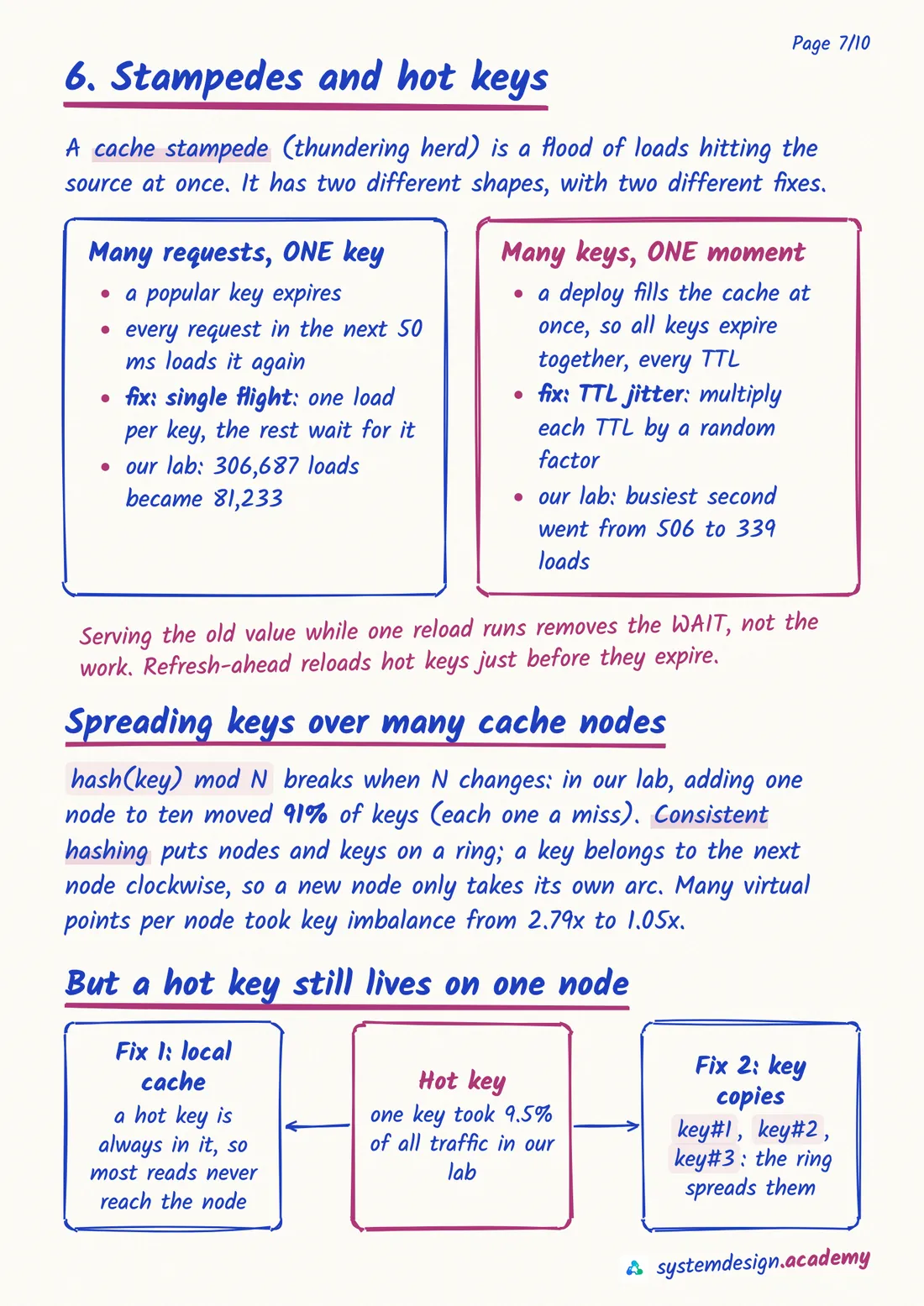
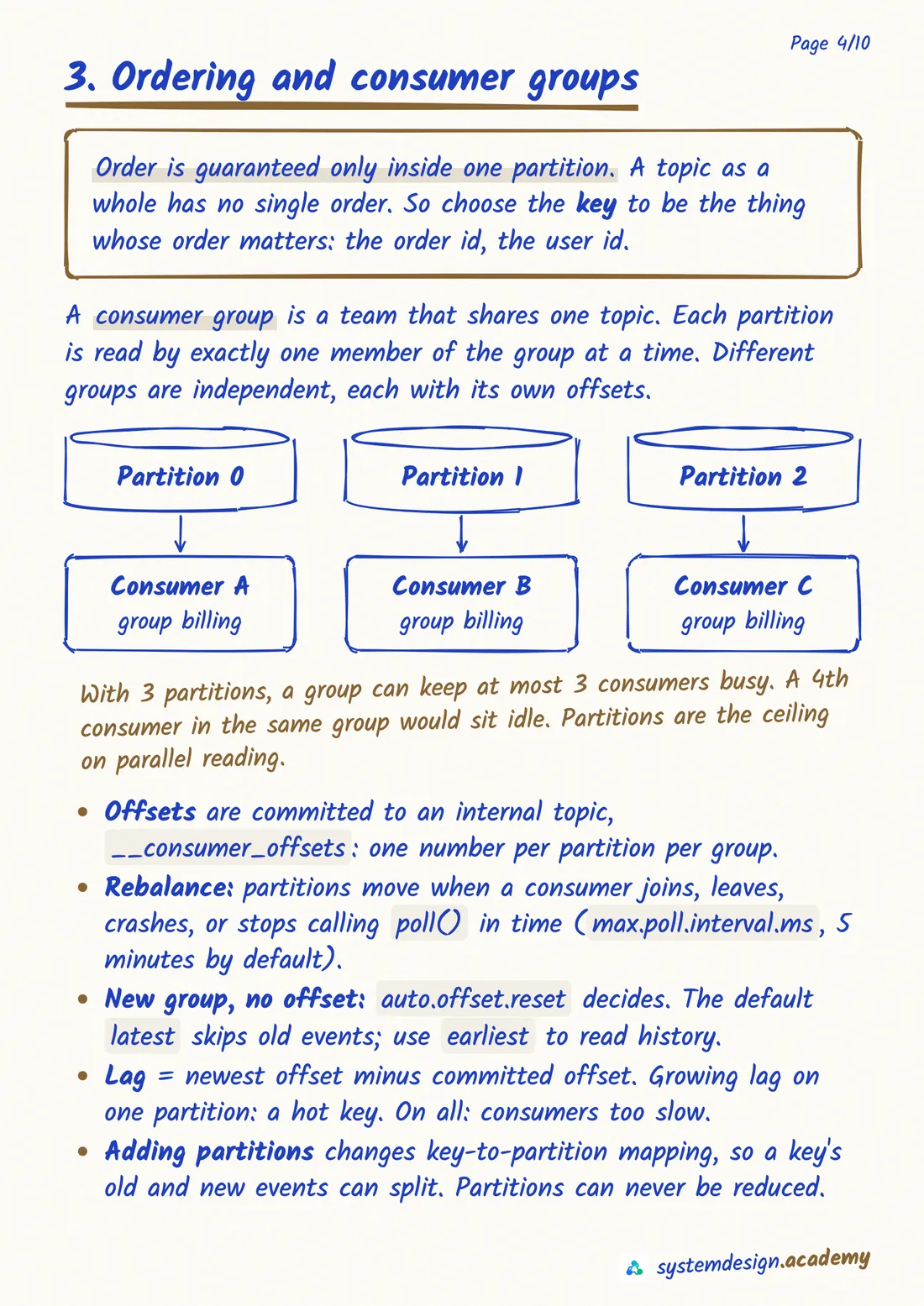
blueprint, PDF 14
Play with the Kafka page
The drawing from the Kafka notes, rebuilt live. Tap a part to read what the notes say about it. Pick the producer to send an event.
Tap any part of the drawing, or a button above. Each note is a line from PDF 14.
hash(key): same key, same partition, every time. An event with key = customer-7 is appended at the end of partition 1, at offset 5.
PDF 14, page 3
Order is guaranteed only inside one partition. A topic as a whole has no single order. So choose the key to be the thing whose order matters: the order id, the user id.
PDF 14, page 4
Offset: an event's position in its partition: 0, 1, 2... It never changes. Reading does NOT delete. Events stay until a retention rule removes them (default 7 days).
PDF 14, page 3
A consumer group is a team that shares one topic. Each partition is read by exactly one member of the group at a time.
PDF 14, page 4
With 3 partitions, a group can keep at most 3 consumers busy. A 4th consumer in the same group would sit idle. Partitions are the ceiling on parallel reading.
PDF 14, page 4
Different groups are independent, each with its own offsets.
PDF 14, page 4
Offsets are committed to an internal topic, __consumer_offsets: one number per partition per group.
PDF 14, page 4
How you get them
PDF, A4, about 0.2 MB per file. This is a digital product: all sales are final. After paying, your files are in My notes.
What these notes are, and are not
They are revision notes: each topic on 6 to 10 pages, written in plain English, with a diagram wherever a picture explains it better than words. They are written from the lessons and labs on this site, and a number marked "our lab" is one we measured ourselves.
They are handwritten in style, not scanned: a handwriting font in blue ink and sketch-style boxes, so every page stays sharp when you zoom or print.
They are not the courses. A course teaches each topic in depth, lesson by lesson, with code and labs. If you want that depth, the last page of each PDF links the lessons it comes from.
for revision, not for a first read
pay from anywhere
Card or PayPal, from any country
Pay by Visa, Mastercard, American Express or Maestro card, or with PayPal. Your access opens the moment the payment is verified.





- Cards are processed by Razorpay, a PCI DSS compliant payment gateway. You enter the card in Razorpay's secure window over an encrypted (TLS) connection.
- Every payment is verified by the payment provider's signed confirmation before your access opens. You get a payment ID on screen and by email.
- Charged in US dollars. Your bank or PayPal shows the amount in your own currency.
Questions
What exactly do I get?
15 PDF files, 149 A4 pages in all, plus one file with all of them together. You download them from My notes right after paying, and the link also comes by email. They are yours to keep, print or read on a tablet.
Is it really handwritten?
It is handwritten style: the text is set in a handwriting font in blue ink and the boxes and arrows are drawn in a sketch style, on a paper-coloured page. It is not a scan of paper notes. That keeps every page sharp when you zoom or print.
Where does the content come from?
From the lessons, guides and labs on systemdesign.academy. Where a page gives a number from our own lab, it says so. Every PDF ends with links to the lessons it summarises.
Is this the same as the courses or the interview packs?
No. The notes are short summaries for revision. The courses teach each topic lesson by lesson with labs, and the interview packs are question banks with full answers. Buying the notes does not include either.
How do I pay?
In India through Razorpay: UPI, cards, netbanking or wallets, in rupees. Everywhere else by card (Visa, Mastercard, American Express) or PayPal, in US dollars.
Can I get a refund?
This is a digital product, so all sales are final and there are no refunds. Look at the six sample pages on this page first.
All 15 notebooks, one payment