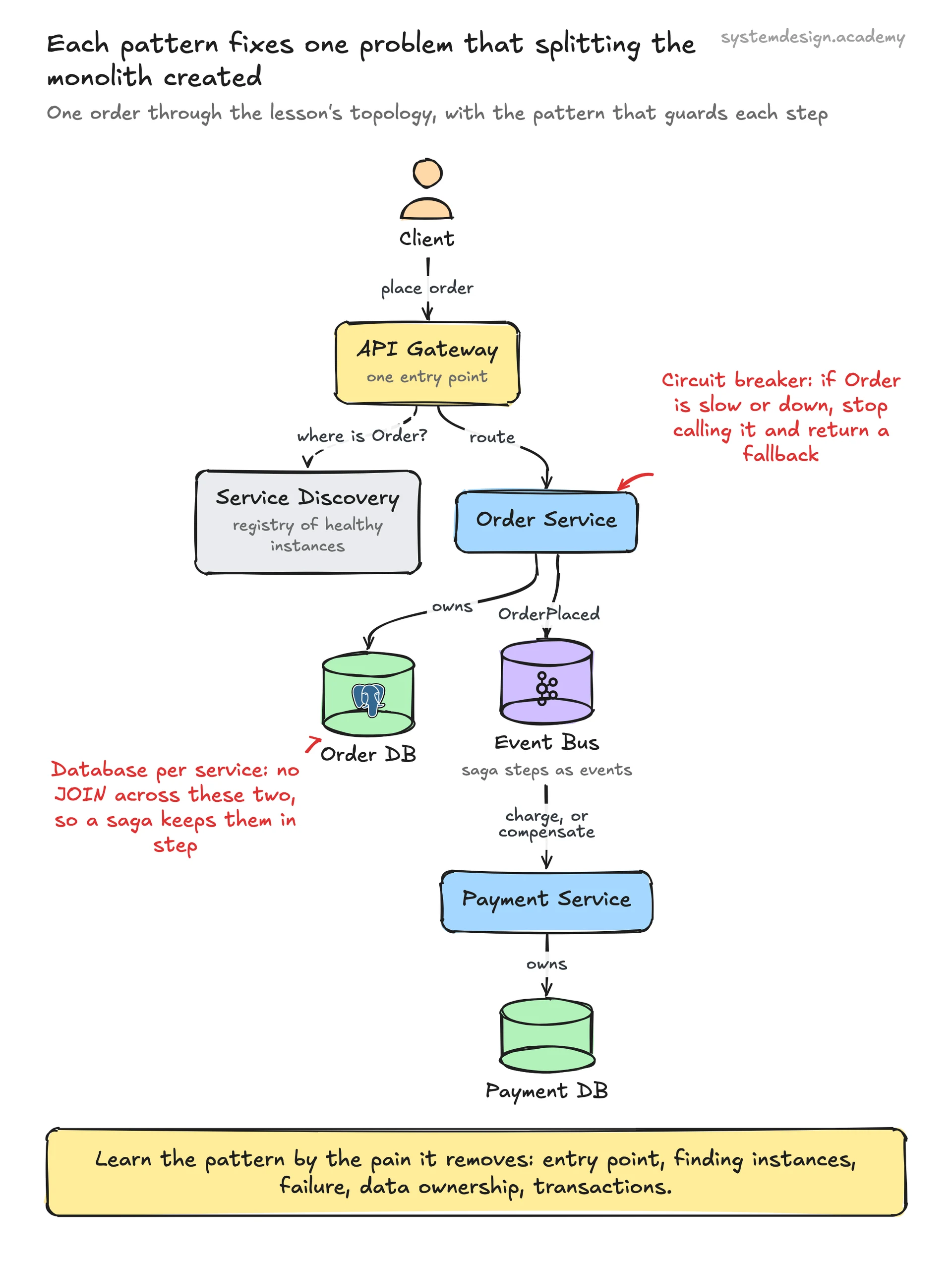
Where to draw service boundaries is the biggest decision. The lesson gives two good ways. Split by business capability, meaning what the business does, such as orders, payments and inventory. Or split by subdomain, using domain-driven design to find bounded contexts. The wrong way is to split by technical layer, into a database service, a logic service and a UI service. That gives you a distributed monolith.
The lesson's sizing checks are practical. Can a team of 5 to 8 people own the service end to end? Can you explain what it does in one sentence? If changing one service always means changing another, they should be one service.
Few teams start from nothing. The strangler fig pattern moves a monolith one route at a time: new code takes over a feature while the old system still serves the rest. The Strangler Fig Pattern lesson shows how. A sidecar is a helper process deployed next to each service to handle shared jobs such as network traffic and telemetry, which is how a service mesh works.
Finally, the lesson is honest about cost. If you have fewer than 20 engineers and your monolith works, it advises you to keep it and structure it well. The patterns are answers to scaling problems you may not have yet. For the full picture, read the Microservices Architecture lesson, including how services talk to each other and the honest trade-offs table.