
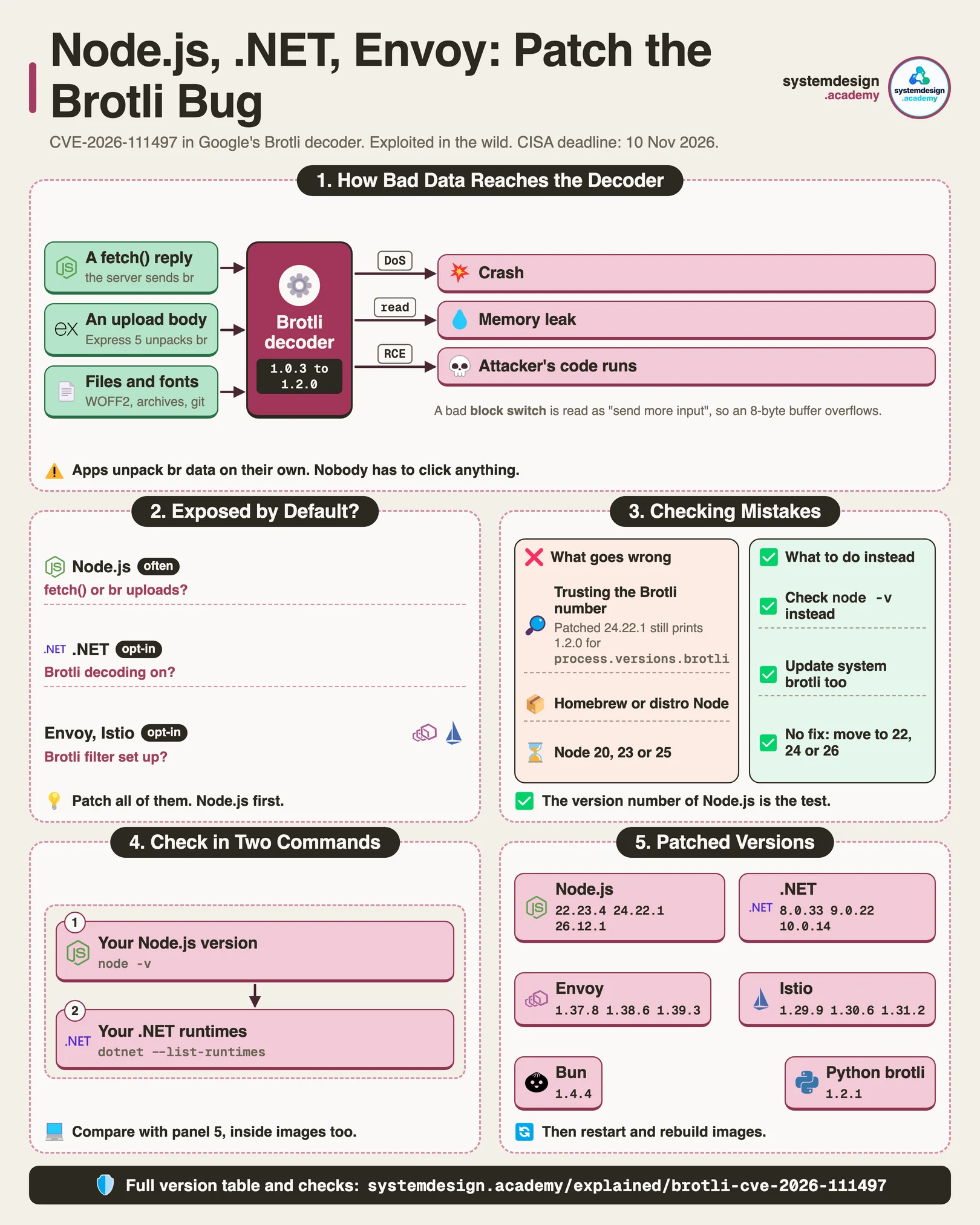
What happened, in plain words
Think of a parcel that arrives vacuum-packed. Before you can use what is inside, somebody has to unpack it. On the internet, a lot of data arrives packed this way to save bandwidth, and the program that receives it unpacks it automatically. Brotli is one of the packing formats. Google made it, every major browser and CDN speaks it, and a server says it used it with the header Content-Encoding: br.
The unpacking code is called the decoder. On 22 October 2026 a bug in Google's Brotli decoder was published as CVE-2026-111497. If the packed data is built in a particular broken way, the decoder writes bytes past the end of a small buffer in memory. That overwrites the decoder's own working state. The record says a remote attacker with no login can use this to crash the program, read memory it should not show, or potentially run their own code.
It is not a theoretical bug. CISA, the US cyber agency, added it to its Known Exploited Vulnerabilities list on 27 October and gave US federal agencies until 10 November 2026 to fix it. ELLIO reported exploit traffic reaching its sensors on 26 October and reproduced a shell on official Node.js builds. Researchers call it Node2Shell; a tracking site calls it Broccoli2Shell.
