
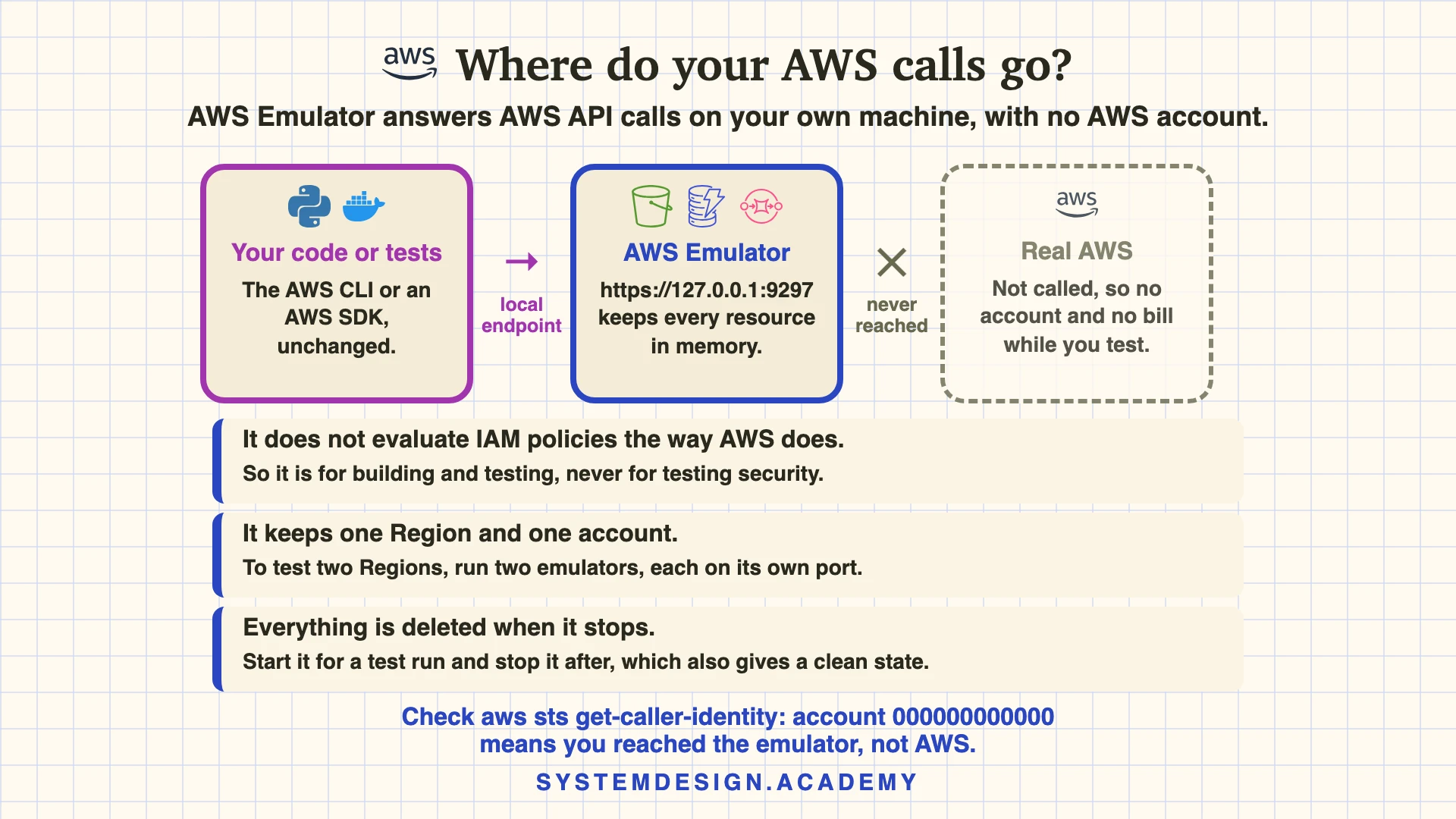
What is AWS Emulator?
“You use it to test your software without calling AWS, on your own machine, on a development server, or in continuous integration (CI). You don't need an AWS account.”
AWS Emulator is a local program, made by AWS, that answers AWS API calls. You start it, point the AWS CLI or an AWS SDK at it, and run your code as usual. Your requests go to the emulator, not to AWS, so you work with emulated buckets, tables and queues instead of real ones. You do not need an AWS account, and AWS charges no fee for it.
AWS lists three uses: testing on your own machine, including calls that cross services; running integration tests in a CI/CD pipeline with no AWS account and no AWS resources; and letting AI coding agents build and try applications locally before they run on AWS. It has no graphical interface. It is a server that speaks the AWS wire protocols.
The source is on GitHub under the CC0 1.0 licence, with the vendored framework code under Apache 2.0. It is written in Rust, with one crate per AWS service, each driven by that service's Smithy API model. When we read the repository on 12 November 2026 it held 436 service crates. The first release on GitHub is v1.0.250, dated 7 November 2026, and new releases arrive several times a day.
