What Google released
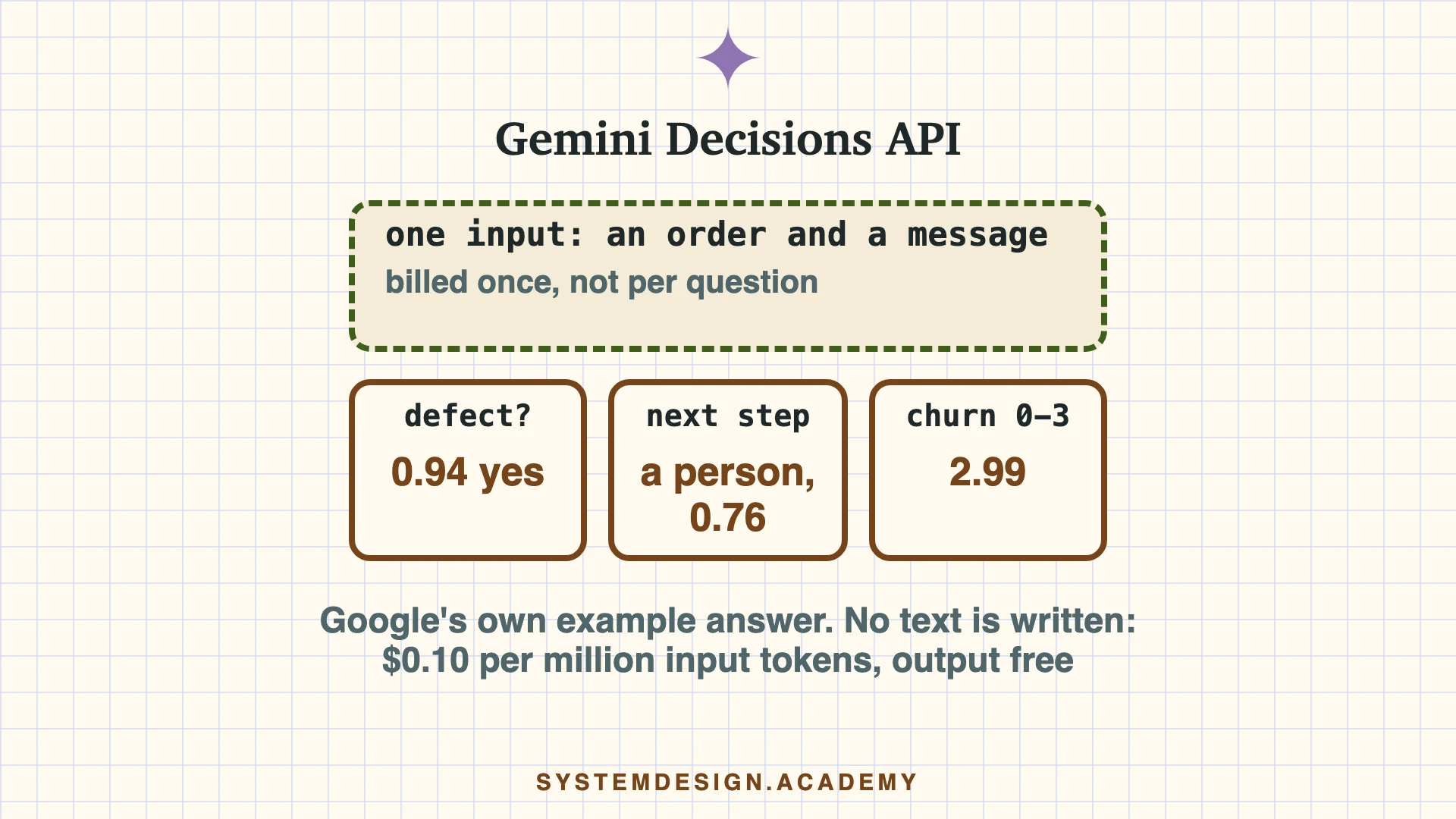
“Rather than generating answer text token by token, Gemini Decision 1 scores your candidate options in a single forward pass, returning probabilities and confidence scores in 150-250 ms end-to-end latency at $0.10 per 1M input tokens with zero output tokens billed.”
On 11 November 2026 Google announced the Gemini Decisions API in a post by Min Choi, a product manager, and Felix Yu, a principal scientist, both at Google DeepMind. The API runs one new model, Gemini Decision 1, and you can use it today with a key from Google AI Studio.
The idea is simple. Many calls an application makes to a language model are not really asking it to write anything. They ask it to pick: is this message a complaint, which support queue should take it, does this photo show damage, which model should answer this question. Normally you would ask a chat model to reply with a word or some JSON and then read that word back. The Decisions API skips the writing. You give it the input and a list of typed questions, and it gives you back a probability for each possible answer.
Google lists four teams already using it inside the company. Gemini Notebook uses it to route each question to the right model and thinking level, which Google says cut latency by up to 40% for everyday queries. Stitch, Google's design tool, uses it to apply design edits made by voice or tap almost at once. CC, a Google Labs app, uses it to pick an emoji reaction from more than 200 options. And Google Search uses it as a safety layer for MCP tools (the standard way AI agents call outside tools), to catch tools and content that try to trick the agent.
In short: this is a fast, cheap classifier you set up by writing questions instead of training a model. The rest of this page is about how it works, what a call really costs, and the cases where it is the wrong tool.