- Can a backend developer become an AI engineer?
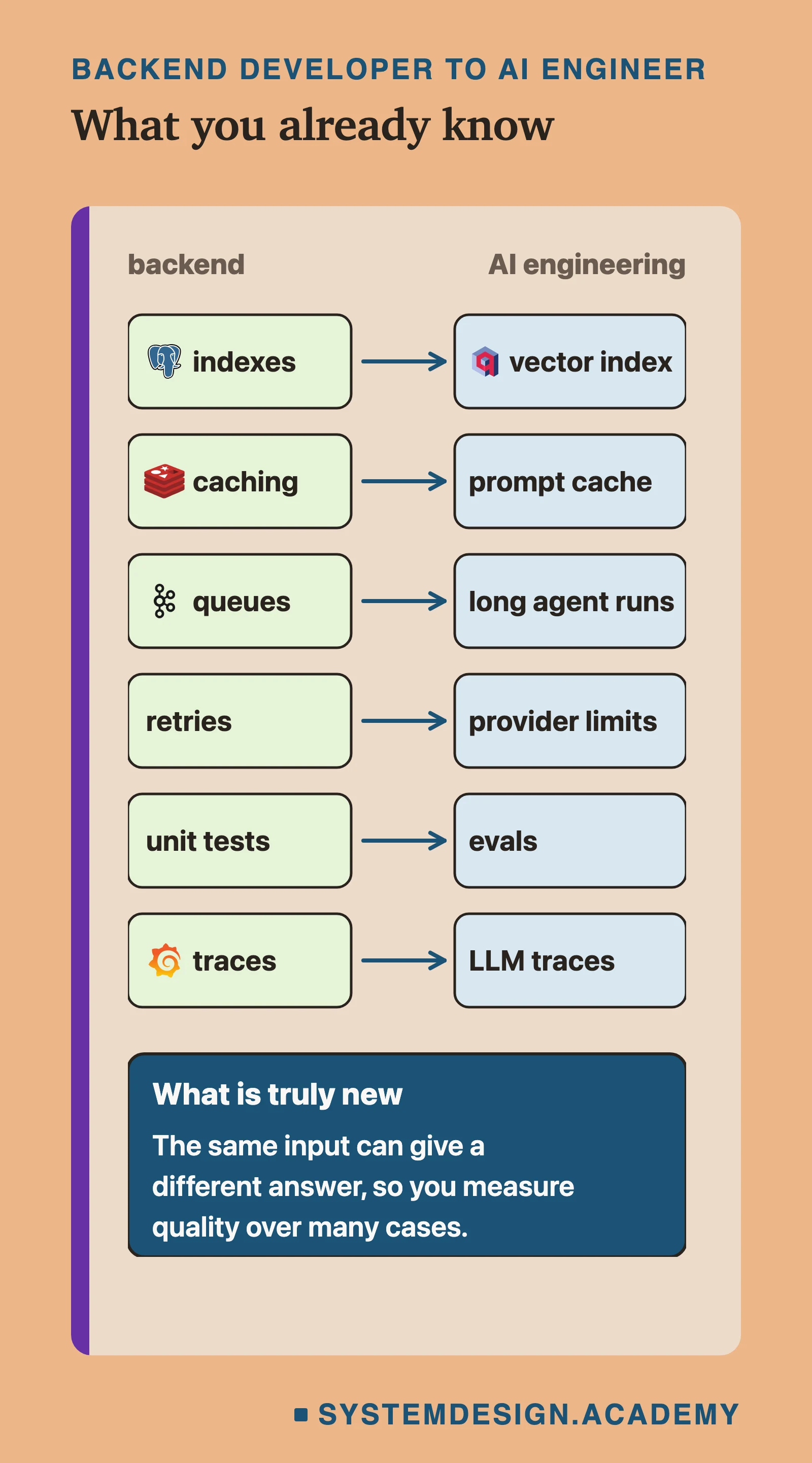
- Yes. Most AI engineering work is building products around models: APIs, data pipelines, search, caching, reliability and monitoring, which are backend skills. The new parts are prompts, RAG, agents and evals, and the 90-day plan above covers them in order.
- Do I need machine learning or advanced maths to become an AI engineer?
- Not for most AI engineer roles, which use trained models through an API or open-source serving. You need to understand how models behave: tokens, sampling, context and embeddings. Training models and the maths behind it matter more for ML engineer and research roles.
- Do I need to learn Python?
- It helps a lot. Most AI libraries, examples and interview code are in Python. If you already write Java, Go or TypeScript, basic Python takes a few weeks, and TypeScript is common for AI product work too.
- How long does it take to move from software engineer to AI engineer?
- Our plan is 90 days at about 8 to 10 hours a week, ending with projects you can show. Some people move faster inside their own company, by adding an AI feature to a product they already work on.
- What projects should I build?
- Three that match the plan: a model call wrapped in a safe API, a RAG service over real documents with a measured search score, and an eval set that shows a before-and-after number for one change. Numbers make a project credible in an interview.
- Is AI engineer the same as ML engineer?
- No. An ML engineer usually trains, deploys and monitors models, often classic ones on tabular data. An AI engineer builds applications on top of large language models. The roles overlap in serving and monitoring.
- Will my backend experience count in AI engineer interviews?
- Yes, especially in the system design round. An AI system design question is a normal design question with a model, a vector index and evals added. Say how you handle timeouts, retries, cost and permissions: many AI-first candidates do not.