- What does an inference engineer do?
- They make trained models answer fast and cheaply in production. That means choosing and tuning the serving engine, fitting requests into GPU memory, batching, quantization, and measuring latency and cost per token. Baseten's posting puts it as reasoning "from first principles about where time and memory go".
- What is the difference between an inference engineer and an ML engineer?
- An ML engineer usually covers the whole life of a model: data, training, evaluation and deployment. An inference engineer goes deep on the last part: serving the model efficiently. Many teams use the titles loosely, so read what the posting asks for.
- Do I need to know CUDA to be an inference engineer?
- For performance roles close to the hardware, yes: Perplexity's posting asks for deep GPU programming experience (CUDA, Triton, CUTLASS or similar). For serving platform roles, strong distributed systems skills and a good grasp of GPU memory matter more than writing kernels.
- What is the KV cache, in simple words?
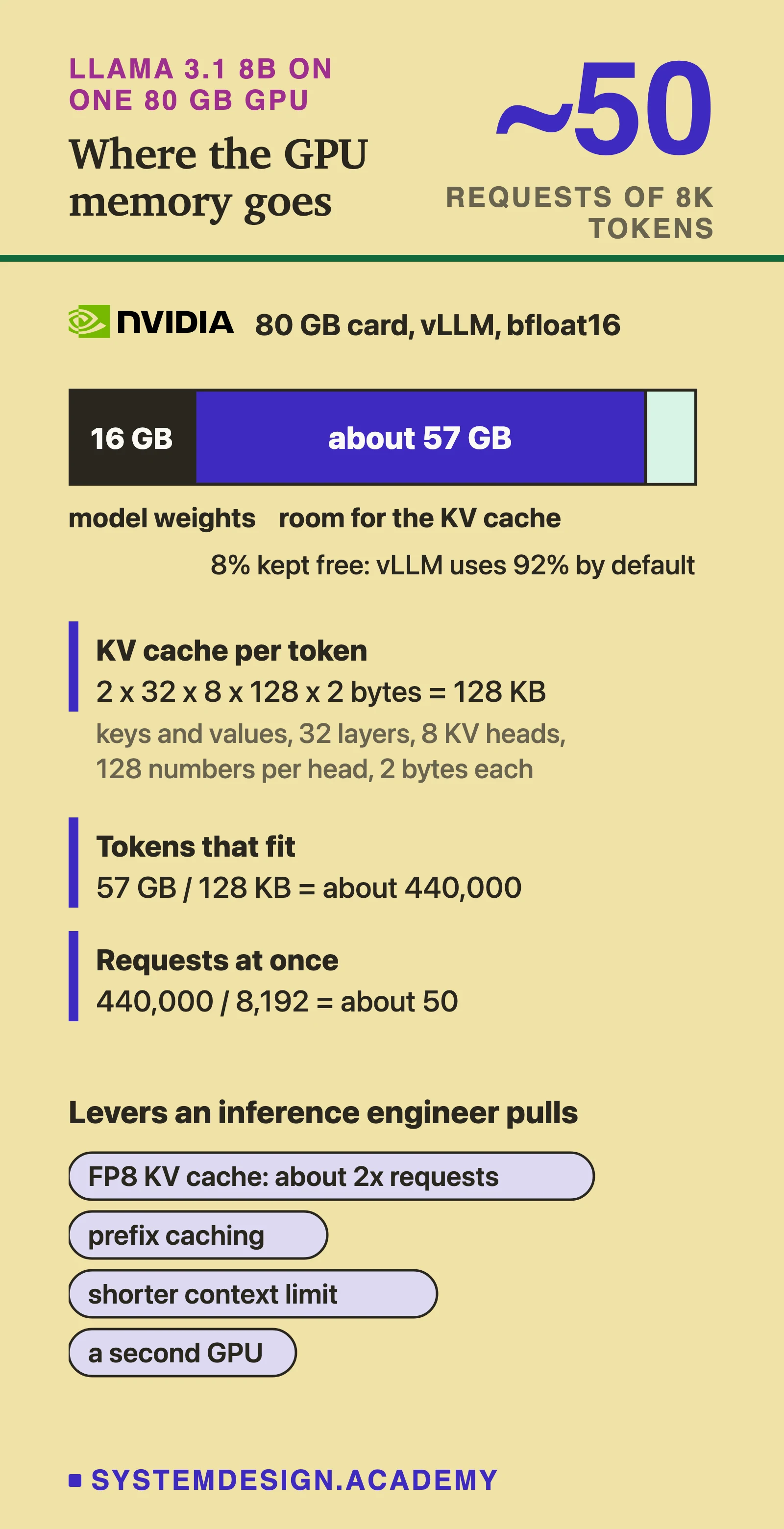
- When a model writes each new token, it needs the keys and values of every earlier token. Saving them, instead of computing them again each step, is the KV cache. It grows with every token and every request, so it is usually what limits how many requests one GPU can serve at once.
- What is vLLM?
- vLLM is an open-source serving engine for language models. It is known for paged attention, which stores the KV cache in small blocks like pages of memory so little space is wasted, and for continuous batching. Many companies run it in production.
- How much does an inference engineer earn?
- In live US postings on 23 October 2026: $266K to $500K at OpenAI, $220K to $485K at Perplexity, $180K to $360K at Baseten and $170K to $245K at Anyscale, each plus equity. The table on this page links every posting.
- Can a backend engineer become an inference engineer?
- Yes, and the platform side of the job is a natural step: routing, autoscaling, load testing and reliability are backend skills. Add the model-side knowledge in the 90-day plan above: how generation works, GPU memory, batching and quantization.