May we use cookies so Meta, Google, LinkedIn and ChatGPT see your visit and we learn which ads work? PrivacyMay we use cookies to see which pages help, and let Meta, Google, LinkedIn and ChatGPT see your visit, so we know which of our ads work? That way we spend less on ads that do not work. We do not sell your data, and the site works the same if you decline. You can change your answer at any time under Cookie settings at the foot of the page. Privacy policy
Loading...
System Design and AI Engineering, by Roni Das. 989 interactive lessons in two courses.: 770 in System Design and 219 in AI Engineering.
An Advanced System Design Course for Engineers Who Already Know the Basics
Is there an advanced system design course online?
Yes. The Advanced level of the System Design course at systemdesign.academy has 182 lessons on distributed systems, consistency models, reliability, stream processing and security testing, followed by 20 capstone designs. Some lessons run real software such as etcd and HAProxy until it fails and show the measured result. It is part of one course you pay for once.
Save your progress and get the interview checklist PDF
System Design Interview Cheat Sheet: the 7 interview stages, the 10 points a scorecard grades, 12 classic systems. 18 pages. Free with an account.
This page shows what the Advanced level of our System Design course teaches, chapter by chapter, with a lesson to open for each part and the numbers the labs measured, in 13 short answers. It starts with a test you can use to judge any advanced course.
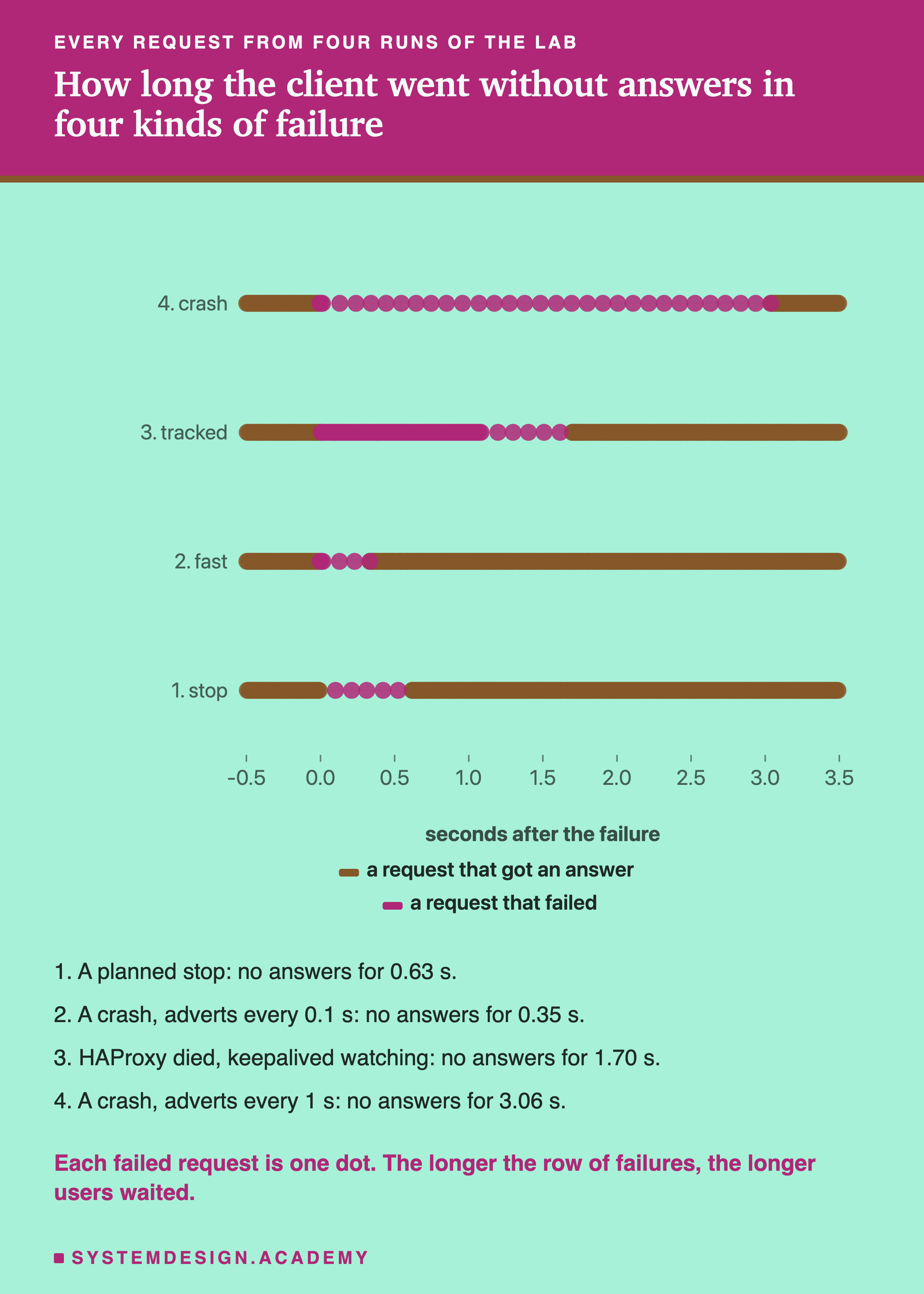
Four failures from one lab in the Advanced level, measuredThe load balancer failover lesson breaks a real pair of load balancers four different ways and records every request. The gap a user sees ran from 0.35 seconds to 3.06 seconds, and the lesson explains which setting caused each one.
Four failures from one lab in the Advanced level, measuredThe load balancer failover lesson breaks a real pair of load balancers four different ways and records every request. The gap a user sees ran from 0.35 seconds to 3.06 seconds, and the lesson explains which setting caused each one.
The short answer
An advanced course should spend its time on what goes wrong between the parts: consistency, consensus, distributed transactions, failover and operations. Ours does that in its Advanced level, with labs that break real systems, and you can read the first lessons free.
This page is the free part.
The course goes deeper on Advanced system design course
₹1,111 in India/$35 everywhere elseonce, for the whole course
The System Design course covers Advanced system design course across a run of lessons, not one page. These 4 alone are about 154 minutes of step-by-step reading, every one with a quiz.
How load balancer failover works: two HAProxy nodes share one IP with keepalived and VRRP. A real lab measures the 3 s crash gap and backend health-check ejection.
1. What an advanced system design course should teach
A short test you can use on any course that calls itself advanced, ours included.
What makes a system design course advanced rather than introductory?
An introductory course teaches the parts: a load balancer, a cache, a queue, a database replica. An advanced course teaches what happens between the parts when something goes wrong. Two replicas disagree. A network splits a cluster in half. A retry storm turns a small outage into a big one. A transaction touches four services and one of them fails halfway.
So the test is simple. An advanced course should spend most of its time on consistency, consensus, distributed transactions, failure handling and operating a system in production, and it should show you real failures, not only diagrams of healthy systems.
Who is an advanced system design course for?
It is for engineers who already build and run services, usually with four or more years of experience, who want to reason about trade-offs instead of naming components. It also suits anyone preparing for a senior or staff level interview, where the interviewer spends most of the hour on deep dives and failure modes rather than the first diagram.
If words like replication lag or idempotency are still new, start one level lower. Every lesson defines its terms, but the advanced chapters move faster.
This page is written by System Design Masterclass at systemdesign.academy, about the Advanced level of our own System Design course. The Advanced level has 182 lessons in 6 chapters, followed by 20 capstone designs. They are part of one course of 770 lessons, written by Roni Das. Every count here is read from the lesson files themselves. We do not rank other courses on this page; the honest comparison is on a separate page.
2. What the Advanced level covers, chapter by chapter
The chapters in the order most people take them, with one lesson to open from each.
Four failures from one lab in the Advanced level, measuredThe load balancer failover lesson breaks a real pair of load balancers four different ways and records every request. The gap a user sees ran from 0.35 seconds to 3.06 seconds, and the lesson explains which setting caused each one.
Distributed Systems Core has 24 lessons. It covers consensus and leader election, quorums and sloppy quorums, split brain, vector clocks and Lamport timestamps, gossip, hinted handoff and read repair, the CAP theorem, and the ways to keep data correct across services: two-phase commit, three-phase commit, sagas, event sourcing and CQRS.
The quorum lesson is a good place to start. It counts by hand why a read can miss a write, then runs a small program 100,000 times per setting to check the count. Every setting where the readers plus the writers outnumber the replicas shows zero misses.
Consistency Models has 21 lessons. It walks the ladder from strong to weak: linearizability, sequential and causal consistency, read your writes, monotonic reads and writes, snapshot isolation and serializability. It then covers the machinery underneath: write-ahead logging, snapshotting, point-in-time recovery, conflict resolution and CRDTs.
The aim is that you can say exactly what a reader is allowed to see after a write under each model, and what it costs to promise more. That is the question a senior interviewer asks when you say the word eventually.
Reliability and Resilience is the largest chapter, with 85 lessons. It covers failover of every kind (load balancer, DNS, database, active-active and active-passive), retries, timeouts, circuit breakers, bulkheads, load shedding and backpressure, then SLOs and error budgets, incident response, post-mortems, on-call, backups, recovery time and recovery point, disaster recovery and chaos engineering.
The figure above comes from this chapter. The load balancer failover lesson breaks a real pair of HAProxy load balancers with keepalived four different ways and records every request. A planned stop cost 0.63 seconds of failed requests and a crash with one-second adverts cost 3.06 seconds, and the lesson shows which setting made the difference.
What is in the stream and batch processing chapter?
Stream and Batch Processing has 36 lessons: event time against processing time, the kinds of windows, late and out-of-order data, stateful stream processing and checkpoints, exactly-once semantics, stream joins, and the Lambda and Kappa architectures beside batch work such as MapReduce, ETL and ELT.
These are the topics behind designs such as an ad click aggregator or a real-time analytics dashboard, where the hard question is not how to count but which events belong in which minute.
Security Testing and Operations has 12 lessons on SAST, DAST, dependency scanning, penetration testing, intrusion detection and SIEM. A short data engineering chapter of 4 lessons covers the lakehouse, open table formats and catalogs.
Why the numbers in these lessons come from runs you can repeat, and two more examples.
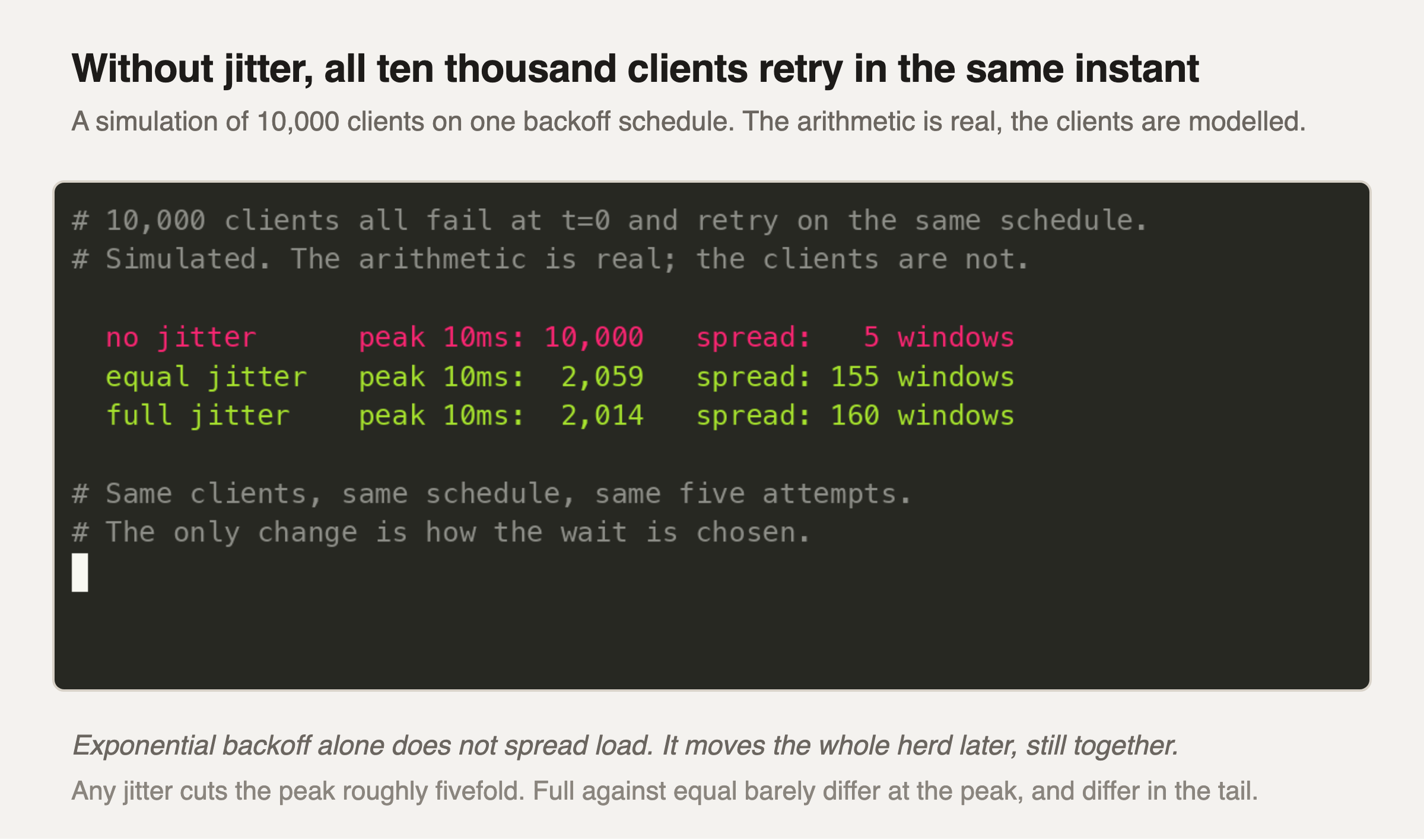
Why backoff without jitter still knocks a service overExponential backoff alone moves the whole crowd of retries later, still together. Adding jitter cut the busiest moment from 10,000 retries to about 2,000 in this simulation, which the retry lesson builds up step by step.
Do the advanced lessons have labs or only diagrams?
Both. Most lessons build their idea with a step-by-step diagram you click through, and several advanced lessons add a lab: a small program, or real software such as etcd or HAProxy, run on purpose until it fails, with the real output shown in the lesson. The programs use plain Python or standard tools, so you can repeat them on your own machine.
The retry lesson is an example of a simulation, and it says so. Ten thousand modelled clients fail at the same moment and retry on the same exponential schedule. Without jitter, all 10,000 retries land in the same 10 millisecond window. With full jitter the busiest window holds 2,014. Same clients, same five attempts; only the way the wait is chosen changes.
Is there an example with real distributed software?
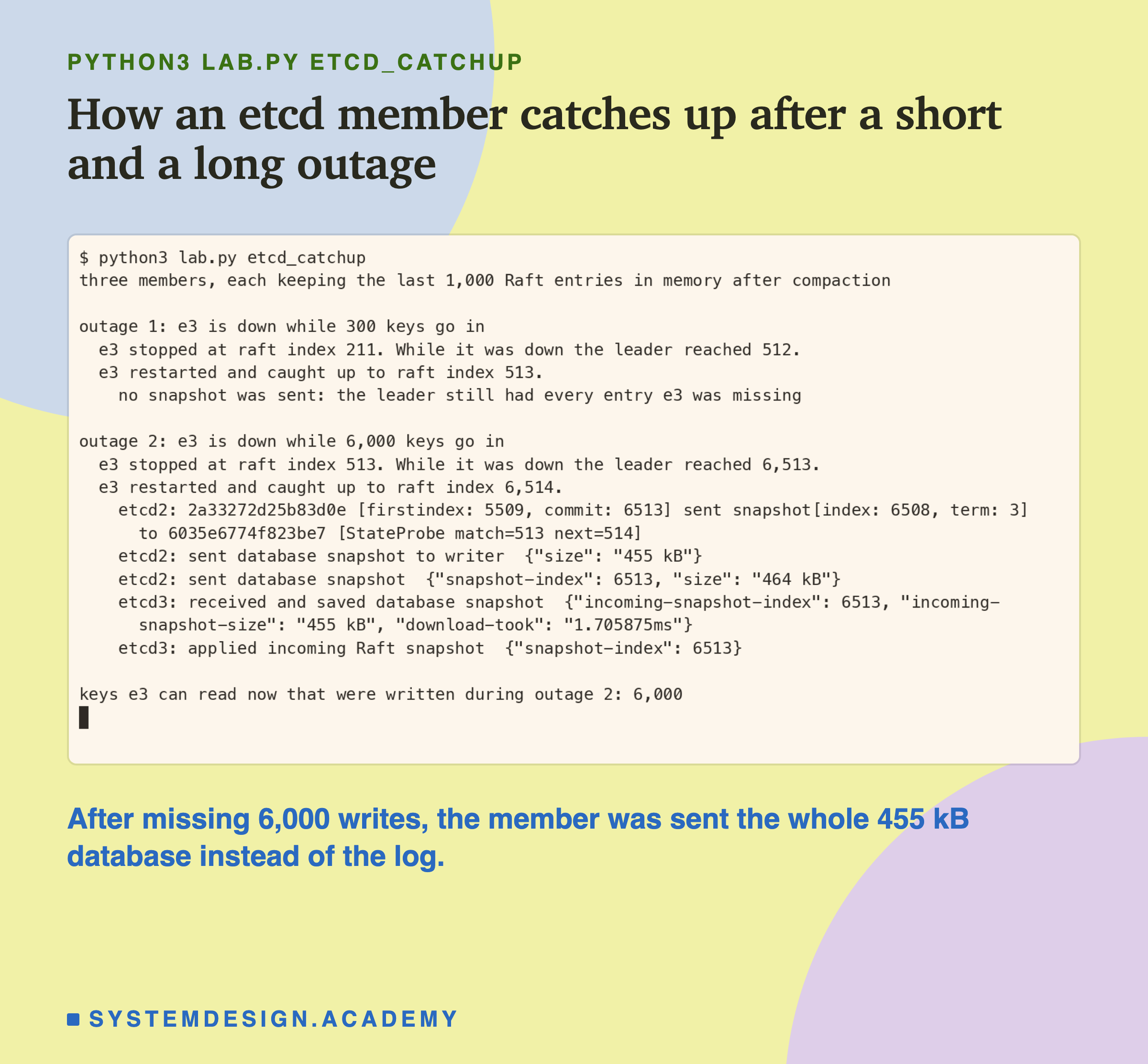
Yes. The snapshotting lesson runs a three member etcd cluster and takes one member down twice. After a short outage of 300 writes it catches up from the leader's log. After a long outage of 6,000 writes, the leader has already compacted the old entries, so it sends the member the whole database as a 455 kB snapshot instead. The figure below is that run.
This is the kind of detail a staff level interviewer probes: what happens to a replica that comes back after the log it needs is gone.
A real etcd cluster catching up after a short and a long outageWhen a member misses a few hundred writes, the leader replays its log. When it misses 6,000 and the log has been compacted, the leader sends the whole database instead. The snapshotting lesson shows both on a real etcd cluster.
Where the advanced chapters come together, and how to try them before you pay.
Are there full designs that use the advanced material?
Yes. After the Advanced level come 20 capstone designs, each taken from requirements to deep dives and trade-offs, with a design review quiz. The ones that lean hardest on the advanced chapters are the distributed key-value store, the multi-region deployment, the payment system and real-time analytics.
Yes. Once you buy, you can open any lesson in any order; nothing is locked behind an earlier level. If you are experienced, a sensible plan is to read the caching and replication lessons you are least sure of in the Foundation and Intermediate levels, then go straight to Distributed Systems Core and Consistency Models. The Senior and Staff learning path lays that order out week by week.
Can I try it before I pay, and how does buying work?
18 lessons of the course are free to read with no card. When you buy, you pay once and keep the whole course for life, all four levels, the capstones, and every lesson added later. There is no subscription. The price for your country is shown in the box near the top of this page and on the pricing page.
How load balancer failover works: two HAProxy nodes share one IP with keepalived and VRRP. A real lab measures the 3 s crash gap and backend health-check ejection.
Every answer on this page comes from our System Design course: 770 lessons on databases, caching, scaling, messaging and reliability, each drawn step by step. You learn why the answer is right, which is what an interviewer checks with the second question. 18 lessons are free to read, with no card needed.
These questions are a start. The interview asks more.
Get all 200 questions in the System Design and Distributed Systems pack
Each question has why it is asked, a full answer, what the interviewer listens for, the follow-ups, the common mistakes and a diagram (268 diagrams in all). A PDF you keep, junior to staff level.
Pay by UPI, cards or netbanking through Razorpay. Pay by card or PayPal, in US dollars. Download at once from My packs.
NEWSystem Design Hands-On
Included in the System Design course: real systems, built live
Postgres Sharding: Complete Hands-On (PgBouncer + Citus). 2 h 36 min and 20 chapters: one PostgreSQL loaded until it breaks, then four shards behind a router you write, PgBouncer and Citus, with the 139-page slide deck. The first 15 minutes are free to watch.