May we use cookies so Meta, Google, LinkedIn and ChatGPT see your visit and we learn which ads work? PrivacyMay we use cookies to see which pages help, and let Meta, Google, LinkedIn and ChatGPT see your visit, so we know which of our ads work? That way we spend less on ads that do not work. We do not sell your data, and the site works the same if you decline. You can change your answer at any time under Cookie settings at the foot of the page. Privacy policy
Loading...
System Design and AI Engineering, by Roni Das. 989 interactive lessons in two courses.: 770 in System Design and 219 in AI Engineering.
How to Prepare for a FAANG System Design Interview in 2 Months
How do I prepare for a FAANG system design interview in 2 months?
Spend weeks 1 to 3 on the building blocks (load balancers, caches, databases, sharding, queues), weeks 4 to 6 on whole designs said out loud on a timer, and weeks 7 and 8 on at least two mock interviews and fixing what they show. About an hour on weekdays and three hours at weekends is enough. Amazon says its final round has four 55-minute interviews with at least one system design question.
Save your progress and get the interview checklist PDF
System Design Interview Cheat Sheet: the 7 interview stages, the 10 points a scorecard grades, 12 classic systems. 18 pages. Free with an account.
This is the plan I give working engineers who have about two months before a system design round at a large tech company. It answers 11 questions in the order you will meet them, with a worked load estimate and the designs worth practising.
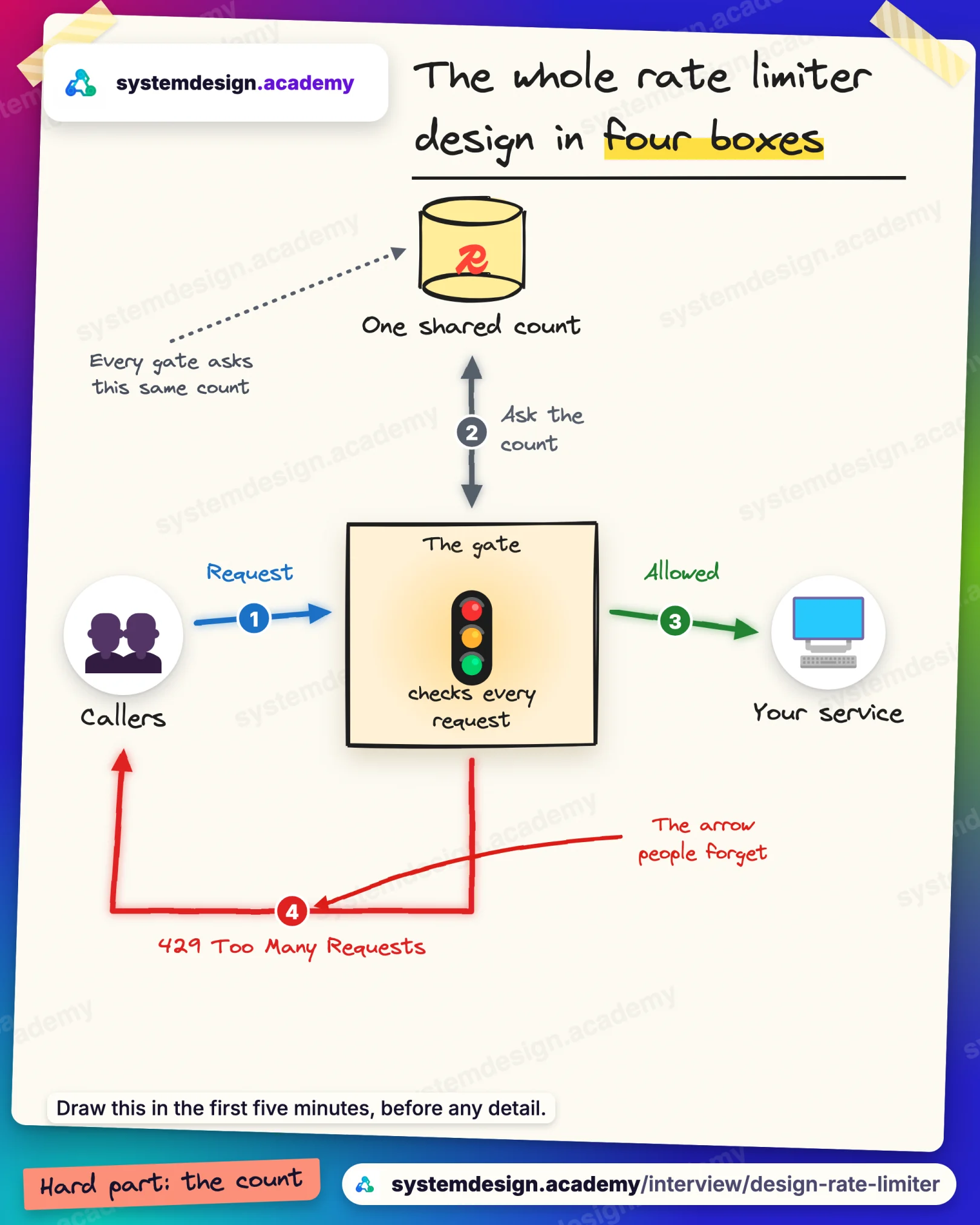
The first thing to practise: the whole design in four boxes, before any detailThis is the rate limiter from our walkthrough, drawn the way you would draw it in the first five minutes of an interview. Callers, a gate, one shared count and your service, plus the refusal that goes back. Two months of practice is mostly learning to draw this kind of picture quickly for any system, then to name its hard part.
The first thing to practise: the whole design in four boxes, before any detailThis is the rate limiter from our walkthrough, drawn the way you would draw it in the first five minutes of an interview. Callers, a gate, one shared count and your service, plus the refusal that goes back. Two months of practice is mostly learning to draw this kind of picture quickly for any system, then to name its hard part.
The idea in one line
A system design interview is a conversation about trade-offs, not a test of memory. So the plan is simple: learn what each part costs, practise saying whole designs out loud, and let someone else tell you where you lose points before the real interviewer does.
The two-month plan, week by week
About 50 hours in all. Each step stands on the one before it.
Weeks 1 to 3: the building blocks. Learn latency, load balancers, caching, indexes, replication, sharding, consistent hashing, queues and the CAP theorem, with one sentence on what each does and one on what it costs.
Weeks 4 to 6: whole designs out loud. Do one design every two or three days on a 45-minute timer: a URL shortener, a rate limiter, a chat app, a notification system, a ride-sharing app and one real company's system.
Week 7: the first mock interview. Take a mock interview with a person, read the report, and fix the two or three things it names.
Week 8: repair and a second mock. Redo your three hardest designs from a blank page, then take a second mock interview to check the fixes.
This page is the free part.
The course goes deeper on FAANG system design prep in 2 months
₹1,111 in India/$35 everywhere elseonce, for the whole course
The System Design course covers FAANG system design prep in 2 months across a run of lessons, not one page. These 4 alone are about 132 minutes of step-by-step reading, 1 of them with code you run in the browser, all with a quiz.
Cache-aside is said to degrade gracefully when the cache fails. Measured, unwrapped it answered 0.0 percent of requests, and wrapped it answered 13.0, which is exactly the database's capacity.
Before you plan, know what you are planning for. Only some large employers publish how the round works, so this part uses what they publish and nothing else.
What happens in a FAANG system design interview?
You are given a short, open problem, such as a URL shortener or a chat app, and about an hour. You ask what the system must do, estimate how much load it carries, draw a first design, and then improve it while the interviewer pushes on its weak points.
Amazon publishes the clearest description. Its guide for mid-level engineers (SDE II) says the final round is four interviews of 55 minutes each, and that you should expect at least one question on designing a software system. Wise says its design interview lasts about an hour, and that your reasoning matters most.
We could not read a published design round format from Google or Meta when we checked, so we do not describe theirs as if it were known.
Amazon's guide lists six objectives: practicality, accuracy, efficiency, reliability, optimization and scalability. It also says you should ask questions to complete and validate your design.
Read that second line twice. Asking questions is not a delay before the real work. It is part of what is judged.
Is two months enough to prepare for a FAANG system design interview?
For a working engineer who can give about an hour on weekdays and three hours at weekends, yes, if the time is spent in the right order. That is roughly 50 hours in eight weeks.
The order matters more than the hours. Three weeks on the building blocks, three weeks on whole designs said out loud, and two weeks of mock interviews and repair. Most people who run out of time spent too long reading and too little time talking.
Every large design is made of the same dozen parts. Learn what each part does and what it costs before you try a whole system.
What should I learn first?
Think of the parts like the kitchen of a restaurant. The load balancer is the host who seats guests at free tables. The cache is the counter of dishes already plated. The queue is the order slips waiting for a cook. The database is the store room, and sharding is splitting that store room across several buildings.
Learn them in this order: latency and throughput, load balancers, caching, database indexes, replication, sharding, consistent hashing, message queues, and the CAP theorem. For each one, be able to say one sentence on what it does and one on what it costs.
How do I estimate the load quickly in an interview?
Use round numbers and say each step out loud. Here is a worked example. Say a service has 10 million daily users and each makes 20 requests a day. That is 200 million requests a day.
A day has 86,400 seconds, so the average is 200,000,000 divided by 86,400, about 2,300 requests a second. Traffic is not flat, so assume the busiest hour runs at about three times the average: roughly 7,000 requests a second.
That one number decides a lot. A few thousand reads a second is easy for one database with a cache in front. Hundreds of thousands means you must split the data. The point is not the exact figure. It is showing that your design follows from the load.
Which small idea do strong candidates mention that others miss?
Idempotency: making an action safe to repeat. Networks fail, clients retry, and a payment or an order must not happen twice. A request key that the server remembers turns a retry into a harmless repeat.
Bring it up whenever money, orders or messages appear. It shows you have thought about failure, not only the happy path.
Now put the parts together. Do one design every two or three days, on a timer, talking as if the interviewer were in the room.
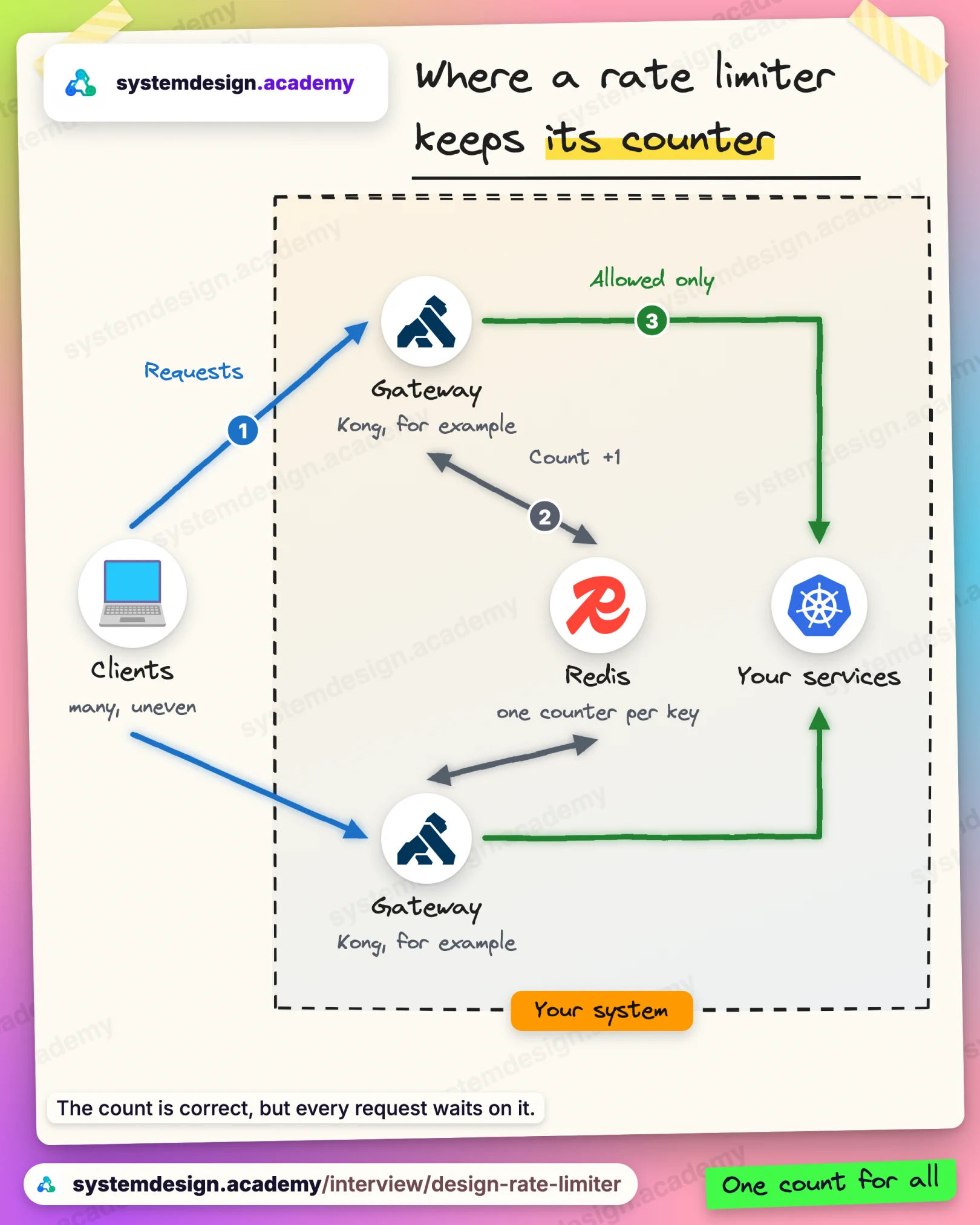
The same design one level deeper: where the counter lives, and what that choice costsThe second picture names the trade-off. Once there is more than one gateway, the count must live in a shared store, and that store now sits in front of every request. Saying the cost of your own choice out loud is what the interviewer is listening for.
Pick designs that each teach a different hard part. A URL shortener teaches unique IDs and read-heavy caching. A rate limiter teaches shared counters. A chat app teaches long-lived connections and message order. A notification system teaches queues and retries. A ride-sharing app teaches location search.
Then do one design built from a real company's own engineering writing, so you practise reasoning from facts rather than from memory. Our Google walkthrough, built from the published Zanzibar paper, is a good one.
Set a timer for 45 minutes. Spend the first five asking yourself the questions you would ask the interviewer and writing the answers down. Spend five on the estimate. Draw the simplest design that works in ten. Use the rest to find its weakest part and fix it, saying what each fix costs.
Record yourself, or explain it to a friend. Reading a design is not the same as giving one, and the gap only shows when you speak.
How do I talk about trade-offs without sounding vague?
Name both options, the one you chose, and the price. For example: "I will keep the counter in Redis rather than in each server's memory. The limit is then correct across the whole fleet, but every request now waits for one network call, and I need a plan for when Redis is down."
That one sentence covers the choice, the gain, the cost and the failure case. Interviewers listen for exactly that shape.
The last two weeks are for finding out what you still get wrong, and fixing it while there is time.
How many mock interviews should I do?
At least two with a person. One at the start of week 7 to find the gaps, and one in the last week to check you fixed them. An AI interviewer is useful for volume, but a person is better at telling you where you lost points and why.
We run 1:1 system design mock interviews with a written report, and the self-paced interview bootcamp includes two of them.
Stop learning new parts. Redo three designs you found hardest, from a blank page, on a timer. Revise your own notes and your estimation numbers. Sleep properly the night before, because a tired mind forgets to ask the first questions.
Cache-aside is said to degrade gracefully when the cache fails. Measured, unwrapped it answered 0.0 percent of requests, and wrapped it answered 13.0, which is exactly the database's capacity.
Every answer on this page comes from our System Design course: 770 lessons on databases, caching, scaling, messaging and reliability, each drawn step by step. You learn why the answer is right, which is what an interviewer checks with the second question. 18 lessons are free to read, with no card needed.
These questions are a start. The interview asks more.
Get all 200 questions in the System Design and Distributed Systems pack
Each question has why it is asked, a full answer, what the interviewer listens for, the follow-ups, the common mistakes and a diagram (268 diagrams in all). A PDF you keep, junior to staff level.
It covers the classic design questions with worked answers and diagrams, the same designs this plan practises.
Pay by UPI, cards or netbanking through Razorpay. Pay by card or PayPal, in US dollars. Download at once from My packs.
NEWSystem Design Hands-On
Included in the System Design course: real systems, built live
Postgres Sharding: Complete Hands-On (PgBouncer + Citus). 2 h 36 min and 20 chapters: one PostgreSQL loaded until it breaks, then four shards behind a router you write, PgBouncer and Citus, with the 139-page slide deck. The first 15 minutes are free to watch.