May we use cookies so Meta, Google, LinkedIn and ChatGPT see your visit and we learn which ads work? PrivacyMay we use cookies to see which pages help, and let Meta, Google, LinkedIn and ChatGPT see your visit, so we know which of our ads work? That way we spend less on ads that do not work. We do not sell your data, and the site works the same if you decline. You can change your answer at any time under Cookie settings at the foot of the page. Privacy policy
Loading...
System Design and AI Engineering, by Roni Das. 989 interactive lessons in two courses.: 770 in System Design and 219 in AI Engineering.
ByteByteGo vs Hello Interview: Which One Fits Your System Design Prep?
ByteByteGo or Hello Interview: which is better?
ByteByteGo is a large reading library built on the System Design Interview books, with illustrated case studies and coding, behavioural and ML courses in one yearly or lifetime plan. Hello Interview is built for the final weeks before an interview: a free guide, plus a Premium tier with breakdowns, videos and AI practice interviews. Pick Hello Interview when your interview is close; pick ByteByteGo when you have time and love detailed diagrams. Prices for both, with the date we read them, are in section 2.
Save your progress and get the interview checklist PDF
System Design Interview Cheat Sheet: the 7 interview stages, the 10 points a scorecard grades, 12 classic systems. 18 pages. Free with an account.
This page compares ByteByteGo and Hello Interview on price, content, practice and AI coverage, using facts read on each provider's own pages, in 10 short answers. It is written by systemdesign.academy, which makes a third option, so it says plainly where each of them is stronger than ours.
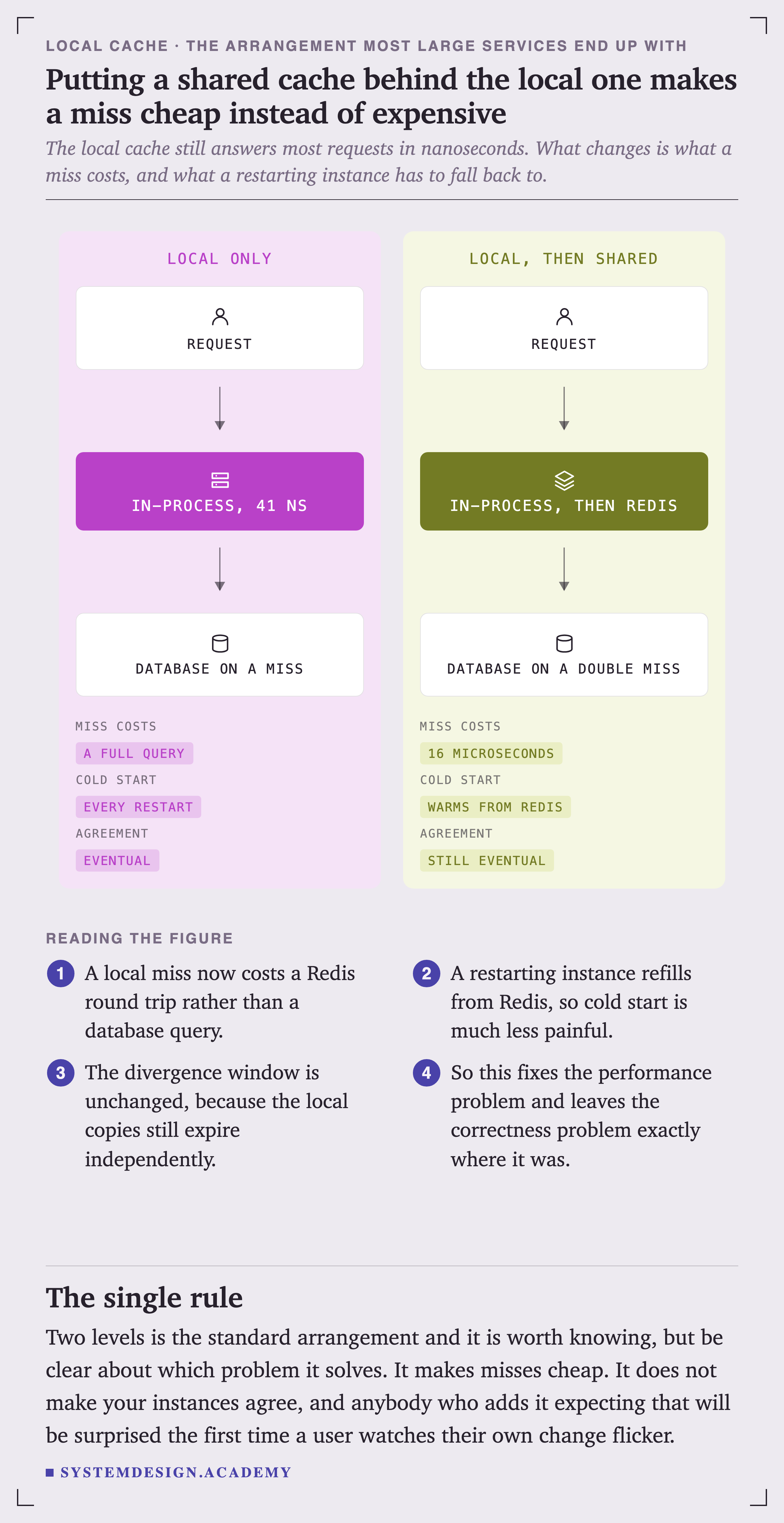
The third option on this page: a figure from a free lesson of oursByteByteGo is known for illustrated case studies and Hello Interview for interview breakdowns. This figure shows how our own course teaches instead: one idea at a time, with the measured cost under each design.
The third option on this page: a figure from a free lesson of oursByteByteGo is known for illustrated case studies and Hello Interview for interview breakdowns. This figure shows how our own course teaches instead: one idea at a time, with the measured cost under each design.
The short answer
Interview in a few weeks and you know the basics: read Hello Interview's free guide, then decide on Premium. More time and you learn from diagrams of real systems: ByteByteGo. Still learning the building blocks: start with a course that teaches them in order, and add either one at the end.
This page is the free part.
The course goes deeper on ByteByteGo vs Hello Interview
₹1,111 in India/$35 everywhere elseonce, for the whole course
The System Design course covers ByteByteGo vs Hello Interview across a run of lessons, not one page. These 4 alone are about 125 minutes of step-by-step reading, every one with a quiz.
What each one is, from its own pages, before any comparison.
What is ByteByteGo?
ByteByteGo is Alex Xu's learning site, from the author of the System Design Interview books. One plan opens 8 courses: System Design Interview, Coding Interview Patterns, Object-Oriented Design Interview, Behavioral Interview, Machine Learning System Design, Mobile System Design, Generative AI System Design and How to Write a Good Resume.
8 courses in one plan. The System Design Interview course lists 31 chapters (a foreword and 30 chapters), from scaling to millions of users, estimation and a framework to designs such as a rate limiter, chat, YouTube, Google Maps, S3-like object storage, a payment system and a stock exchange. Its format: book-based written chapters with many detailed diagrams.
Hello Interview is an interview prep site with a free system design guide, System Design in a Hurry, and a paid Premium tier. Premium adds 64 premium articles, 43 premium videos, 66 guided practice problems, more than 5,000 interview questions reported by candidates, an AI tutor and practice interviews with an AI interviewer.
64 premium articles and 43 premium videos. The premium list has 30 system design items, 12 low-level design, 16 coding, 9 behavioural, 20 AI coding and 8 code review. The core guide, System Design in a Hurry, is free.
ByteByteGo or Hello Interview: which is better for system design?
They are built for different moments. ByteByteGo is a library you read over weeks: long illustrated chapters based on the System Design Interview books, plus coding, object-oriented design, behavioural and machine learning courses in the same plan. Hello Interview is built for the last few weeks before an interview: short breakdowns of common questions, videos, and practice interviews with an AI interviewer.
If your interview is close and you know the basics, start with Hello Interview's free guide. If you have more time and learn best from detailed diagrams of real systems, ByteByteGo suits you better. Many people use one of them beside a longer course that teaches the building blocks in order.
2. Price, content and practice, side by side
Every number below was read on the provider's own page: ByteByteGo's prices on 9 November 2026 and its other facts on 15 November 2026, Hello Interview's prices on 9 November 2026 and its other facts on 15 November 2026. Prices change often and many were sale prices that day.
How much do ByteByteGo and Hello Interview cost?
ByteByteGo: $189 a year or $499 once for lifetime access in US prices, during a 50% off launch sale (list $399 and $999), on 9 November 2026. That one plan opens all of its courses.
Hello Interview Premium: $89 for a year, $47 for a month or $299 for lifetime access in US prices, shown as discounts from $119, $59 and $399, on 9 November 2026. Its page said the payment is one-time and never renews by itself. Much of Hello Interview's system design content is free without Premium.
Hello Interview, clearly. Yes: 66 guided practice problems with feedback after each step, quizzes, and practice interviews with an AI interviewer (1 with a month, 2 with a year, 10 with lifetime).
ByteByteGo is mostly reading: mostly reading. The plan includes Ask Alex, an assistant trained on the ByteByteGo books.
Which one covers AI and machine learning system design?
ByteByteGo: Machine Learning System Design and Generative AI System Design courses are included, and so is the Ask Alex assistant.
Hello Interview: An AI tutor that answers questions as you study, AI practice interviews with a written report, an AI coding section and a ChatGPT design breakdown.
Can I try either one for free?
Hello Interview, yes, and a lot of it. Much of it is. On 15 November 2026 System Design in a Hurry had 16 question breakdowns open to everyone, including Bitly, Dropbox, Ticketmaster, WhatsApp, YouTube and Uber, plus most core concepts and key technologies such as Redis, Kafka and Cassandra. Another 16 breakdowns, such as Google Docs and a payment system, and the whole Patterns section were marked as Premium.
ByteByteGo's courses, including the System Design Interview course, are sold inside its paid plan.
3. Who should pick which
Plain advice, including where neither is the best fit.
When is ByteByteGo the better pick?
Pick ByteByteGo if you already know the basics, love detailed diagrams, and want coding, design and behavioural prep in one plan.
The diagrams are some of the clearest in the field, and the authors' books are widely read.
One plan covers more than system design: coding patterns, object-oriented design, behavioural interviews, resume writing, mobile, ML and generative AI system design.
Pick Hello Interview if your interview is a few weeks away, you know the basics, and you want breakdowns, videos and AI practice interviews. Read its free guide either way.
Its core guide, System Design in a Hurry, is free, and the site keeps free content and videos beside Premium. That is a good place for anyone to start.
When you need the building blocks first. Both are strongest once you already know what a cache, a queue and a replica are for. If you are still learning those, or want system design for your day job as well as the interview, a long course that starts at the beginning will serve you better, with one of these two for the final weeks.
That is what our System Design course is: 770 lessons from latency and caching to consensus and reliability, 695 of them with a diagram that builds step by step, a quiz in every lesson, and an AI tutor beside each one. 18 lessons are free to read. It is ours, so weigh that; the price for your country is in the box at the top of this page.
Every answer on this page comes from our System Design course: 770 lessons on databases, caching, scaling, messaging and reliability, each drawn step by step. You learn why the answer is right, which is what an interviewer checks with the second question. 18 lessons are free to read, with no card needed.
These questions are a start. The interview asks more.
Get all 200 questions in the System Design and Distributed Systems pack
Each question has why it is asked, a full answer, what the interviewer listens for, the follow-ups, the common mistakes and a diagram (268 diagrams in all). A PDF you keep, junior to staff level.
Pay by UPI, cards or netbanking through Razorpay. Pay by card or PayPal, in US dollars. Download at once from My packs.
NEWSystem Design Hands-On
Included in the System Design course: real systems, built live
Postgres Sharding: Complete Hands-On (PgBouncer + Citus). 2 h 36 min and 20 chapters: one PostgreSQL loaded until it breaks, then four shards behind a router you write, PgBouncer and Citus, with the 139-page slide deck. The first 15 minutes are free to watch.