May we use cookies so Meta, Google, LinkedIn and ChatGPT see your visit and we learn which ads work? PrivacyMay we use cookies to see which pages help, and let Meta, Google, LinkedIn and ChatGPT see your visit, so we know which of our ads work? That way we spend less on ads that do not work. We do not sell your data, and the site works the same if you decline. You can change your answer at any time under Cookie settings at the foot of the page. Privacy policy
Loading...
System Design and AI Engineering, by Roni Das. 989 interactive lessons in two courses.: 770 in System Design and 219 in AI Engineering.
The Adyen System Design Interview: What Adyen Says, and How to Prepare
Does Adyen have a system design interview?
Adyen's careers FAQ lists six stages, including a skills assessment that is "either a technical skills test or a case study presentation" depending on the role. It does not name a system design round, so ask your recruiter. For backend roles, prepare the ideas Adyen's own engineers write about: idempotency keys, queued asynchronous APIs and very large PostgreSQL databases.
Save your progress and get the interview checklist PDF
System Design Interview Cheat Sheet: the 7 interview stages, the 10 points a scorecard grades, 12 classic systems. 18 pages. Free with an account.
This page sticks to what Adyen has published itself: the interview stages on its careers site, and what its engineers have written about the systems they run. Each part links to the source and to the lessons that teach the idea, in 7 short answers.
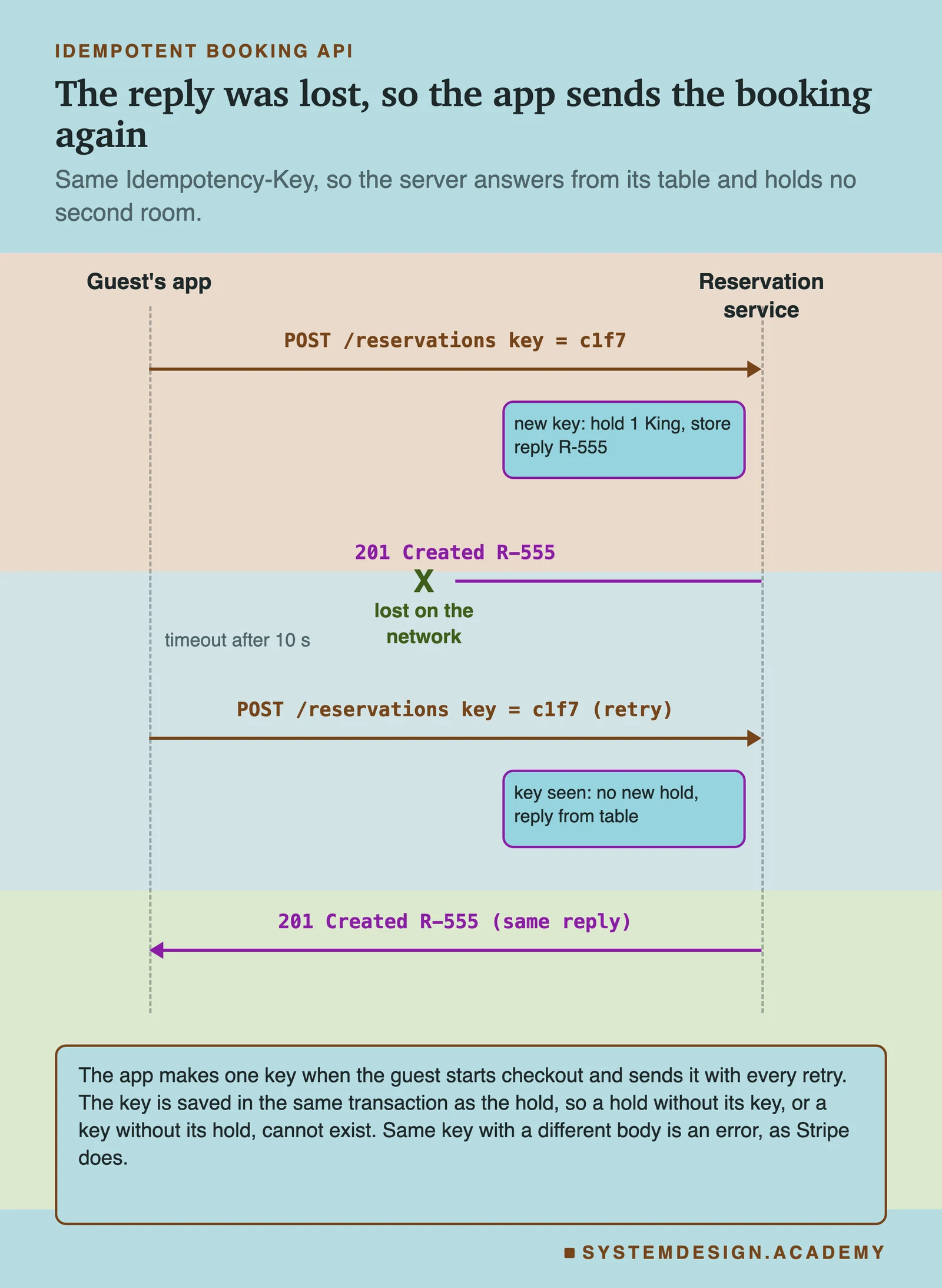
A retry with the same idempotency key gets the first answer back instead of a second charge or bookingA figure from our hotel reservation walkthrough. The client makes one key per action and sends it with every retry. The server stores the key with the result in the same transaction, so a retry after a lost reply returns the stored answer. Adyen's own API works on the same idea, as its documentation describes below.
A retry with the same idempotency key gets the first answer back instead of a second charge or bookingA figure from our hotel reservation walkthrough. The client makes one key per action and sends it with every retry. The server stores the key with the result in the same transaction, so a retry after a lost reply returns the stored answer. Adyen's own API works on the same idea, as its documentation describes below.
The short answer
Adyen does not publish a system design round, so ask what your skills assessment is. Then prepare the payments basics its engineers write about: idempotency keys, accepting a request now and finishing it later, ordering per account, and how large databases are replicated and upgraded.
This page is the free part.
The course goes deeper on system design
₹1,111 in India/$35 everywhere elseonce, for the whole course
The System Design course covers system design across a run of lessons, not one page. These 4 alone are about 80 minutes of step-by-step reading, every one with a quiz.
Asynchronous processing lets a system accept work now and finish it later, so nobody waits. Sync vs async side by side, common patterns, and the costs.
Start with what Adyen itself publishes. Everything in this section comes from Adyen's careers FAQ, linked under each answer.
What are the stages of the Adyen interview process?
Adyen's careers FAQ lists six stages. First an application review, with a reply within five business days. Then a recruiter screen, a team interview with someone from the hiring team, and a skills assessment. After that comes a leadership interview with a leader from the team you would join, and a final interview with a senior executive from the Management Board or the Global Leadership team.
Adyen says the whole process takes a little over a month on average, and that it varies by role. Interviews happen by phone, over Zoom or in person.
Adyen's FAQ does not name one. What it says is that the skills assessment is, depending on the role, "either a technical skills test or a case study presentation". Anything more specific you read online comes from candidates, not from Adyen, and teams differ.
So ask your recruiter early what the skills assessment is for your role. For backend and platform roles it is still sensible to prepare to explain a design out loud, because the systems Adyen's own engineers write about, described in the next section, are exactly the kind of thing a design discussion turns to: queues, retries, duplicate requests and very large databases.
2. What Adyen's engineers have written about their systems
Adyen publishes engineering articles and API documentation. Three of them teach ideas that every payments design needs, and each maps to lessons you can study.
What does "design for 20x" mean at Adyen?
In a 2020 article, an Adyen tech lead describes asking of every system: what if traffic doubles, grows ten times, or twenty times? The example is an API for merchants that first worked synchronously. Each request went straight to an internal application, so during database maintenance requests failed and merchants had to send them again.
Adyen changed it to asynchronous processing. The outer system checks the request, puts it on a local queue and answers at once with HTTP 202, which means "accepted, not done yet". A separate process feeds the queue to the internal system and can pause during maintenance. Merchants learn the final result from a webhook notification. Inside, requests are grouped by a key such as the account, so changes to one account run in the order they arrived while different accounts run in parallel.
Those three ideas, accept now and finish later, tell the caller the result by notification, and keep order per key, are worth being able to draw and explain.
How does Adyen's API stop a payment from being processed twice?
With an idempotency key. Adyen's documentation says a client can send an idempotency-key header of up to 64 characters (Adyen suggests a UUID). If the client gets no response, for example after a timeout, it sends the same request again with the same key. If the first attempt was already processed, Adyen returns the first response instead of doing the work again.
The documentation also covers the awkward cases. Keys stay valid for 7 to 14 days after the first request. If two requests with the same key arrive at the same time, one is processed and the other gets a transient error that is safe to retry. A duplicate sent while the first is still running gets error code 704, "request already processed or in progress".
This is the single most useful idea to understand before any payments interview. The figure at the top of this page shows the same pattern on a hotel booking.
How did Adyen upgrade a 50 TB PostgreSQL database?
A 2018 article by an Adyen system administrator says Adyen was running more than 5,000 PostgreSQL transactions per second across several clusters. The database had been under 10 TB in 2015, the upgrade in the article was 50 TB, and the largest cluster had reached 74 TB. Each cluster had one primary and at least three replicas across data centres.
The old upgrade method used logical replication and took days per upgrade, and it could not keep up with that size. The new method stopped traffic, upgraded the primary with a script in a few minutes, took storage snapshots of the primary and copied them to the replicas, then reopened the cluster only when at least two replicas were back and up to date. With preparation it took about a day per cluster, and the snapshots gave a way back if something went wrong.
The lesson for a design discussion is the trade-off itself: logical versus physical copies of a database, why replicas matter during maintenance, and why a plan to roll back counts as much as the plan to go forward.
These designs exercise the same ideas as the articles above. They are good practice, not a list of questions Adyen asks.
Which practice designs fit a payments company like Adyen?
Design a payment system first. It makes you deal with retries, duplicate requests, a ledger that must always balance and a final status that arrives later by webhook. Then design a hotel reservation system, which has the same double booking problem in a different setting. After both, the third is a distributed logging system, because a payments company has to keep a reliable record of every event.
Do each one out loud in about 45 minutes: requirements, a rough estimate of traffic, the API, the data model, the main diagram, then the two hardest parts in depth. Say the trade-offs as you choose them.
Week one: idempotency, idempotency keys, asynchronous processing, message queues and webhooks, in that order, because each one builds on the one before. Week two: replication, then the payment system walkthrough twice, the second time without looking.
The System Design course at systemdesign.academy holds all of these lessons, and its first lessons are free so you can check the style before you pay.
How is system design done in a real production system?
The answers on this page are the short version. The lessons below are the long one, with the trade-offs and failure cases, starting with "Asynchronous Processing".
The lessons that teach the next part
Asynchronous processing lets a system accept work now and finish it later, so nobody waits. Sync vs async side by side, common patterns, and the costs.
Every answer on this page comes from our System Design course: 770 lessons on databases, caching, scaling, messaging and reliability, each drawn step by step. You learn why the answer is right, which is what an interviewer checks with the second question. 18 lessons are free to read, with no card needed.
These questions are a start. The interview asks more.
Get all 200 questions in the System Design and Distributed Systems pack
Each question has why it is asked, a full answer, what the interviewer listens for, the follow-ups, the common mistakes and a diagram (268 diagrams in all). A PDF you keep, junior to staff level.
Pay by UPI, cards or netbanking through Razorpay. Pay by card or PayPal, in US dollars. Download at once from My packs.
NEWSystem Design Hands-On
Included in the System Design course: real systems, built live
Postgres Sharding: Complete Hands-On (PgBouncer + Citus). 2 h 36 min and 20 chapters: one PostgreSQL loaded until it breaks, then four shards behind a router you write, PgBouncer and Citus, with the 139-page slide deck. The first 15 minutes are free to watch.