May we use cookies so Meta, Google, LinkedIn and ChatGPT see your visit and we learn which ads work? PrivacyMay we use cookies to see which pages help, and let Meta, Google, LinkedIn and ChatGPT see your visit, so we know which of our ads work? That way we spend less on ads that do not work. We do not sell your data, and the site works the same if you decline. You can change your answer at any time under Cookie settings at the foot of the page. Privacy policy
Loading...
System Design and AI Engineering, by Roni Das. 989 interactive lessons in two courses.: 770 in System Design and 219 in AI Engineering.
The Booking.com System Design Interview: What Booking.com Says, and How to Prepare
Does Booking.com have a system design interview?
Booking.com's careers site describes a first call, then several rounds with your manager and teammates, with technical tests and coding interviews for some technical roles, over 3 to 6 weeks. It does not mention a system design round, so ask your recruiter. It does say the technical assessment is as much about communication as code, so practise explaining your reasoning step by step.
Save your progress and get the interview checklist PDF
System Design Interview Cheat Sheet: the 7 interview stages, the 10 points a scorecard grades, 12 classic systems. 18 pages. Free with an account.
This page sticks to what Booking.com and its engineers have published: the interview steps on its careers site, and how its experimentation platform protects users. Each part links to the source and to the lessons that teach the idea, in 7 short answers.
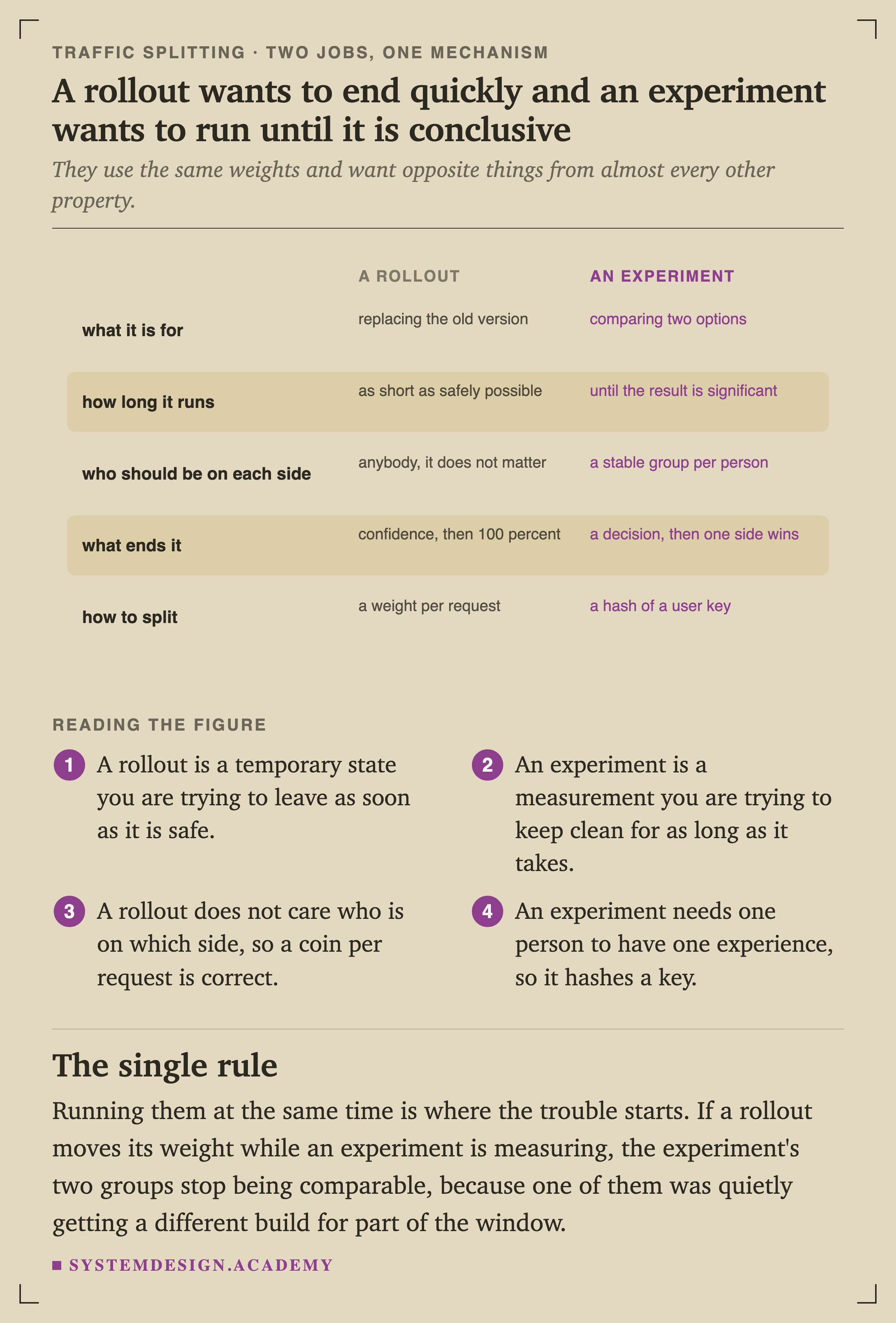
A rollout and an experiment use the same traffic split but want opposite thingsA figure from our traffic splitting lesson. An experiment needs each person to see one version for its whole run, so it splits by a hash of a user key, while a rollout can split each request at random. Booking.com is known for running a very large number of experiments, which is why this difference is worth knowing before you talk to its engineers.
A rollout and an experiment use the same traffic split but want opposite thingsA figure from our traffic splitting lesson. An experiment needs each person to see one version for its whole run, so it splits by a hash of a user key, while a rollout can split each request at random. Booking.com is known for running a very large number of experiments, which is why this difference is worth knowing before you talk to its engineers.
The short answer
Booking.com does not publish a system design round, so ask what each round covers. Practise explaining your reasoning out loud, then learn the ideas behind its experimentation culture: stable traffic splits, feature flags, canary releases and circuit breakers, plus the classic hotel reservation design.
This page is the free part.
The course goes deeper on system design
₹1,111 in India/$35 everywhere elseonce, for the whole course
The System Design course covers system design across a run of lessons, not one page. These 3 alone are about 81 minutes of step-by-step reading, every one with a quiz.
1. What Booking.com says about its interview process
Start with what Booking.com publishes on its own careers site, linked under each answer.
What are the stages of the Booking.com interview process?
Booking.com's careers site describes four steps. You apply, and the site says it uses AI to analyse your CV before recruiters review it. Then a first call about your experience and motivation. Then several rounds with your future manager, teammates and colleagues, which vary by department and seniority. Finally your recruiter collects feedback and gets back to you within a week.
The site says the whole process can take anywhere from 3 to 6 weeks, and that some technical roles add technical tests and coding interviews, which can make it a little longer.
The careers page does not mention one. It talks about technical tests and coding interviews for some technical roles, and it describes the technical assessment as "just as much a communication exercise": the interviewers want to hear how you reason through each step, and the page advises you to understand the problem you are trying to solve first.
That advice is also the core of any design discussion, so it is worth practising even if your rounds turn out to be mostly coding. Ask your recruiter what each round covers for your level. The page also says that new backend systems at Booking.com are written in Java by default, which is useful to know if you are choosing a language for coding rounds.
Booking.com's engineers have written publicly about how the company tests every change on real traffic. It is the clearest window into how they think about systems.
How does Booking.com stop a bad experiment within seconds?
A 2019 article by Iskra and Lukas Vermeer, about Booking.com's in-house experimentation platform, describes the company running hundreds of experiments at the same time on a daily basis. To protect users, the platform has a circuit breaker. For the first three minutes after a change goes live, it watches for severe errors and drops in key measures, and it stops the release automatically if it finds one.
The numbers are worth remembering. It tests for a real difference roughly four times per second, uses a very strict threshold to avoid false alarms, and counts unique visitors in batches of 36 seconds so it can do the work in memory. In one example it stopped an experiment within a second, because the new code caused errors for 47% of the users who reached it. The article says only one experiment had ever been stopped by mistake.
In a design discussion this is a good example of a trade-off said out loud: checking often means catching problems fast, but every extra check raises the chance of a false alarm, so the threshold has to be strict.
Why must an experiment split users by a stable key?
Because one person has to see one version for the whole experiment. If the same visitor saw version A on one page and version B on the next, the two groups would no longer be comparable and the result would mean nothing. So an experiment hashes a user key into a group, while a simple rollout can send each request either way at random.
The figure at the top of this page sets the two jobs side by side. Running both at once is where trouble starts: if a rollout changes its weights while an experiment is measuring, one group quietly gets a different build for part of the time.
What else does the Booking.com engineering blog cover?
Its index lists posts such as "Scaling our customer review system for peak traffic", "How We Built Automated Capacity Testing for Kafka Consumers", "Sequential Testing at Booking.com" and "Meta-experiments". We have only checked the titles, so read the posts themselves for the details.
The titles alone show the themes a Booking.com engineer deals with: traffic peaks, queues that must keep up, and careful measurement. Reading two or three posts before an interview gives you real examples to mention.
These designs exercise the ideas above. They are good practice, not a list of questions Booking.com asks.
Which practice designs fit a travel company like Booking.com?
Design a hotel reservation system first. It makes you deal with two guests trying to book the last room, a payment that is retried, and search that must stay fast while prices and availability change. Then design the system that runs experiments: how users are assigned to groups, how events are collected, and how a bad change is stopped quickly.
Do each one out loud in about 45 minutes, and keep explaining your reasoning as you go, since Booking.com's own page says the interviewers want to hear it.
Week one: traffic splitting, feature flags, A/B testing deployments, canary deployments and circuit breakers. Week two: the hotel reservation walkthrough, idempotency keys and caching, then the walkthrough again without looking.
The System Design course at systemdesign.academy holds all of these lessons, and its first lessons are free so you can check the style before you pay.
How is system design done in a real production system?
The answers on this page are the short version. The lessons below are the long one, with the trade-offs and failure cases, starting with "Circuit Breaker for Resilience".
The lessons that teach the next part
Stop calling failing services to prevent cascade failures, open, closed, and half-open states.
Every answer on this page comes from our System Design course: 770 lessons on databases, caching, scaling, messaging and reliability, each drawn step by step. You learn why the answer is right, which is what an interviewer checks with the second question. 18 lessons are free to read, with no card needed.
These questions are a start. The interview asks more.
Get all 200 questions in the System Design and Distributed Systems pack
Each question has why it is asked, a full answer, what the interviewer listens for, the follow-ups, the common mistakes and a diagram (268 diagrams in all). A PDF you keep, junior to staff level.
Pay by UPI, cards or netbanking through Razorpay. Pay by card or PayPal, in US dollars. Download at once from My packs.
NEWSystem Design Hands-On
Included in the System Design course: real systems, built live
Postgres Sharding: Complete Hands-On (PgBouncer + Citus). 2 h 36 min and 20 chapters: one PostgreSQL loaded until it breaks, then four shards behind a router you write, PgBouncer and Citus, with the 139-page slide deck. The first 15 minutes are free to watch.