Made by systemdesign.academy, the site with 984 interactive system design and AI engineering lessons.
See all 100 questions in this pack10 sections, in the order the PDF prints them. The answers are in the PDF; 5 are free below.
The FDE role (8)
1.What is a forward deployed engineer, in your own words? junior
2.How is an FDE different from a product software engineer, a solutions engineer and a consultant? junior
3.What does a typical week look like for an FDE? junior
4.How would you measure whether an FDE is doing a good job? mid
5.Why would a product company hire FDEs instead of just selling the software? mid
6.When do you write one-off code for a customer, and when do you push for a product feature instead? senior
7.You are on site with the customer's own engineers. How do you work with them so the deployment survives after you leave? mid
8.Why do you want to be a forward deployed engineer? junior
Scoping an ambiguous customer problem (10)
9.A customer says: "We want AI for our support team." What do you do in the first meeting? midfree below
10.How do you turn a customer's ask into a measurable outcome with a baseline? mid
11.How do you choose the scope of a 2 to 4 week pilot? mid
12.How do you map the stakeholders on a new enterprise account? mid
13.A hospital network asks you to reduce emergency department wait times. You have two weeks and access to their data. Break the problem down. mid
14.Before you promise anything, how do you check that the customer's data is actually available and usable? mid
15.When would you tell a customer that their problem should not use ML or an LLM at all? senior
16.How do you give a timeline when you do not yet know the customer's environment? staff
17.Walk me through the risk register you keep on a customer deployment. senior
18.The customer says success means "make it better". How do you turn that into acceptance criteria? junior
Technical discovery (9)
19.What questions do you ask on the first technical call with a customer? junior
20.What do you cover in security and compliance discovery for an AI deployment? senior
21.How do you find all the data sources a project needs, and who owns each one? junior
22.What do you need to learn about the customer's identity setup, and why? mid
23.The product must connect to systems inside the customer's network. How do you do network discovery? senior
24.How do you map the customer's current workflow end to end? junior
25.How do you pin down volume, latency and uptime requirements with real numbers? staff
26.How do you uncover hidden constraints, such as change freezes, procurement steps or a team that must approve? senior
27.How do you document discovery so another engineer can pick up the account without you? staff
Integrating with messy enterprise data (16)
28.Your integration needs to call a customer's API. When do you use the OAuth 2.0 client credentials grant, and when the authorization code grant? Whose identity does the access token carry in each case? mid
29.The customer's IT team asks: "When we remove someone in Okta or Entra ID, how fast do they lose access to your product?" How do you answer, and what is SCIM? mid
30.The customer wants single sign-on through their identity provider. Explain how a SAML sign-in and an OIDC sign-in work, what you must validate in each, and which you would offer. mid
31.The customer's admin offers you a global admin account "to save time". What do you ask for instead, and why? juniorfree below
32.You must pull 2 million records from a customer's SaaS REST API. It returns 100 records per page and allows 10 requests per second. How do you build the extractor? mid
33.What is the difference between ETL and ELT, and which would you choose when the customer already runs Snowflake? junior
34.Here is a CSV export of customer orders with mixed date formats, duplicate rows and amounts like "Rs 1,200.50". Write Python to clean it and load it so that re-running the load is safe. junior
35.The customer wants changes from their production Postgres in Snowflake within a few minutes, without heavy queries on production. How does change data capture work, and how would you set it up with Debezium? senior
36.You load the customer's orders table every hour with WHERE updated_at > last_watermark. A week later finance finds orders missing from your copy. What went wrong, and how do you fix it? senior
37.Your connector writes tickets into the customer's system. A request timed out, the connector retried, and now there are duplicate tickets. How do you make the writes safe to retry? midfree below
38.An upstream team renames a column and changes a type without telling anyone. Your pipeline either breaks at 2 a.m. or, worse, keeps running and fills the column with nulls. How do you design for schema drift? senior
39.Before customer data reaches the model, whether a RAG index (documents searched to answer questions) or a forecasting model, what data quality checks do you put in, and what happens when one fails? mid
40.The customer will not let traffic between your platform and their database cross the public internet. Compare VPC peering, AWS PrivateLink and site-to-site VPN. Which do you choose? senior
41.All outbound traffic at the customer goes through a corporate proxy that does TLS inspection. What breaks in your integration, and how do you make it work? senior
42.Where do your connector's credentials live inside the customer's environment, and how do you rotate them without downtime? mid
43.The customer's data lives in an on-prem data center. Their firewall allows no inbound connections, and they want the AI assistant to see changes within a minute. How do you get the data out, and can you use webhooks? staff
Debugging in the customer's environment (11)
44."It works in our cloud but not in theirs." Walk me through your method for finding out why. senior
45.You get access to an unfamiliar 50,000-line service at the customer and one failing integration test. Walk me through your first hour. mid
46.The customer's security team will not give you shell access to their servers. How do you debug a failing deployment? mid
47.You were given credentials for the customer's API, but every call returns 403 Forbidden. What do you check? junior
48.Your Python connector fails at the customer with "SSL: CERTIFICATE_VERIFY_FAILED, unable to get local issuer certificate", but curl on the same machine works. Why, and how do you fix it properly? mid
49.From your laptop the customer's API hostname resolves fine, but from your connector inside their VPC it fails to resolve or returns a different IP. Explain split-horizon DNS and private zones, and how you debug it. senior
50.The same request takes 2 seconds in your demo environment and 40 seconds at the customer. How do you find out why? mid
51.The connector works most of the time, but a few calls a day fail with "connection reset" or hang until timeout, usually the first call after a quiet period. What is going on, and how do you fix it? senior
52.The assistant's weekly revenue number does not match the customer's finance report. There are no errors anywhere. How do you find which number is wrong, and what usually causes it? staff
53.You are debugging for a hospital. You need logs, but they contain patient data and secrets. How do you collect what you need without creating a data breach? staff
54.You are in a live demo with the customer's VP when production starts failing for their real users. What do you do in the first 15 minutes? staff
Deploying an LLM solution into an enterprise (15)
55.Walk me through a reference architecture for an enterprise LLM assistant that answers employee questions from internal documents. mid
56.Support tickets contain names, phone numbers and account numbers. How do you handle PII before any text goes to an LLM? mid
57.The customer wants to fine-tune a model on 50,000 past tickets. When would you fine-tune, when would you use RAG, and when would better prompting be enough? mid
58.A customer asks whether to call the model vendor's API directly, use the same model through their cloud provider, or host an open-weight model themselves. How do you compare the three? junior
59.What are input and output guardrails in an LLM application? Give examples of each. junior
60.Our assistant reads customer emails and shared documents, and it can create Jira tickets and update Salesforce. How do you defend it against prompt injection? staff
61.In a RAG system over SharePoint and Confluence, how do you make sure a user never sees content from documents they are not allowed to open? senior
62.Before rolling out an LLM support assistant, how would you build the evaluation set, and how do you decide it is good enough to ship? mid
63.How do you measure hallucination, or groundedness, in a RAG assistant? senior
64.Describe a staged rollout plan for an LLM feature in a 2,000-person support organization. Where does the kill switch fit? senior
65.When should a human approve what the AI does, and how do you design that step so it does not become a bottleneck? mid
66.Estimate the monthly token cost of an internal assistant for 2,000 support agents. Show your arithmetic. mid
67.Give me a latency budget for one chat answer in a RAG assistant. Where does the time go, and what would you cut first? senior
68.The assistant is live. What do you monitor in production, and how do you notice quality slipping before users complain? senior
69.What should an audit log for an enterprise LLM application record, and how long should it be kept? mid
Writing a technical proposal (4)
70.What goes into a strong technical proposal for a customer? junior
71.Write the one-page executive summary for your proposal. What goes on it, and what stays off? senior
72.How do you present two or three options in a proposal so the customer can actually choose? staff
73.In a proposal, how do you write the risks section so the customer accepts the risks they own, and how do you price risk into the plan? senior
Pushback, communication and prioritization (8)
74.You present your integration design, and the customer's lead architect rejects it in the meeting. What do you do? mid
75.An executive at the customer says the system must be live in three weeks (15 working days). Your honest plan says 28 working days. What do you say? senior
76.How do you say no to a customer request without losing their trust? junior
77.Three customers all tell you their issue is urgent, and you can only work on one today. How do you prioritize? mid
78.When should you escalate a customer issue to the product or engineering team, and how do you do it well? senior
79.How would you explain a technical failure to a non-technical executive? junior
80.A change you made caused an outage at a customer site, and the customer is angry. Walk me through how you handle it. senior
81.You believe a customer need is important, but your own product team disagrees. How do you handle it? staff
Behavioral (STAR) (10)
82.Tell me about a time you deployed something users did not adopt at first. How did you drive adoption? staff
83.Tell me about a time you shipped something under real ambiguity. mid
84.Tell me about a time you failed, and what you changed afterward. junior
85.Tell me about a time you influenced a team you had no authority over. senior
86.Tell me about a time you had to learn a new technology fast to unblock a customer. junior
87.Tell me about a time you disagreed with a customer and turned out to be wrong. mid
88.Tell me about a time you chose speed over polish. What did it cost? mid
89.Tell me about a time you delivered bad news to a customer early. senior
90.Walk me through the most technically complex thing you have built and deployed. junior
91.Tell me about a time you built trust with a skeptical customer team. senior
Mini system-design cases (9)
92.The customer wants RAG over 10 million documents, all behind their firewall. Size it for me on the whiteboard. seniorfree below
93.Design an invoice extraction pipeline with human review for a finance team. mid
94.A support team on Zendesk wants an LLM assistant. How would you design it? mid
95.Analysts want to ask questions in plain English and get answers from Snowflake. Design text-to-SQL safely. senior
96.The customer streams fraud alerts into Kafka. Integrate them, in near real time, into their case management tool. senior
97.One deployment of your AI platform must serve 50 business units of the same enterprise. How do you design multi-tenancy? stafffree below
98.Design an agent that automates a back-office process, such as refund requests, with human approval steps. staff
99.A customer wants to move from a nightly batch export to near-real-time data without breaking the downstream reports. How do you do it? staff
100.A bank requires your platform to run inside its own AWS account, with no internet access from the cluster. How do you package, install, upgrade and support it? staff
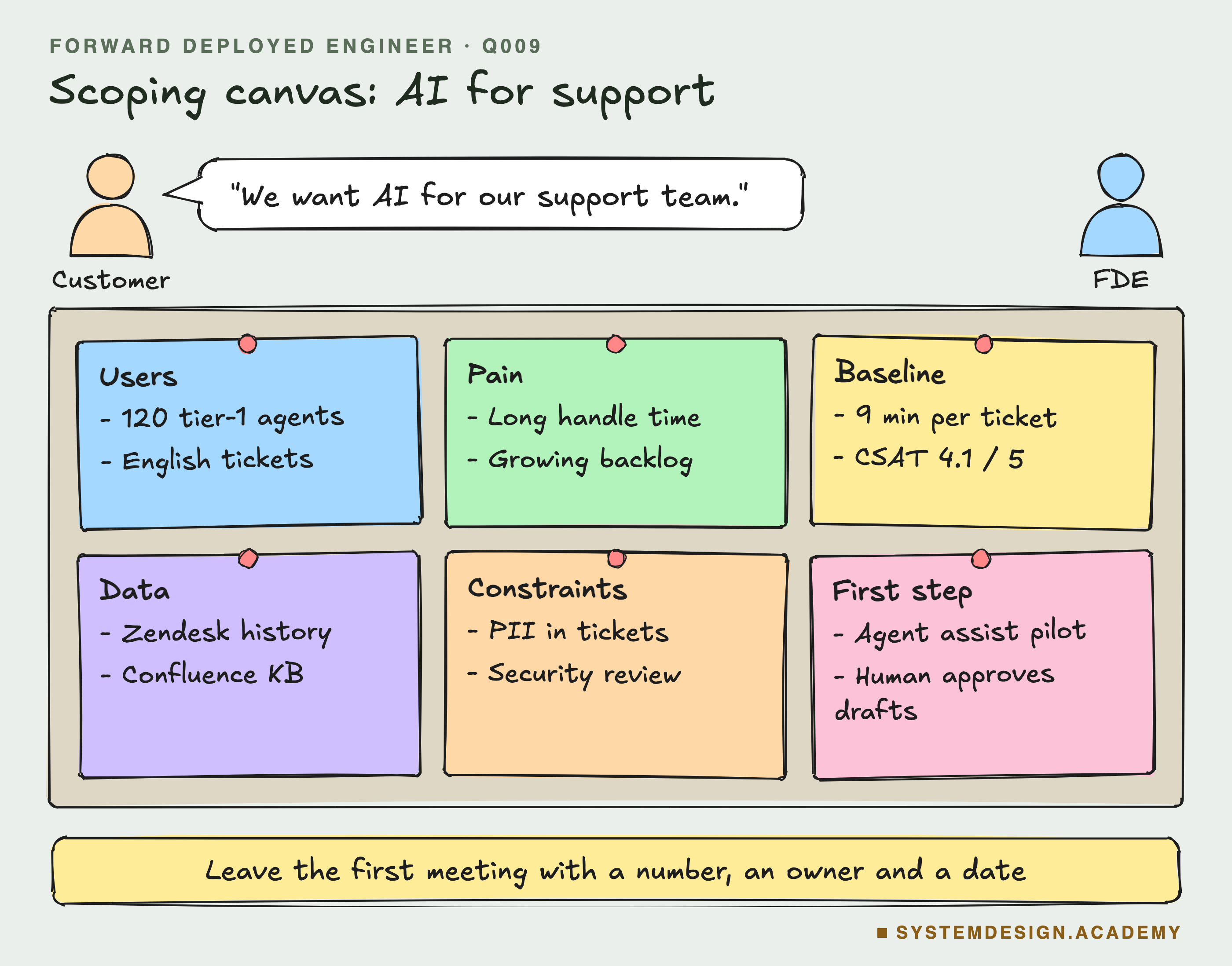
A scoping board of six sticky notes beside the customer and the FDE covering users, pain, baseline, data, constraints and an agent assist first step.
Why it is asked: This is the classic FDE scoping question. The interviewer checks that you ask before you build and that you end with a concrete next step.
In the first meeting I turn the vague ask into a specific problem, a number we want to move and a small first step, and I do not propose a solution yet.
I ask questions in six areas:
- Users: who exactly? For example 120 tier-1 agents (the first line who answer tickets), or customers helping themselves?
- Pain: where is time or money lost? Long handle time, a backlog, slow first response, too many escalations, or wrong answers?
- Workflow and tools: which help desk (Zendesk, Salesforce Service Cloud), and where knowledge lives (the knowledge base, or KB, in Confluence or SharePoint, and old tickets).
- Data: how many past tickets, which languages, how much personal data in them.
- Baseline: what are today's numbers, for example average handle time of 9 minutes and a customer satisfaction score (CSAT) of 4.1 out of 5?
- Constraints: security review, data location rules, budget, deadline and who signs.
Then I suggest two or three candidate use cases and rank them by value and risk: agent assist (the tool drafts a reply and a human agent approves every draft), ticket routing, or a customer-facing chatbot. I usually recommend starting with agent assist, because a human checks every answer, so a wrong draft costs a few seconds instead of a wrong promise to a customer.
I end the meeting with a one-page summary, a named owner on their side, a data access request and a date for the next session.
Several candidate use cases ranked by value and risk.
Prefers a human-in-the-loop start.
Leaves with an owner, a data request and a date.
Follow-ups the interviewer may ask
The CEO wants a customer-facing chatbot live in a month. Hint: show the risk, offer agent assist first as the path to a chatbot, with the eval data it creates.
They cannot give you any baseline numbers. Hint: measure it yourself from a ticket export in week one.
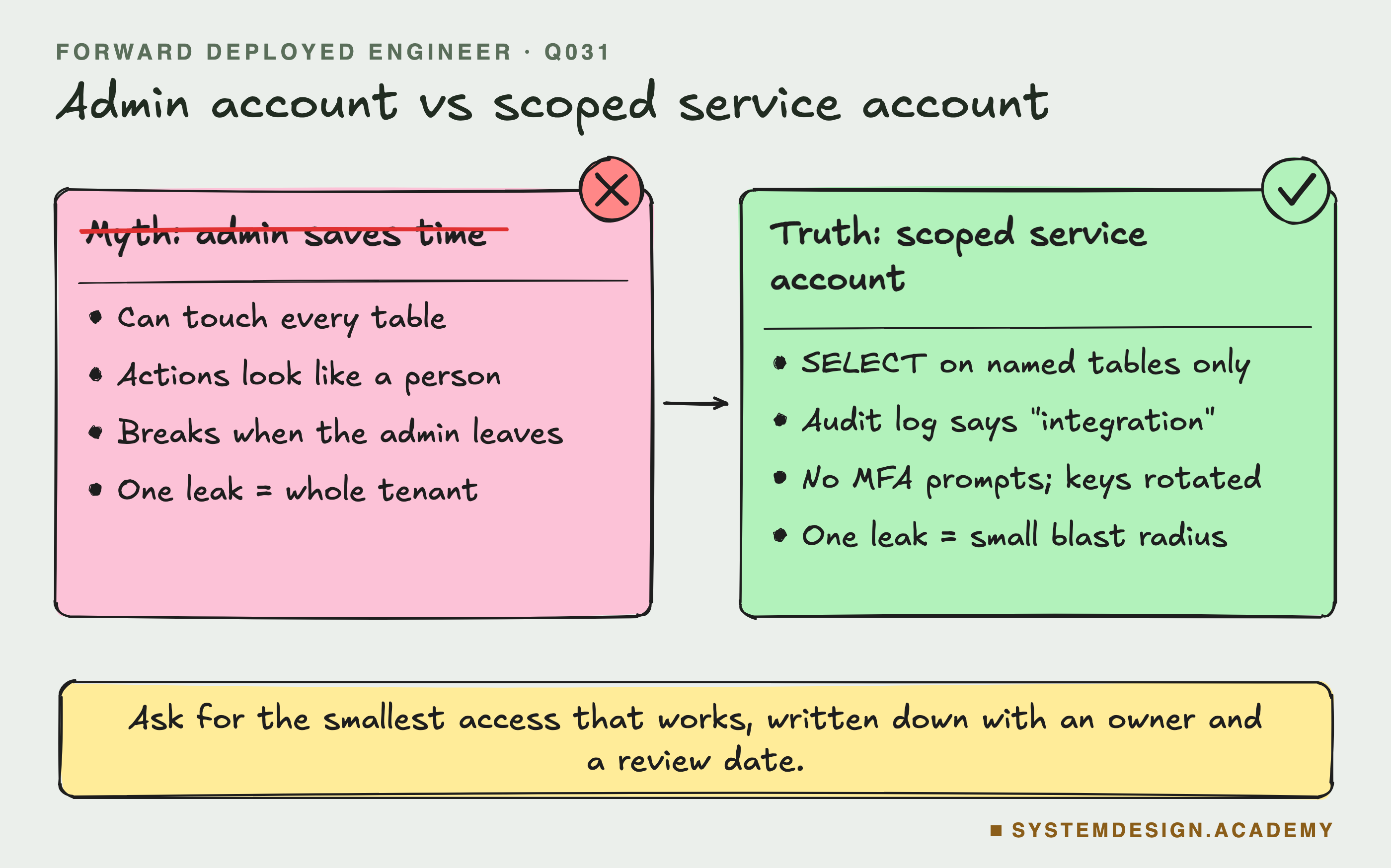
A hand-drawn myth versus truth comparison: the admin account panel is crossed out for its wide access and fragile audit trail, and the scoped service account panel is ticked for narrow grants and a small blast radius.
Why it is asked: This tests judgment and security hygiene. A good FDE turns down convenient but risky access and asks for something precise.
I thank them and ask for a dedicated service account with only the permissions the integration needs, on only the data it needs. A service account is a non-human identity used by one system. Least privilege means giving the smallest set of rights that still lets the job work.
Why not the admin account:
- Blast radius: if our credential leaks, an attacker gets the whole tenant (the customer's entire account), not three tables.
- Audit: every action looks like the admin did it, so nobody can tell our sync from a person.
- Fragility: human accounts get MFA prompts (second-step login codes), password expiry and get disabled when the person leaves, and then our sync breaks at night.
- Compliance: auditors flag shared human credentials.
What I ask for, concretely:
- Snowflake: a role with USAGE on one warehouse, database and schema, and SELECT on the named tables, granted to a user of TYPE = SERVICE with key-pair authentication (logging in with a private key file instead of a password).
- Postgres: a read-only role with SELECT on one schema, pointed at a read replica.
- AWS: an IAM role (a set of AWS permissions) our account can use, limited to one S3 bucket prefix.
I write the request as a short table: system, identity, permission, reason, owner, review date. Admins approve that quickly because it is easy to check, so it rarely costs time. If they insist on the admin account for a first test, I agree only for a sandbox, with an expiry date written down.
What the interviewer listens for
Ask for a dedicated, non-human service account.
Scope: only the systems, objects and actions the integration needs.
Reasons: blast radius, clean audit trail, no MFA or leaver breakage.
Put the request in a reviewable table with an owner and review date.
Follow-ups the interviewer may ask
The integration later needs write access to one table. What do you do? Hint: request a second, separate grant for that table only, with its reason.
How do you authenticate the service account without a password? Hint: key pairs, workload identity or OAuth client credentials, with keys stored in a secrets manager.
Who should own the service account? Hint: a named team on the customer side, so it is reviewed and not orphaned.
Common mistakes
Accepting admin access because it makes the first demo faster.
Sharing one service account across several integrations, so audit and revocation lose meaning.
Forgetting that a Snowflake role also needs USAGE on the warehouse, database and schema.
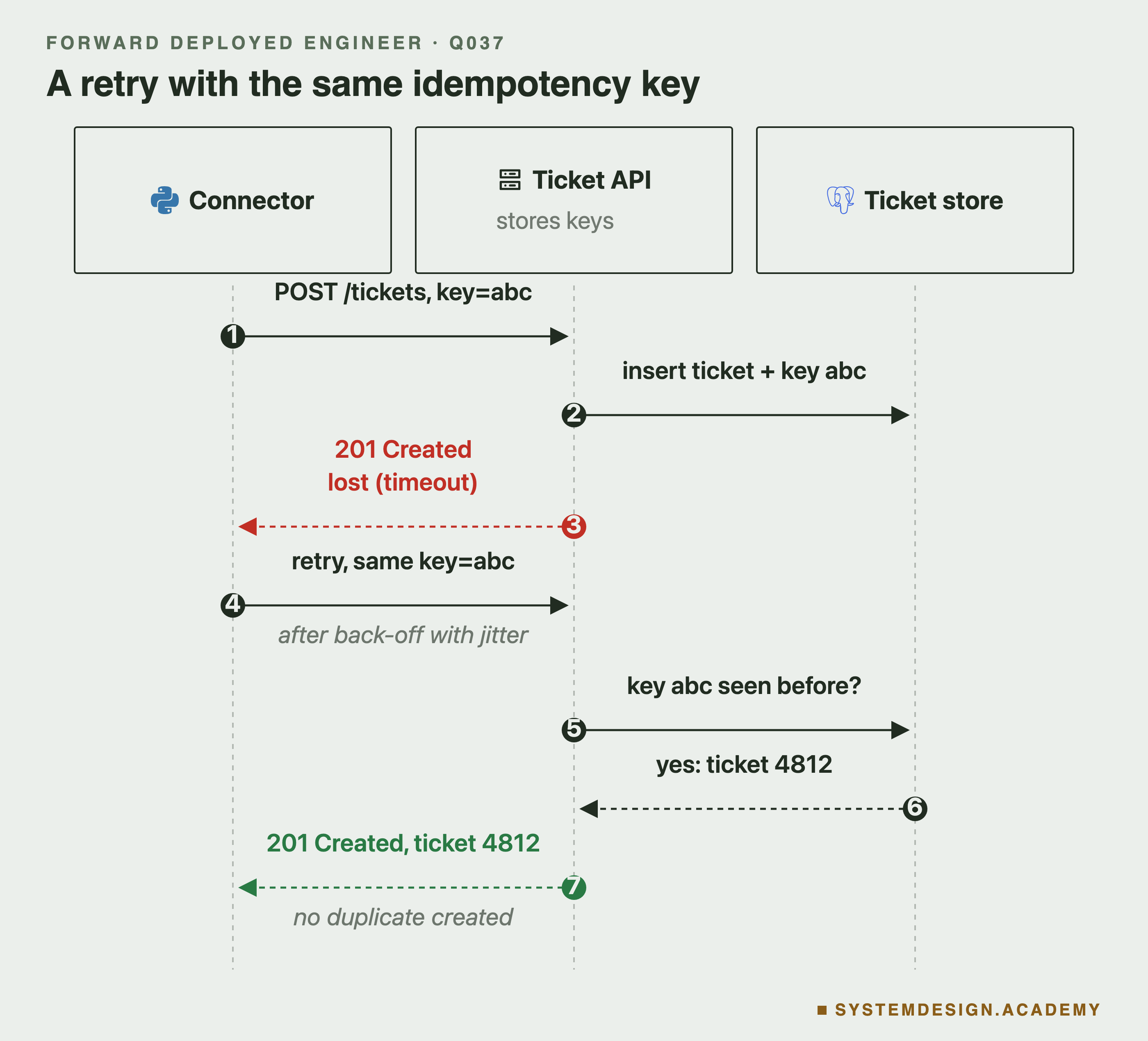
Sequence lifelines where the connector's first POST creates a ticket but the reply is lost, then the retry with the same idempotency key finds the stored key and returns the same ticket 4812 instead of creating a duplicate.
Why it is asked: Retries are unavoidable over enterprise networks. The interviewer checks that you know a timeout is not a failure and how idempotency fixes duplicates.
Make every write idempotent, which means doing it twice has the same effect as doing it once. A timeout does not mean the first request failed; often it succeeded and only the reply was lost.
Three ways, best first:
1. Idempotency key. Before the first attempt, create one key per logical operation, ideally derived from the source event ID, and send the same key on every retry, usually in an Idempotency-Key header (Stripe's API is the well-known example). The server stores key and result; a repeat returns the stored result instead of creating a new ticket. The key must not change between retries.
2. Upsert on a natural key. If we write to a database, put a unique constraint on the external ID and use INSERT ... ON CONFLICT in Postgres or MERGE in Snowflake. A repeat updates the same row.
3. If the target API supports neither, store our source ID in a custom field on the ticket, look it up before creating, and run a single writer per ticket so two workers cannot race between the lookup and the create. Keep our own ledger of what we wrote.
This is the usual pairing: delivery is at-least-once (messages can repeat), and the consumer is idempotent, so the outcome is as if each change happened exactly once.
I also add a guard against old data: only overwrite when the incoming updated_at is newer, so a late retry cannot replace a fresher status.
What the interviewer listens for
A timeout is unknown outcome, not failure.
Idempotency key fixed before the first attempt and reused on every retry.
Upsert on a unique external ID (ON CONFLICT / MERGE).
At-least-once delivery plus idempotent consumer gives exactly-once effect.
Guard against older data overwriting newer data.
Follow-ups the interviewer may ask
How long should the server keep idempotency keys? Hint: longer than your longest retry window, often 24 hours or more.
What if the same key arrives with a different body? Hint: reject it with an error; it signals a client bug.
How do you clean up the duplicates already created? Hint: group by source ID, keep the earliest, merge or close the rest with the customer's approval.
Common mistakes
Generating a new idempotency key on each retry.
Turning retries off, which turns duplicates into data loss.
Search-then-create with several parallel workers, which still races.
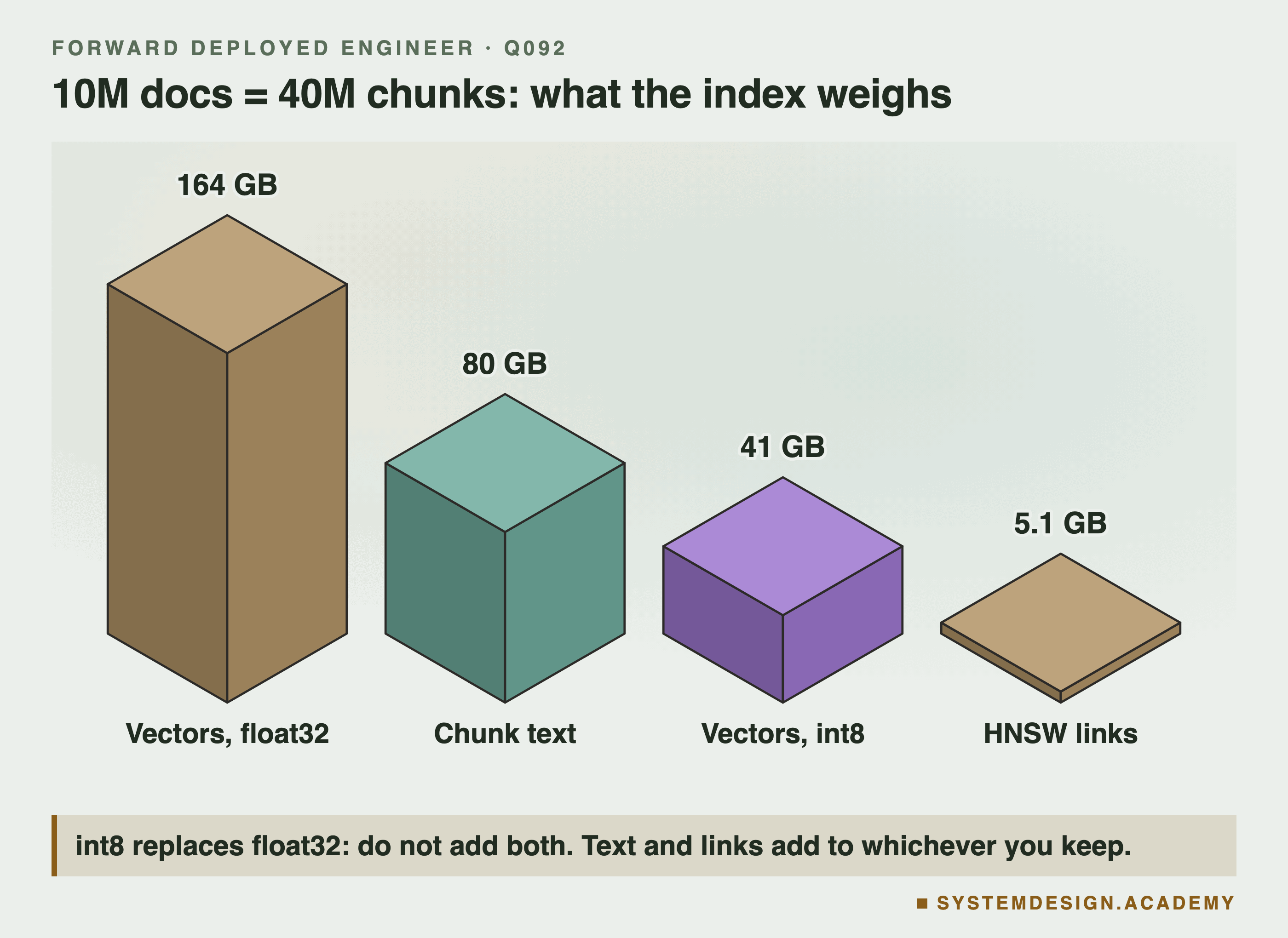
Isometric columns for 40 million chunks: 164 GB of float32 vectors, 80 GB of chunk text, 41 GB of int8 vectors and 5.1 GB of HNSW index links.
Why it is asked: A classic FDE case: can you turn a vague ask into numbers (chunks, storage, ingest time) quickly and correctly, and do you remember permissions and freshness, not just size?
I would run everything inside their network (self-hosted embedding model and vector database, plus an on-premises LLM or private endpoint), and size it first.
Assumptions: 2,000 tokens per document, 500-token chunks, 1,024-dimension embeddings, about 4 characters per token, and one GPU embedding 25,000 tokens per second. An embedding is a list of numbers (here 1,024) that stands for a chunk's meaning.
- Tokens: 10,000,000 × 2,000 = 20 billion.
- Chunks: 2,000 / 500 = 4 per document, so 40 million.
- Vectors in float32 (4 bytes per number): 40,000,000 × 1,024 × 4 = 163.84 GB, about 164 GB.
- With int8 quantization (each number squeezed to 1 byte, with a small loss of accuracy): 40.96 GB, about 41 GB.
- HNSW links (HNSW is a common graph index for fast search), 32 neighbors of 4 bytes per vector: 40,000,000 × 32 × 4 = 5.12 GB.
- Chunk text: 500 × 4 = 2,000 bytes, so 40,000,000 × 2,000 = 80 GB, on disk.
- Ingest: 20,000,000,000 / 25,000 = 800,000 seconds: about 222 hours (9.3 days) on one GPU, about 28 hours on 8.
So int8 vectors fit easily on one node; float32 vectors plus 5 GB of links need a large-memory node or two to three shards, leaving room for growth and re-indexing. Parsing and OCR (reading text from scanned pages) are often slower than embedding, so I time them on 1,000 real documents first.
Two design points matter as much as size:
- Permissions: store each document's access list with its chunks and filter every search by the user's groups.
- Freshness: re-embed only changed documents, found by modified dates or change events.
What the interviewer listens for
States assumptions before computing.
Correct chunk, storage and ingest arithmetic.
Quantization or sharding to fit memory.
Parsing and OCR are often the real bottleneck.
Permission filtering and incremental refresh.
Follow-ups the interviewer may ask
What if they need 3,072 dimensions? Hint: storage triples: 40M × 3,072 × 4 = 491.52 GB in float32.
How do you choose chunk size? Hint: test 300, 500 and 800 tokens on a labeled question set and measure retrieval recall.
Which LLM if nothing may leave the network? Hint: an open-weight model on their GPUs, sized for peak queries per second.
Common mistakes
Forgetting the 4 bytes per float32 number, or mixing up GB and GiB without saying so.
Sizing only the vectors and ignoring text, OCR and re-indexing.
Searching first and checking permissions afterward, which leaks snippets.
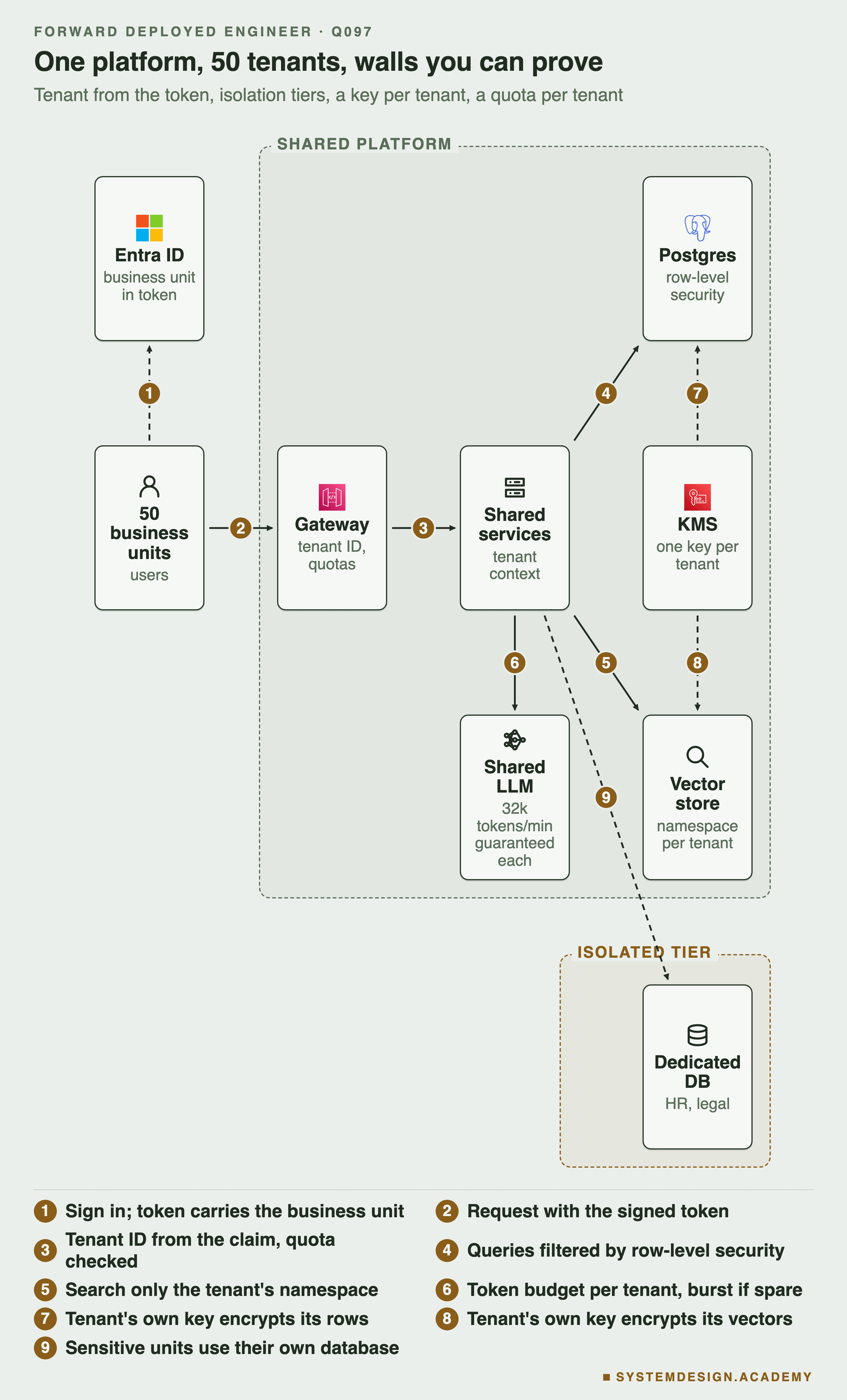
Architecture where 50 business units sign in through Entra ID, a gateway derives the tenant ID and applies quotas, shared services use row-level security, per-tenant vector namespaces, per-tenant LLM budgets and KMS keys, and sensitive units use a dedicated database.
Why it is asked: Large enterprises want one platform but strict separation between units. The interviewer checks tenant identity, data isolation tiers, encryption, fair quotas and how you prove isolation.
I would run one shared platform with strong logical isolation: a tenant ID from the identity provider on every request, data separated per tenant, a key per tenant, and quotas so no unit starves the others.
Identity: users sign in through Entra ID or Okta. The token carries the business unit as a claim (a field inside the token), and the gateway turns it into a tenant ID. Services never trust a tenant ID sent by the client.
Data isolation, in tiers:
- Default: shared Postgres with a tenant_id column and row-level security (the database itself hides other tenants' rows). The app connects as a role that does not own the tables, so the policy cannot be skipped.
- Sensitive units, such as HR or legal: their own schema or database.
- Vector search: a separate namespace (a walled-off section of the index) per tenant. Inside a tenant, per-user document permissions still use metadata filters, as in a permission-aware RAG design. The namespace is an extra wall between business units, so one missing filter cannot leak across tenants.
Encryption: one KMS key per tenant. Offboarding disables the key at once and schedules it for deletion after the agreed retention period, which makes the remaining data unreadable.
Quotas: per-tenant rate limits and token budgets at the gateway. If the shared LLM limit is 2,000,000 tokens per minute and we keep 20% headroom, 2,000,000 × 0.8 = 1,600,000 remain, so each of the 50 units gets a guaranteed 1,600,000 / 50 = 32,000 tokens per minute and can burst into spare capacity.
Operations: per-tenant metering and audit logs, and release tests that try to read tenant B's data as tenant A.
What the interviewer listens for
Tenant ID from the token, never from the client.
Isolation tiers: RLS, own schema or database, per-tenant vector namespace.
Per-tenant KMS keys.
Guaranteed quota plus burst, computed.
Cross-tenant access tests on every release.
Follow-ups the interviewer may ask
Why not one deployment per unit? Hint: 50 stacks to patch and run; reserve dedicated stacks for the few units that need them.
How do you handle a user in two units? Hint: the token lists both; the user picks one per session, and every request carries exactly one.
How do you bill units fairly? Hint: meter tokens, storage and requests per tenant and report them monthly.
Common mistakes
Taking the tenant ID from a request header the client controls.
One shared vector index across business units, walled only by a metadata filter.
No per-tenant quota, so one batch job starves 49 units.
Customer deep dives, scoping vague problems, integrations, debugging on site and deploying AI into enterprises.
100 questions and 127 diagrams, each with why it is asked, a full answer, what the interviewer listens for, follow-ups, common mistakes and a diagram. By Roni Das.