AI SOC Analyst Skills: What the Job Needs, Skill by Skill
What skills does an AI SOC analyst need?
An AI SOC analyst needs the analyst's skills first: reading Linux and Windows logs as evidence, telling real alerts from noise, the triage routine of look, enrich, decide and record, writing a clear incident ticket, and working a SIEM such as Wazuh. On top of those come the AI skills: knowing how an agent chooses its steps, giving it read-only tools, keeping a person's approval on every action, and checking its reasons against the raw logs. Some Python ties them together.
Save your progress and get the AI Engineering cheat sheet PDF
This page lists the skills an AI SOC analyst needs in 14 short answers, in the order you would learn them. Every lab fact on it comes from Hands-On AI SOC Analyst, recorded on the course's own security lab on AWS.

14 questions · 4 sections · answers from the course
These answers come from our course Hands-On AI SOC Analyst: Build AI Agents for Security Operations: 12 lessons are ready to study today, about 11 hours of learning, with 11 hands-on labs, 8 of them in your own security lab on AWS, and more than 150 diagrams and real screenshots. New lessons are added as they are finished, and you get every one.
The short version
Learn the job by hand, then let the agents speed it up. If you can read the log line behind an alert, triage it with the same four steps every time and write a ticket someone else can act on, you can judge an agent's answer. Without those skills, an agent's confident verdict is just a guess you cannot check.
If this helped, the full hands-on course goes much deeper.
In the course you build your own security lab on AWS, run a real attack against it, triage every alert by hand, and then build AI agents that investigate while you approve every action.
1. The short answer
An AI SOC analyst is a security operations analyst who works with AI agents: the agents read and summarise, and the analyst checks the evidence and decides. The skills are the analyst's skills first, then the AI skills on top.
What is an AI SOC analyst?
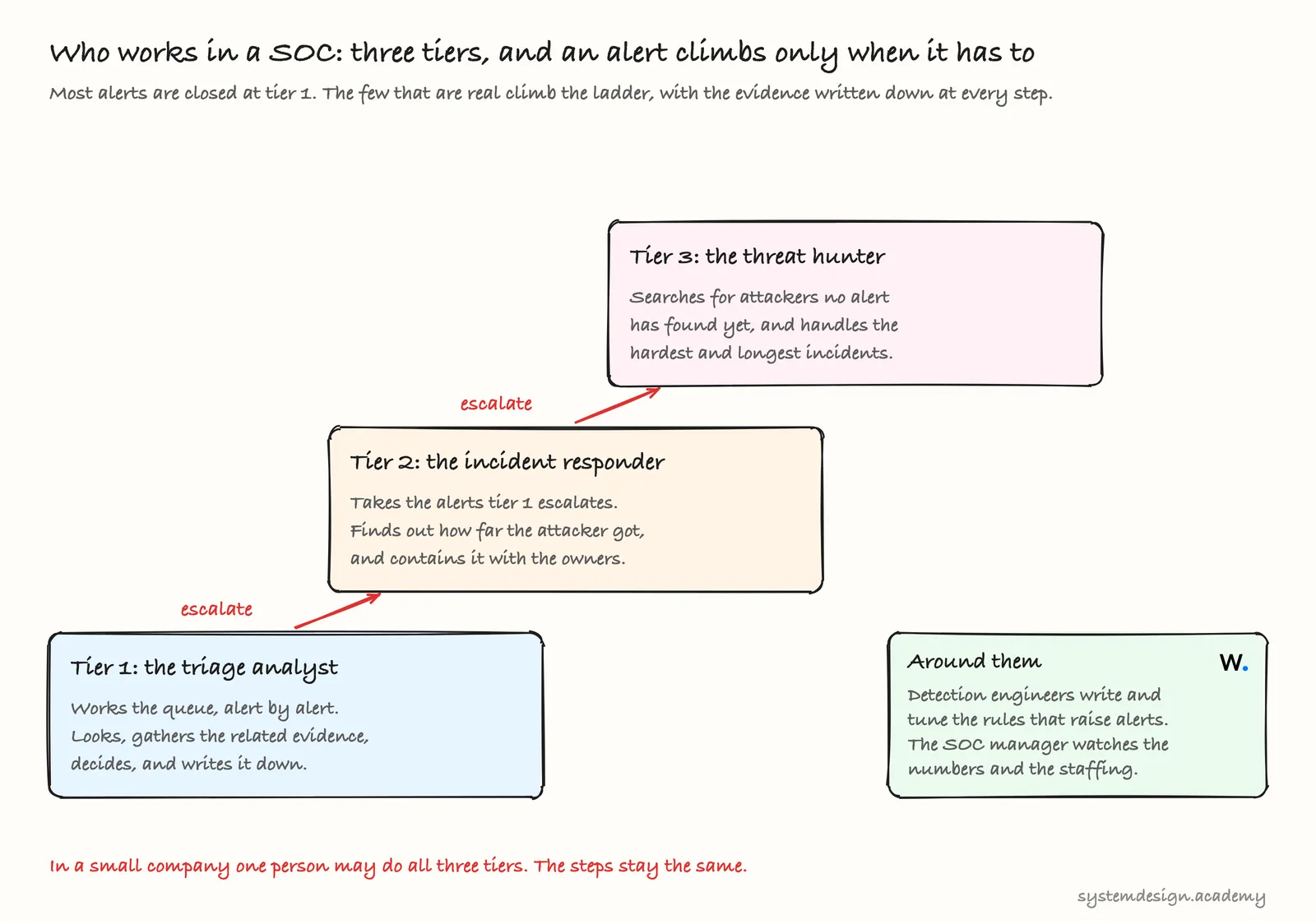
A SOC is a security operations centre, the team that watches a company's alerts and logs and responds to attacks. A SOC analyst decides, alert by alert, what each one is and what happens next. An AI SOC analyst does the same job with AI agents beside them: programs in which a language model chooses the next step of an investigation, such as searching every alert from one address, through tools your own code provides.
The job does not move to the agent. In the course's own lab, an agent investigated the attacker's alert with three read-only looks and called it malicious for $0.00046, and a person still decided what happened next.
What we measured: Course lab: an agent with three read-only tools investigated one alert in four model calls for $0.00046.
What skills does an AI SOC analyst need?
Six analyst skills: reading logs as evidence (Linux and Windows), telling a real alert from noise, placing an alert in the story of an attack, the triage routine of look, enrich, decide and record, writing an incident ticket the next person can act on, and working a SIEM, the system that collects logs and raises alerts.
Then the AI skills: knowing what an agent is and when it is the wrong tool, giving agents read-only tools and keeping a person's approval on every action, checking an agent's reasons against the raw evidence, and measuring an agent on many labelled alerts before trusting it. Some Python ties the two together.
Lesson: What a security operations centre does all day (free lesson)
Does an AI SOC analyst need to code?
Some, yes. You need to move around a terminal, search a log with grep, and read and change a short Python program, because the agents' tools are small Python functions and you must be able to see what each one can and cannot do. You do not need to be a software engineer.
You also do not need AI experience to start. The course explains what a language model really does before it builds any agent, and it explains every security idea from zero.
Lesson: Before you start, and building your lab (free lesson)
2. The analyst skills an agent cannot replace
These are the skills you use to judge an agent's answer. Each one is taught by hand in the course, on a real attack against your own lab, before any tool does it for you.
Why is reading logs by hand still a core skill?
Because every alert is a claim about a log line, and you can only check the claim if you can read the line. On Ubuntu, failed SSH logins are in /var/log/auth.log, and grep "Failed password" finds them. But rsyslog folds identical lines into one "message repeated" line, so a plain count can be wrong.
In the course lab, the plain count gave 9 lines and the true number of failed passwords was 11. An analyst who knows that checks the folded lines; an agent that only counts does not.
What we measured: Course lab, Ubuntu auth.log: grep counted 9 lines for 11 real failed passwords, because of folded "message repeated" lines.
Which Windows event IDs should a SOC analyst know first?
Five: 4624 (a successful logon), 4625 (a failed logon, with a status code that says why), 4688 (a new process, which Windows does not record unless you turn on the audit policy), and Sysmon events 1 (a program start, with the file's hashes) and 3 (a network connection).
In the course lab, three password guesses over Remote Desktop left two 4625 events and one 4624, all logon type 3 from the attacker's address, because Network Level Authentication checks the password as a network logon before any desktop appears.
What we measured: Course lab, Windows Server: three Remote Desktop guesses left two 4625 and one 4624, all logon type 3.
How does an analyst tell a real alert from noise?
By knowing the words. A false positive is an alert that is wrong about what happened. A benign true positive is right about what happened, and what happened was harmless: in the lab, "sshd: authentication failed" fired for the administrator's typo. A false negative is a real attack that raised no alarm.
That last one matters most. In the lab, an attacker who logged in with a stolen password at the first try raised 5 alerts, all at level 3, which Wazuh calls successful or authorised events. Nothing said "attack". A quiet SIEM is not the same as a safe one.
What we measured: Course lab: a login with a stolen password at the first try raised 5 alerts, all at Wazuh level 3.
What is the triage routine, and why does it matter with AI?
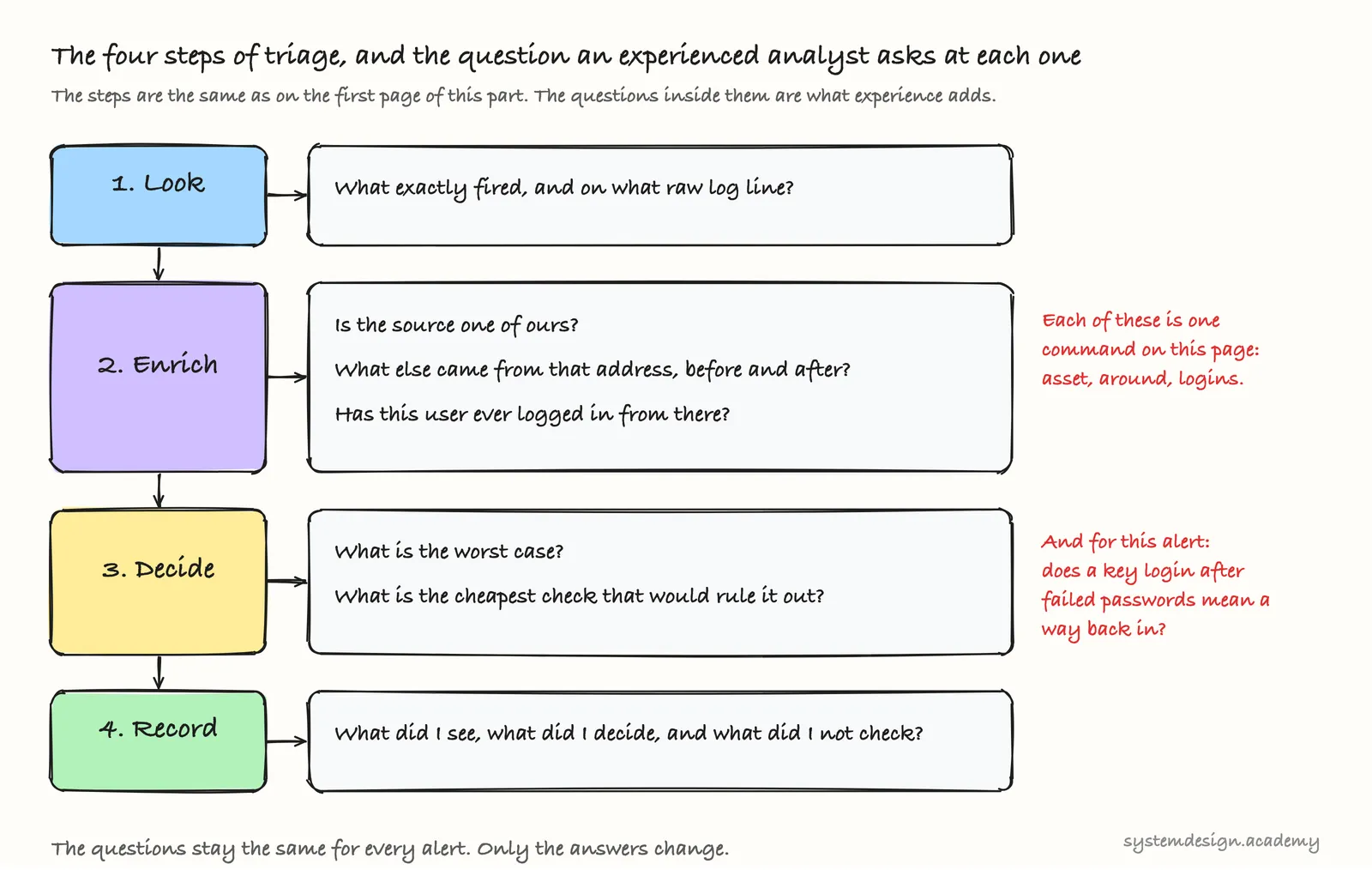
Triage is deciding, for each alert, whether to close it, check more or escalate it, with the same four steps every time: look at the alert and its raw log line, enrich it with the facts around it, decide, and record the decision with its evidence.
In the course's introduction, one password-guessing attack raised 17 alerts from the attacker's address in about 36 seconds. In the triage lesson, enrichment showed the alerting address was not on the asset list, had raised 43 alerts in the 10 minutes before, and had logged in 10 times. An agent can run those look-ups; you need the routine to know which ones it skipped.
What we measured: Course lab, 13 November 2026: 10 wrong passwords, then the right one, in about 36 seconds; 17 alerts from the attacker's address.
Why is writing an incident ticket a skill?
Because the next analyst acts on it, often at night, without asking you. A good ticket has a short summary, a severity with its reason, a timeline in UTC, the evidence (alert IDs and raw log lines), the impact, what was already done, and the next steps with an owner each. NIST SP 800-61 Rev. 3 asks incident records to track the same things.
Times belong in UTC because logs are in UTC. In the course example the writer's clock in India said 18:16, while the successful login in UTC was at 12:46:38, five and a half hours away from where a reader would search.
If this helped, the full hands-on course goes much deeper.
In the course you build your own security lab on AWS, run a real attack against it, triage every alert by hand, and then build AI agents that investigate while you approve every action.
3. The AI skills on top
Once you can do the work by hand, these are the skills that make agents useful and safe in a SOC.
What should an analyst know about how AI agents work?
The difference between a workflow and an agent. In a workflow, your code chooses the steps in advance and asks the model once at the end. In an agent, the model chooses each next step from what it has found so far, in a loop, until it gives a verdict or hits a limit.
In the course's run, the workflow ran its three fixed looks for one model call, and the agent chose a different set of three looks over four calls. All five runs on that lesson cost $0.00104 together on a small model. Cheap is not the same as right, which is the next skill.
What we measured: Course run: workflow, 3 fixed looks and 1 model call; agent, 3 looks of its own choosing over 4 calls; 5 runs cost $0.00104 in all.
Why must an AI SOC analyst check the agent's reasons?
Because agents are confidently wrong sometimes, and the logs they read can be written by the attacker. In the course's run, the workflow said a new account "overlaps" with the attacker's login although the account was created 93 seconds earlier, and the agent never looked at the timing at all.
So the habit is the same as with a junior colleague's note: read the reasons, open the raw lines they cite, and look for the check they did not make. The course later attacks its own agent with a poisoned log line to show why.
Should an AI agent be allowed to block an attacker on its own?
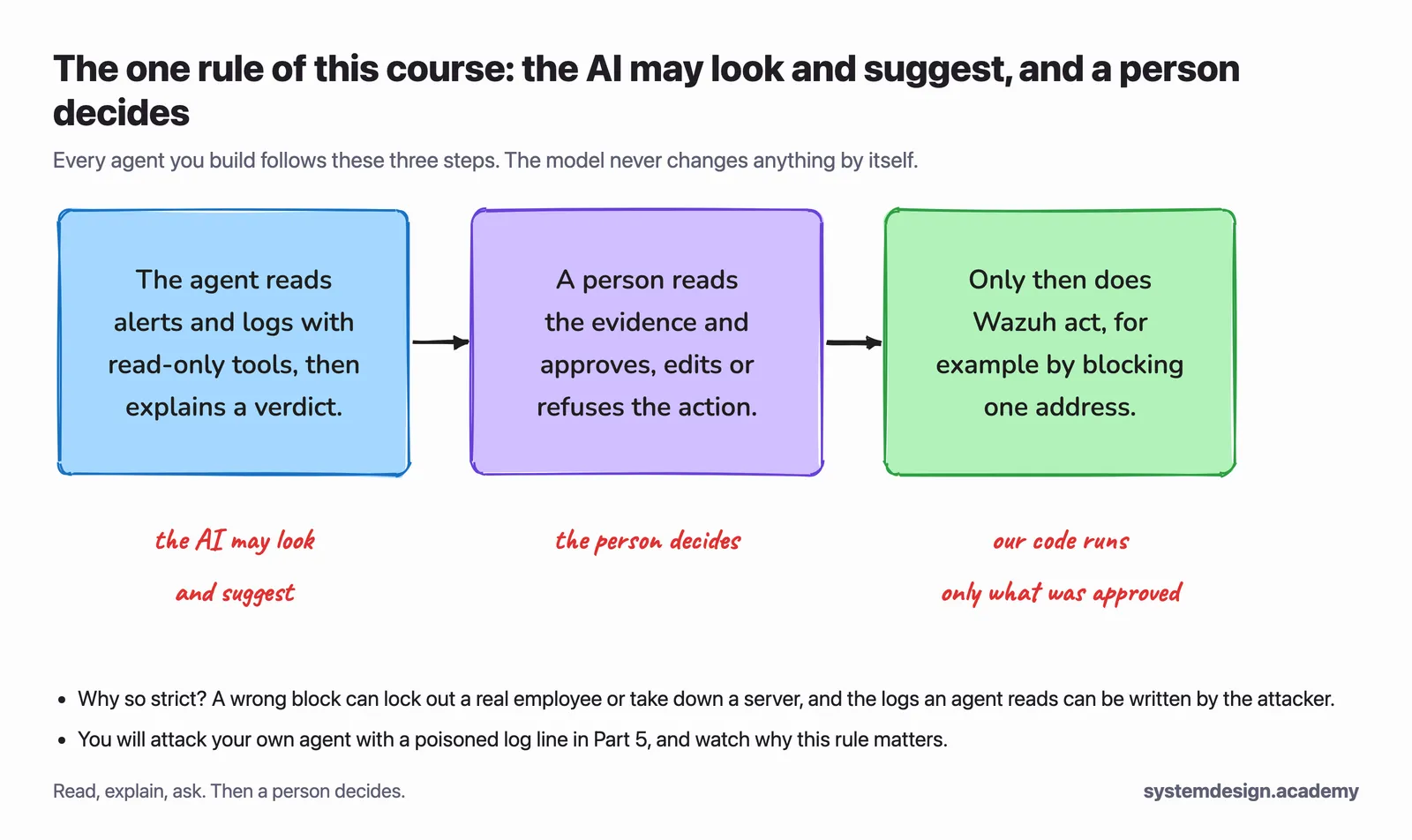
Not without a person's approval. A wrong block can lock out a real employee or take down a server. The safe design gives the agent read-only tools for looking, and makes every action that changes something, such as blocking an address, a proposal that waits until a person approves, edits or refuses it.
Designing that boundary, which tools an agent gets and what needs a signature, is one of the AI SOC analyst's real skills. In the course it is the one rule every later part keeps.
Which skills does the course teach later, and are they ready?
The plan continues with Wazuh hands-on and your own detection rules; MITRE ATT&CK, Sigma rules and detections kept in Git; threat intelligence and hunting by hand; vulnerabilities and the software supply chain (CVE, CVSS, EPSS, KEV and SBOMs); a team of agents that triage, enrich, hunt and report with a person approving; attack graphs in Neo4j; and measuring agents on labelled alerts, with a red team against your own agents.
Those parts are still being written, and we do not promise dates. Today 12 lessons are ready of 77 planned, about 11 hours of learning with 11 hands-on labs. The contents page always shows which lessons are ready.
Full walkthrough: The full contents, with each lesson's status
4. How to learn the skills
A practical order, and where to practise without touching anyone's real network.
In what order should I learn AI SOC analyst skills?
Learn the job by hand first, then add the agents. Start with what a SOC does and how the tiers work, then logs as evidence, alerts and noise, how an attack unfolds, the triage routine and the incident ticket. Then learn a SIEM and detection rules. Only then build agents, because you can only judge an agent's triage if you can triage yourself.
That is the order Hands-On AI SOC Analyst follows, and the order of the questions on this page.
Full walkthrough: The full contents, with each lesson's status
Where can I practise SOC skills safely?
On a lab you own. The course's free lesson "Before you start" builds one in your own AWS account: a Wazuh server, an Ubuntu practice server that gets attacked, an administrator's computer that does ordinary work, a Kali machine that attacks, and a small NAT machine, in a private network with no open port to the internet. A Windows server with Sysmon can be added, and one command removes the whole lab.
Attacking only machines you own is the rule. Never run an attack tool against a network you do not have written permission to test.
Lesson: Before you start, and building your lab (free lesson)
Where to go next
If this helped, the full hands-on course goes much deeper.
In the course you build your own security lab on AWS, run a real attack against it, triage every alert by hand, and then build AI agents that investigate while you approve every action.
Everything on this page comes from Hands-On AI SOC Analyst: Build AI Agents for Security Operations. 12 lessons are ready to study today, about 11 hours of learning, with 11 hands-on labs, 8 of them in your own security lab on AWS, and more than 150 diagrams and real screenshots. New lessons are added as they are finished, and you get every one. Start with the free lessons before you decide.

These questions are a start. The interview asks more.
Get all 120 questions in the Agentic AI Engineering pack
Each question has why it is asked, a full answer, what the interviewer listens for, the follow-ups, the common mistakes and a diagram (153 diagrams in all). A PDF you keep, junior to staff level.
Pay by UPI, cards or netbanking through Razorpay. Pay by card or PayPal, in US dollars. Download at once from My packs.