System Design Interview Bootcamp: What Each Recorded Class Covers
Is there a self-paced system design interview bootcamp?
Yes. The System Design Interview Bootcamp on systemdesign.academy is 14 recorded video classes, one new class each week, that you stream on the site or download. Classes 1 to 4 are out now (334 minutes so far), and the first 3 minutes of Class 1 are free to watch. It teaches one method for a 45-minute design round, the building blocks and well-known designs, with drills and a handout for each class and two one-to-one mock interviews.
Save your progress and get the interview checklist PDF
This page explains what the System Design Interview Bootcamp is, what each recorded class covers so far, and how it differs from our System Design course, in 12 short answers. The price, the free preview and enrolling are on the bootcamp page.

12 questions · 4 sections · answers from the course
This page is about our System Design Interview Bootcamp: 14 self-paced recorded classes, one new class each week. Classes 1 to 4 are out (334 minutes so far), and the first 3 minutes of Class 1 are free to watch.
The short answer
The bootcamp is recorded classes you watch at your own pace, one new class a week, built around the five steps an interviewer scores and practised on real designs. Watch the free part of Class 1 first to see if the teaching suits you.
1. What the System Design Interview Bootcamp is
The format, who it suits, and how it differs from our System Design course.
Is the system design interview bootcamp live?
No. It is self-paced. The bootcamp is 14 recorded video classes, and a new class is added every week. You watch them on systemdesign.academy on any device, or download them, at any time of day and in any time zone. Classes 1 to 4 are out now, 334 minutes so far.
The only parts with a time are the two one-to-one mock interviews, and you book those yourself at a time that suits you.
Who is the bootcamp for?
It is for working engineers with a system design round coming up, from a first backend job to a senior or staff interview, who want one method and a lot of practice with it. It suits people who learn well from a teacher talking through a design on a board, and who want someone to test them in a mock interview at the end.
If you are still learning what a cache or a load balancer is, the classes explain each part from the start, but you will get more from them alongside the System Design course, which comes with the bootcamp.
How is the bootcamp different from the System Design course?
The System Design course is a self-paced interactive course you read: 770 lessons of text with diagrams you step through, runnable code, labs and a quiz in every lesson. It goes broad and deep, topic by topic, from latency to distributed systems.
The bootcamp is recorded video classes aimed at the interview itself: one method for a 45-minute round, the building blocks, then well-known designs worked through on a board against the clock, with drills, a handout for every class and two mock interviews with written feedback. The System Design course comes with it. Included once your fee is fully paid: lifetime access to the self-paced System Design Masterclass on systemdesign.academy (770 lessons and 125 interview walkthroughs).
2. What each class covers
The classes released so far, taken from the class scripts, and the ones still to come. Classes 1 to 4 are out of 14.
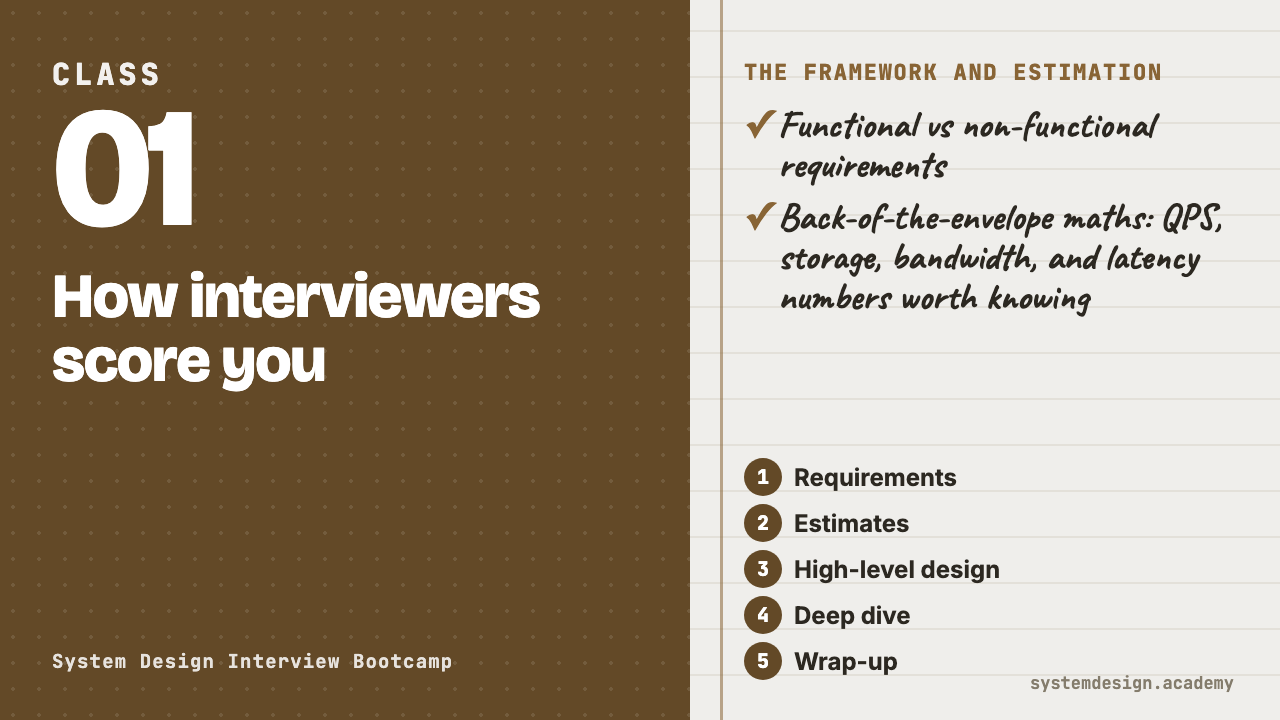
What does Class 1 of the bootcamp, "How interviewers score you", cover?
Class 1 is a recording of 75 minutes in 11 parts, from "Ravi's interview: why a strong engineer still failed" to "Saying an estimate out loud". The main points:
Most candidates who fail a design round do not fail for lack of knowledge. They fail because they draw boxes before they know what to build, give no numbers, and cannot say why each box is there.
A 45-minute design interview has five steps in a fixed order: requirements, estimates, high-level design, deep dive and wrap-up. The class shows how many minutes each one gets.
It ends with a drill to do on your own: five timed estimation drills, done with the video paused, then checked against the worked answers.
What does Class 2 of the bootcamp, "Designs 1 and 2: URL shortener and rate limiter", cover?
Class 2 is a recording of 89 minutes in 13 parts, from "Two designs, the same five steps" to "Knowledge check, what to keep and homework". The main points:
Both designs follow the same five steps as Class 1, and in both the deep dive comes straight from the requirements: click counts and editable links decide the redirect, bursts and strictness decide the counting rule.
Twenty million new links a day is about 231 writes and 23,000 redirects a second. Kept for ten years that is 73 billion links: six base-62 characters give about 57 billion codes and run out, seven give about 3.5 trillion.
It ends with a drill to do on your own: draw both designs yourself, then compare with the model answer in the class.
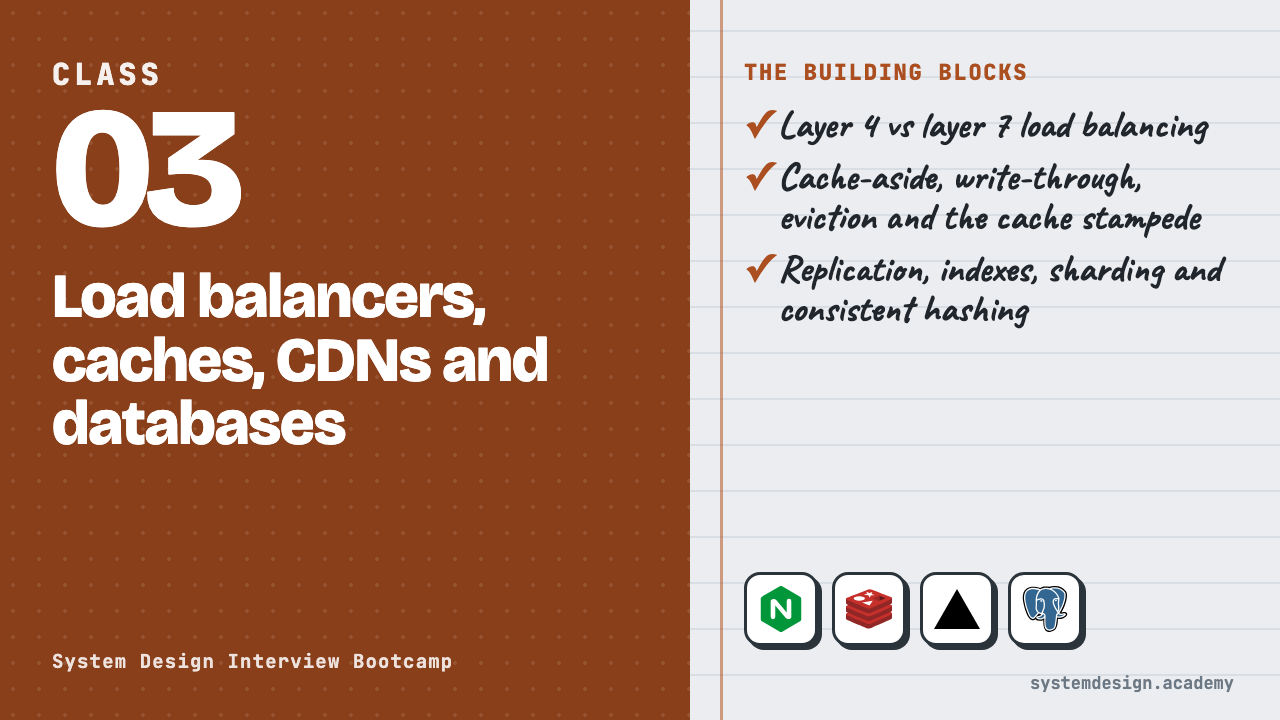
What does Class 3 of the bootcamp, "Load balancers, caches, CDNs and databases", cover?
Class 3 is a recording of 96 minutes in 16 parts, from "Why every later design is built from four building blocks" to "Knowledge check, what to keep and homework". The main points:
Every design in the later classes is built from four blocks: a load balancer, a cache, a CDN and a database. Each one is a choice with a cost, and an interviewer expects you to say both.
A layer 7 balancer reads the request and can route by path: in the lab, /static went to its own server. A layer 4 balancer only passes the connection along, so it cannot. With one server slowed by 200 ms, round robin still sent it 300 of 600 requests; least connections sent it 15.
It ends with a drill to do on your own: choose a database for six short scenarios and write down why, then check the reasoning in the class.
What does Class 4 of the bootcamp, "Designs 3 and 4: search suggestions as you type, and the news feed", cover?
Class 4 is a recording of 75 minutes in 16 parts, from "Two designs from the building blocks: what we build today" to "Knowledge check, what to keep and homework". The main points:
Every key press is a request, so the answer must already exist. On 100,000 real Wikipedia titles, reading every phrase took about 9 ms for any prefix, and a plain trie took about 24 ms for the single letter a, because it visited 67,866 points to find the top five.
Storing the top five at every point of the trie made each lookup take under a microsecond, at a cost of 442 MB against 237 MB and a longer build. A prefix table in Redis held 779,033 prefixes in 87 MB and answered one lookup in about 0.04 ms.
It ends with a drill to do on your own: draw both designs yourself, then compare your trade-offs with the ones in the class.
Which classes are still to come?
10 more classes are planned, one a week, in this order: Class 5, "Queues, logs and Kafka"; Class 6, "Designs 5 and 6: a Kafka-like queue and a notification system"; Class 7, "Connections, presence and location"; Class 8, "Designs 7 and 8: WhatsApp and Uber"; Class 9, "Blobs, video and sync"; Class 10, "Designs 9 and 10: Netflix and Google Drive"; Class 11, "Payments without losing money"; Class 12, "Designs 11 and 12: a payment system and IRCTC Tatkal booking"; Class 13, "Designs 13 and 14: web crawler and Google Docs"; Class 14, "The mistakes that cost people offers".
Together the designs cover a URL shortener, a rate limiter, search suggestions, a news feed, a Kafka-like queue, notifications, WhatsApp, Uber, Netflix, Google Drive, a payment system, IRCTC Tatkal booking, a web crawler and Google Docs.
Full walkthrough: Every class, with what is out and what is next

Self-paced bootcamp · new class every week
System Design Interview Bootcamp
System design interview preparation in 14 recorded classes: the framework, estimation, the building blocks and 14 real designs, with two 1:1 mock interviews. Classes 1 to 4 are out, and its first 3 minutes are free.
3. How the bootcamp works
Watching, practising and the two mock interviews.
How do I watch and practise with the classes?
You stream each class in the browser, or download it as an HD file or a smaller phone-sized file, and each class has a PDF handout with its numbers, lab commands and drill answers. The classes are built to be paused: each one ends with timed drills you do on your own first and then check against the worked answers.
Every class stays in your account for life, so you can watch a design again the week before your interview.
How do the mock interviews work?
There are two one-to-one mock interviews of 45 minutes each. You book the first after Class 8 and the second after Class 12, at a time that suits you, and written feedback arrives within three days of each one.
4. Trying it and buying it
How to see a class before you pay.
Can I watch part of a class for free?
Yes. The first 3 minutes of Class 1, "How interviewers score you", play on the bootcamp page with no sign-up. You see how a class is taught, with a real interview story and the board, before you decide.
How does buying the bootcamp work?
You pay once for all 14 classes, including the ones not released yet, the downloads and handouts, the two mock interviews, a certificate of completion and lifetime access. There is no subscription. The price for your country is in the box on this page and on the bootcamp page.
Where to go next
Everything on this page comes from System Design Interview Bootcamp. 14 self-paced recorded classes, one new class each week. Classes 1 to 4 are out (334 minutes so far), and the first 3 minutes of Class 1 are free to watch. Watch the free preview before you decide.
Self-paced bootcamp · new class every week
System Design Interview Bootcamp
System design interview preparation in 14 recorded classes: the framework, estimation, the building blocks and 14 real designs, with two 1:1 mock interviews. Classes 1 to 4 are out, and its first 3 minutes are free.

These questions are a start. The interview asks more.
Get all 200 questions in the System Design and Distributed Systems pack
Each question has why it is asked, a full answer, what the interviewer listens for, the follow-ups, the common mistakes and a diagram (268 diagrams in all). A PDF you keep, junior to staff level.
Pay by UPI, cards or netbanking through Razorpay. Pay by card or PayPal, in US dollars. Download at once from My packs.