Security operations for critical infrastructure: where AI helps, and where it must not act
A power station or a water plant runs on two networks. The IT network has email, laptops and servers. The plant network, often called OT for operational technology, has the controllers that open valves and spin turbines. A mistake on the second one is not a lost file, it is a city without water.
AI is changing how security teams work, and the Gulf's critical infrastructure is a heavily targeted place to work. This guide shows where an AI agent helps a security operations centre, and the line it must never cross.
Can AI run a security operations centre for a power plant?
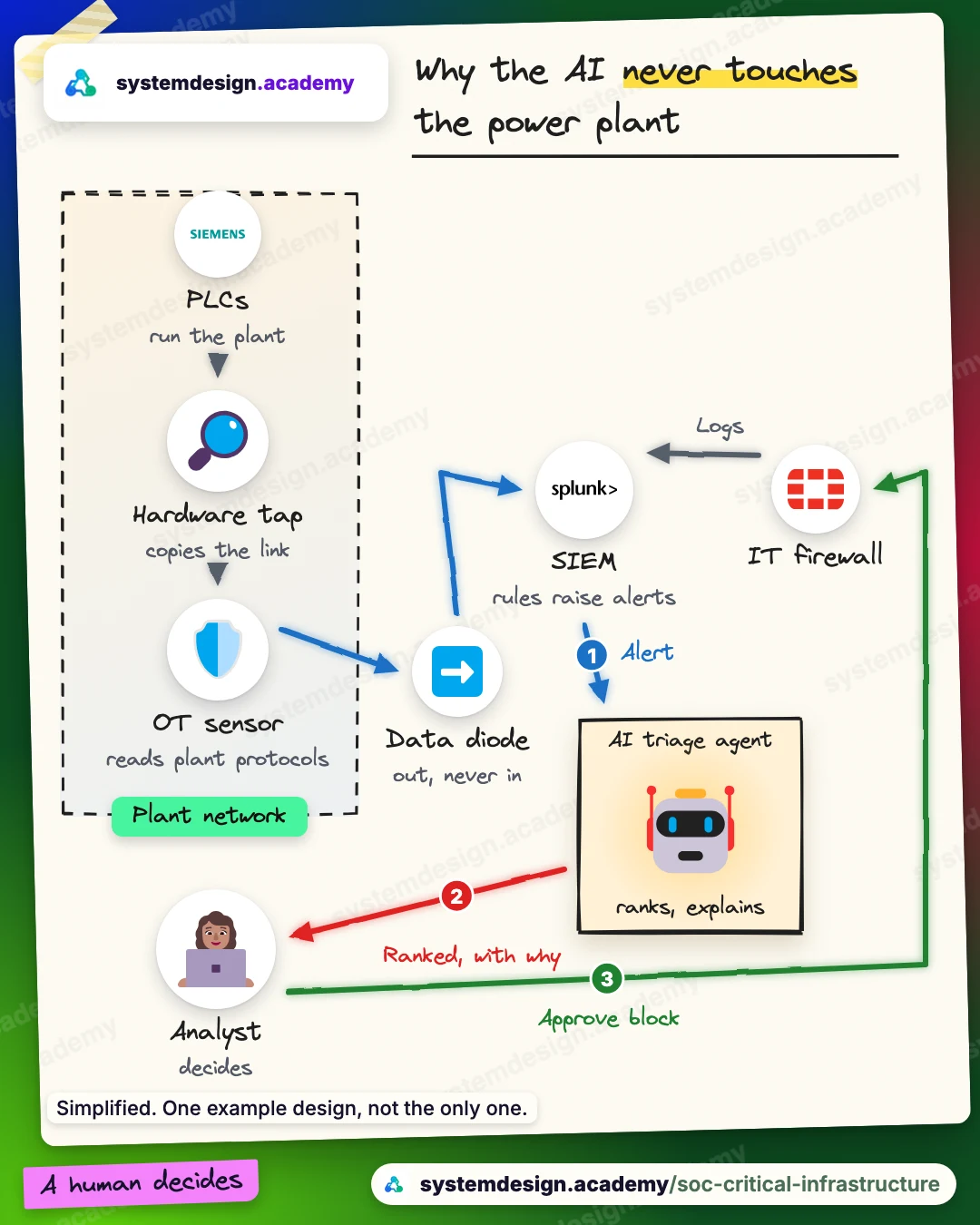
It can help, but it should not act on the plant. In a well-designed SOC for a utility, the plant network is watched passively through a hardware tap, alerts leave through a one-way link, and an AI agent ranks and explains alerts for a human analyst. The analyst decides. Any response happens on the IT side, such as a firewall block, and only after a person approves it.

Watch, don't touch
A hardware tap copies plant traffic. Nothing is ever sent back in.
One way out
A data diode lets alerts leave the plant network and nothing return.
The AI ranks
The agent explains why an alert matters and shows its evidence.
A human decides
Every response is approved by an analyst before it happens.
If this helped, the full course goes much deeper.
In it, you build a security lab in your own AWS account, investigate real attacks by hand, then build AI agents that triage the alerts while a person makes every decision.
From the Gulf you pay in US dollars, by card or PayPal.
Why the Gulf takes this seriously
Energy, government and finance are the backbone of Gulf economies, and attackers know it.
The UAE faces more than 200,000 cyberattacks a day, according to the head of cyber security for the UAE government, with government (34.9%), finance (21.3%) and energy (14%) the most targeted sectors.
Source: Khaleej Times, 16 October 2025Saudi Arabia's Essential Cybersecurity Controls (ECC-2:2024) have 4 main domains, 28 subdomains and 108 main controls, and apply to government bodies and to operators of critical national infrastructure.
Source: National Cybersecurity Authority: ECC-2:2024, 2024Kuwait's government and Microsoft announced Cybersphere, a government cybersecurity platform, alongside plans for a cloud region in the country.
Source: Microsoft News Center, 6 March 2025Microsoft's Qatar cloud region holds the National Information Assurance certification from Qatar's National Cyber Security Agency.
Source: Microsoft News Center, 31 August 2022
What a SOC for a utility looks like
Read the drawing from the plant outwards. Inside the plant network, controllers run the plant. A hardware tap copies the traffic on their network link without taking part in it. An OT sensor reads that copy and understands plant protocols such as Modbus, which ordinary security tools cannot read.
The sensor's alerts leave through a data diode, a device that physically lets data travel one way only. They reach the SIEM, the system that collects logs and alerts from everywhere and runs detection rules over them. The IT firewall sends its logs there too, all day long.
When a rule fires, the AI triage agent takes the alert (step 1), adds context, and ranks it with an explanation of why (step 2). The analyst reads that and decides. Only if the analyst approves does anything change, and then only on the IT firewall (step 3).
Why plant networks are different
On an office network, the first rule is to protect the data. On a plant network, the first rule is to keep the process running safely. That changes almost every security habit.
Plant controllers often run for many years and cannot be patched or restarted on short notice. Some older devices can misbehave when they receive traffic they did not expect, even an ordinary scan. That is why monitoring on the plant side is passive: you listen to a copy of the traffic and never send anything in.
It is also why automatic responses stay on the IT side. Blocking an address on an office firewall is a reversible inconvenience. Blocking traffic to a controller in the middle of a process could be dangerous.
What the AI triage agent does, and its limits
A busy SOC sees far more alerts than people can read. The agent does the first look: it pulls the history of the address involved, checks whether the same pattern was seen before and marked harmless, gathers the related log lines, and writes a short explanation with a rank. The analyst starts from that summary instead of from a blank screen.
The agent has real weaknesses that you must design around. Its summary can be wrong, so the evidence must be shown next to it. And attackers can write text into the very logs the agent reads, trying to give it instructions, which is called prompt injection. The agent therefore gets read-only tools, its output is checked, and a human approves every action.
Finally, you measure it. Keep a set of past alerts with known answers and check how often the agent ranks the dangerous ones highest. Without that test you cannot know whether it helps or hides attacks.
If this helped, the full course goes much deeper.
In it, you build a security lab in your own AWS account, investigate real attacks by hand, then build AI agents that triage the alerts while a person makes every decision.
From the Gulf you pay in US dollars, by card or PayPal.
The skills a SOC analyst needs now
The core skills have not changed: reading logs, writing and tuning detection rules, investigating an alert from first signal to conclusion, and writing up what happened so others can act on it.
What is new is working alongside an AI agent: knowing what to hand it, checking its work, and recognising when its explanation does not match the evidence. The AI SOC Analyst course teaches both, with AI agents you build and supervise yourself.
To be clear about scope: the AI SOC Analyst course's lab is an IT environment you build on AWS, with Wazuh, Linux and Windows machines and a real attack to investigate. It does not simulate a plant network. The plant-side design on this page is the context those skills are used in.
Questions people ask
What is the difference between IT and OT security?
IT security protects data and office systems. OT security protects the controllers that run physical processes, where safety and keeping the process running come first. OT monitoring is usually passive, and changes are made slowly and carefully.
What is a data diode?
A hardware device that lets data flow in one direction only. A plant can send alerts and logs out to the security team, but nothing can be sent back in through it.
Will AI replace SOC analysts?
Not in critical infrastructure. AI can sort and explain alerts faster, but decisions that could affect a plant stay with people. Analysts who know how to supervise an AI agent will be more useful, not less.
Every source on this page was read on 19 November 2026. Plans, rules and numbers change, so check the linked page before you rely on one.
If this helped, the full course goes much deeper.
In it, you build a security lab in your own AWS account, investigate real attacks by hand, then build AI agents that triage the alerts while a person makes every decision.
From the Gulf you pay in US dollars, by card or PayPal.