Contents Part 1 · The job and the customer
Part 1 · The job and the customer
What a forward deployed engineer does, in the words of the companies that hire them
One customer, many capabilities: how Palantir, OpenAI, Salesforce and Ramp describe the work in their own words, and what a real week looks like.
Free lesson
About 50 minutes to read.
Your progress0 of 7 checks answered right
It fills only when a prediction matches the measured result. Reading a page does not move it. It is kept in this browser.
Become a Forward Deployed Engineer: Ship AI for Real Customers. Part 1, The job and the customer.
A forward deployed engineer is a software engineer who works directly with one customer, inside that customer's world, until a piece of software really does the job the customer needs. The title is new to most people. It also means slightly different things at different companies. So this lesson does not give you our opinion of the job. Instead, it reads what the hiring companies say about the job themselves. Palantir started the role. OpenAI, Salesforce and Ramp have written about how their own teams work. Then the lesson goes through 41 real job postings from 18 companies and counts the skills they ask for.
After this lesson you will be able to:
- say in two plain sentences what a forward deployed engineer is, and how Palantir's "one customer, many capabilities" sums it up;
- describe how one real engagement ran, from the first week with the customer to production and then to a second team, as OpenAI tells it;
- describe what a real working week looks like, and how much travel the postings ask for;
- name the skills that the job postings mention most, with their real counts;
- tell a forward deployed engineer apart from a product engineer, a consultant, a solutions engineer and a deployment strategist, in the companies' own words.
What you need first: nothing. This is a reading lesson, with a knowledge check at the end. There is no code to run and no lab to start. If you have not read the introduction to this course yet, "Introduction: what this course builds" tells the whole course in one story, and it helps to read it first.
Time: about 35 minutes.
Dates: every company post and job posting in this lesson was read and saved on 13 November 2026. Job postings change every week, so the counts in this lesson are a snapshot of that day.
Looking for the career guide? If you came here asking "what is a forward deployed engineer, and how do I become one", our free career guide at systemdesign.academy/forward-deployed-engineer covers the role, the roadmap, the interview and the salaries quoted in live postings. This is the first lesson of the course, so it goes deeper into the work itself.
The problem: "we want AI", and nobody has said what that means
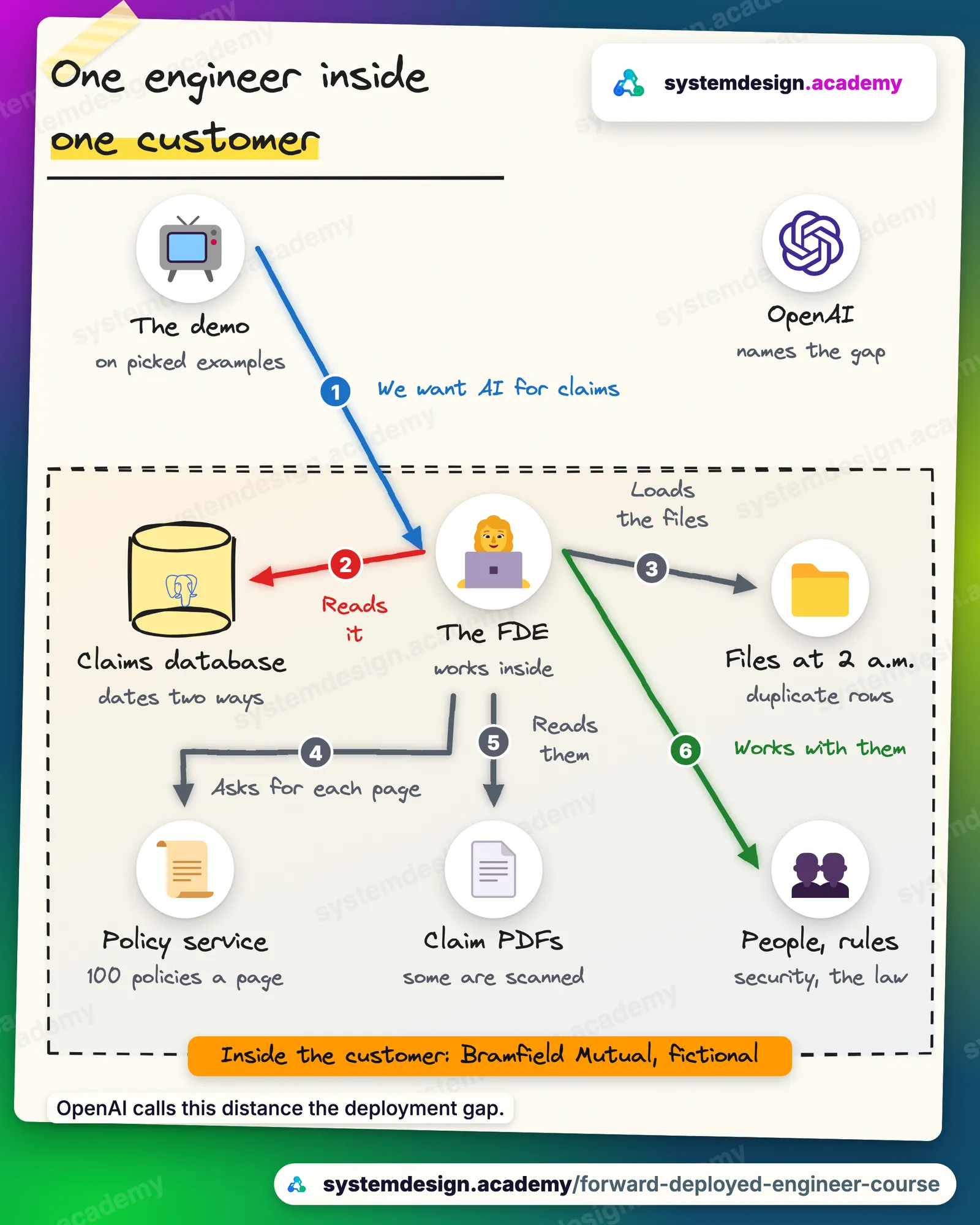
Picture the head of claims at a medium-sized insurance company. She has just watched a demonstration in which an AI model read a claim file and wrote a sensible summary in a few seconds. Her team takes about three weeks to settle a simple car claim, and the backlog grows after every storm. So she says the sentence that starts most of these projects: "We want AI for claims."
The demo ran on examples someone picked by hand. Her team's real work lives in old systems, in files that arrive every night and in scanned paper forms. A security team and the law watch over all of it, and none of that was in the room.
Think of a new oven in a showroom. There it looks perfect. At home it has to fit your kitchen, run on your wiring and cook your food every day. The showroom proves very little about your kitchen. An AI demo is the showroom, and the claims team's daily work is the kitchen.
Someone has to close the distance between "the model can do it in a demo" and "the claims team uses it every morning and trusts it". OpenAI has a name for that distance. Colin Jarvis, who leads OpenAI's forward deployed engineering team, wrote on 22 October 2026 that he founded the team in early 2025 "to close what we call 'the deployment gap': the distance between what models appear capable of and what people can reliably use to do their work." The person who closes that gap, for one customer, is the forward deployed engineer.
This course follows one such customer from the first meeting to the day its team runs the system without you. The customer is Bramfield Mutual Insurance Company, an auto and home insurer in Harrisburg, Pennsylvania. Bramfield is fictional: it does not exist, and every record in its systems is generated by the course. The lesson "Meet Bramfield Mutual, the customer in this course" introduces it properly.
Words for this lesson
Seven words come up again and again in this lesson. Here they are first in plain words, each with an everyday comparison. The lesson explains each one again where it first matters.
| Word | Plain meaning | Everyday comparison |
|---|---|---|
| forward deployed engineer (FDE) | a software engineer who works with one customer until the software does a real job in that customer's systems | a builder who stays on one site until the family moves in |
| the deployment gap | the distance between what an AI model can do in a demo and what people can rely on every day | the oven that looks perfect in the showroom but must still work in your kitchen |
| engagement | the whole piece of work with one customer, from the first meeting to the end | one building job, from the first visit to handing over the keys |
| scoping | agreeing exactly what will be built, and what will not, before building it | a tailor measuring you and asking what the suit is for before cutting cloth |
| eval | a set of test cases with known right answers, run to measure how often the AI is right | the marking sheet of a driving test, agreed before the drive |
| production | the live system that real people depend on every day, not a test copy or a demo | the kitchen you cook dinner in, not the showroom |
| stakeholder | anyone at the customer who has a say in, or is affected by, what you build | everyone in the family who will live in the house |
Why it matters: the job is growing fast, and the title is confusing
The role is not new. Ramp's engineering blog says that "Palantir famously created the role after its founding in 2003 for software engineers literally deployed at military sites and customer offices." What has changed is how many companies now hire for it, and how quickly. On 13 November 2026 we read these companies' public job boards, the careers pages where they list open jobs. Databricks had 118 open postings with "Forward Deployed", "Deployment Strategist" or "FDE" in the title, Palantir had 95 and OpenAI had 39. Ramp wrote in August 2025 that its own team "grew from 2 to 16 FDEs" in a year and a half.
When a job grows this fast, its title gets stretched. On the same day we found postings called "Forward Deployed Software Engineer", "Forward Deployed AI Engineer", "Forward Deployed Builder", "Frontier Agents Engineer (Forward Deployed Engineering)" and "Deployment Strategist", which is a related but different job. If you are deciding whether to aim for this work, or how to prepare for it, you need to know what the companies themselves mean. That is why this lesson quotes them directly, with the date we read each source, instead of summarizing what other people have said about them.
The idea: one customer, many capabilities
Idea: A product engineer builds one part of the product for every customer, while a forward deployed engineer works for one customer and uses whatever it takes to reach that customer's goal.
Think of a restaurant chain. A cook at the head office perfects one dish, and the recipe goes out to every branch. A caterer at one wedding cooks whatever that family wants, in whatever kitchen the venue has. The first cook serves many people with one thing. The caterer serves one family with many things. Both are good cooks. They point the same skill at different targets.
The clearest short description of the job comes from Palantir, the company that started it. In a post on its blog called "Dev versus Delta: Demystifying engineering roles at Palantir", published on 8 April 2019, Palantir explains its two biggest engineering jobs by number of people. Inside the company, software engineers who build the product are called "Devs", and forward deployed software engineers are called "Deltas". The name "Delta" goes back to Palantir's early days, when each business development team was named after a letter of the NATO alphabet.
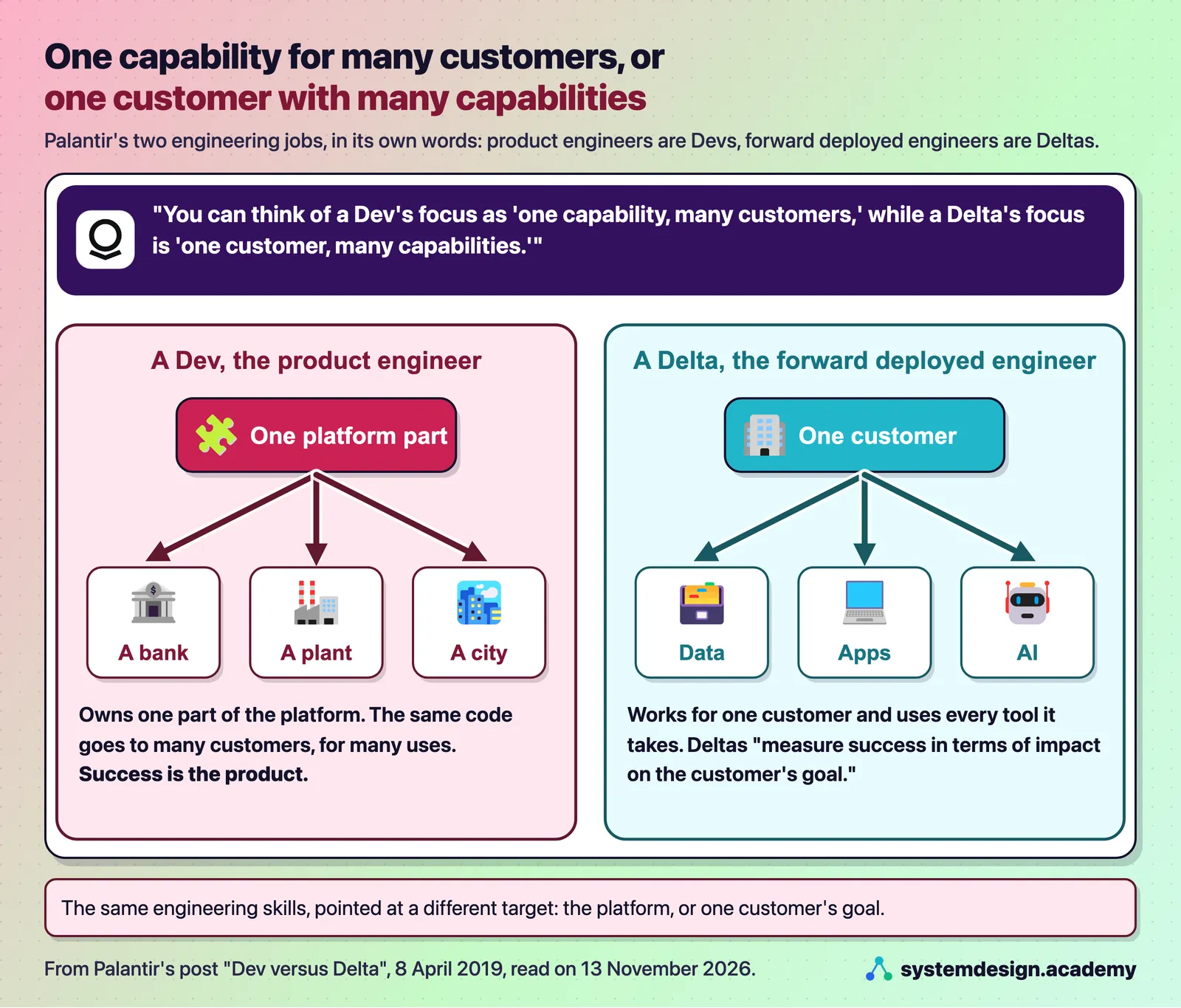
Here is how the post puts the difference, in its own words: "You can think of a Dev's focus as 'one capability, many customers,' while a Delta's focus is 'one customer, many capabilities.'"
Read those two halves slowly, because the rest of the job follows from them.
- A product engineer, a Dev, owns one part of the platform. The post says Devs make "design and architecture decisions that impact code that will ultimately be deployed to many different customers for many different use cases." Their success is the product.
- A forward deployed engineer, a Delta, owns one customer's outcome. The post says a Delta is "part of a team that directly supports one customer", and that Deltas "measure success in terms of impact on the customer's goal." To reach that goal a Delta uses "Palantir products, a variety of languages, open-source tooling, and industry-standard build tooling, and their own creativity". Their success is the customer's result.
The same post names the skill that sits under all of this. A Delta in New York, Elisa, describes it as "technical decomp": "Our job is to take a high-level problem, 'decompose' or break it down, and design a solution. We need to be capable of understanding from the high-level business problem down to the lines of code you need to solve it." In plain words, you start from a business goal such as "settle claims faster", and you keep breaking it into smaller pieces until you reach the actual code, data and systems that will do it.
She also names the decision that makes the job hard: "you'll frequently need to decide whether to invest time building a feature your customer needs into the core platform, or to create something custom that we can deliver faster." Building it into the product helps every future customer but takes longer. Building it just for this customer is faster but leaves something only one customer uses. You will meet this decision again, in the words of OpenAI and Ramp, later in this lesson.
Watch out: Do not read "works with the customer" as "does sales" or "gives advice". Another Delta in the same Palantir post says that "A Delta does significantly more engineering and technical work than a consultant". The job is engineering, done close to one customer.
An engineer spends a year making one feature of a product faster, and every customer gets the change. In Palantir's words, is that engineer working as a Dev or as a Delta?
Show the answer
The answer: B.
As a Dev. The work is one capability that goes out to many customers, which is Palantir's "one capability, many customers". A Delta would start from one customer's goal and use whatever parts of the product, and whatever extra code, that goal needs.
What the companies say the job is, in their own words
Idea: Each company describes the same job from its own side, and together they say: sit with the customer, start from the outcome, work in a small team and question every request before you build it.
Palantir is not the only company that has written about the job. Here are six of them side by side, from their own blog posts and from the job postings we saved. Google's line comes from its Public Sector team's posting for state and local government:
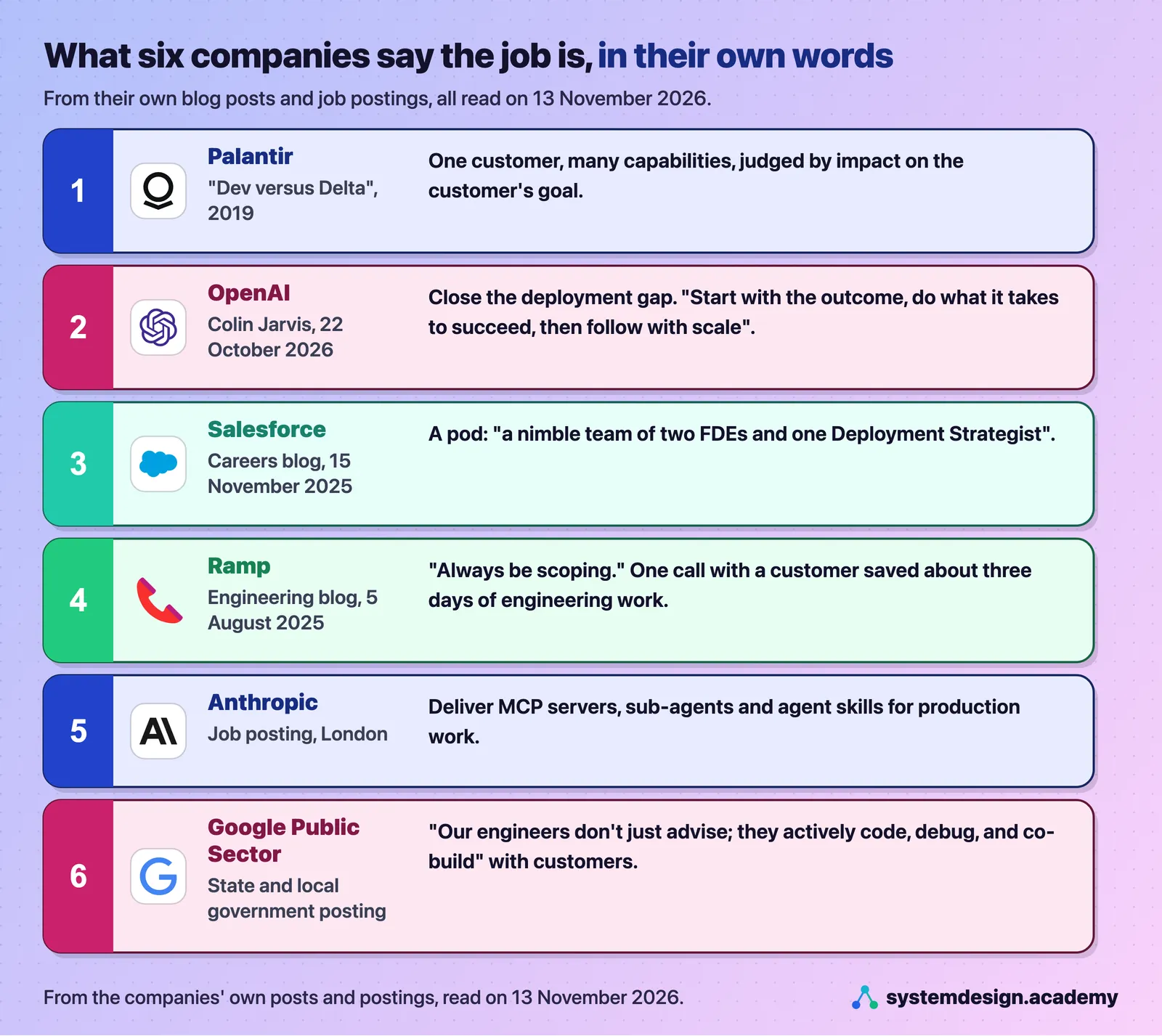
Two terms in row 5 need a word of explanation. MCP, the Model Context Protocol, is a standard way to let an AI model use a company's own tools and data. A sub-agent is a smaller AI helper that a main AI program hands one part of a task to.
Palantir: the engineers who are deployed with the customer
Palantir's current posting for a Forward Deployed Software Engineer in New York calls the role "the blueprint" and says Palantir pioneered it by "embedding talented engineers directly with our customers to tackle their most pressing challenges head-on." Almost everything it lists is engineering work: architecture and design decisions, handling very large amounts of data, "Developing custom applications tailored to customer needs", and "Engaging directly with customer stakeholders, from technical teams to executives".
OpenAI: start with the outcome, then make it repeatable
Colin Jarvis's post "What FDE means at OpenAI" is the most detailed first-party account we found, and it is recent, from 22 October 2026. He says he shows one core value at the start of every team session: "Start with the outcome, do what it takes to succeed, then follow with scale". He also gives a warning that every new forward deployed engineer should hear early: "An impressive demo can go a long way before anyone asks whether it works in the real world."
Two more sentences from that post matter for anyone moving into the job. The first is about industry knowledge: "Our FDEs don't need to know the industry on day one but it is their responsibility to learn it." You do not need to have worked in insurance to help an insurer, but you must learn how its claims work. The second is about what the work should leave behind: "Our goal is for each engagement to leave the next customer with a better starting point". The next section shows what that looked like in one real engagement.
Salesforce: a pod of two engineers and one strategist
Salesforce's careers blog published "Back to Build: Why Agentforce Inspired 3 FDEs to Return to Salesforce" by Dani Laven on 15 November 2025. Agentforce is Salesforce's product for building AI agents, which are programs that use an AI model to decide which steps to take to finish a task, such as answering a customer's question. The post describes how Salesforce organizes the people who work with one customer, as "a nimble team of two FDEs and one Deployment Strategist". Salesforce calls this team a pod.
A house is often built the same way. Two builders do the building. One site manager keeps the schedule, orders the materials and talks to the family. Nobody asks the site manager to lay bricks, and nobody asks the builders to run the calendar. A pod splits the work like that.
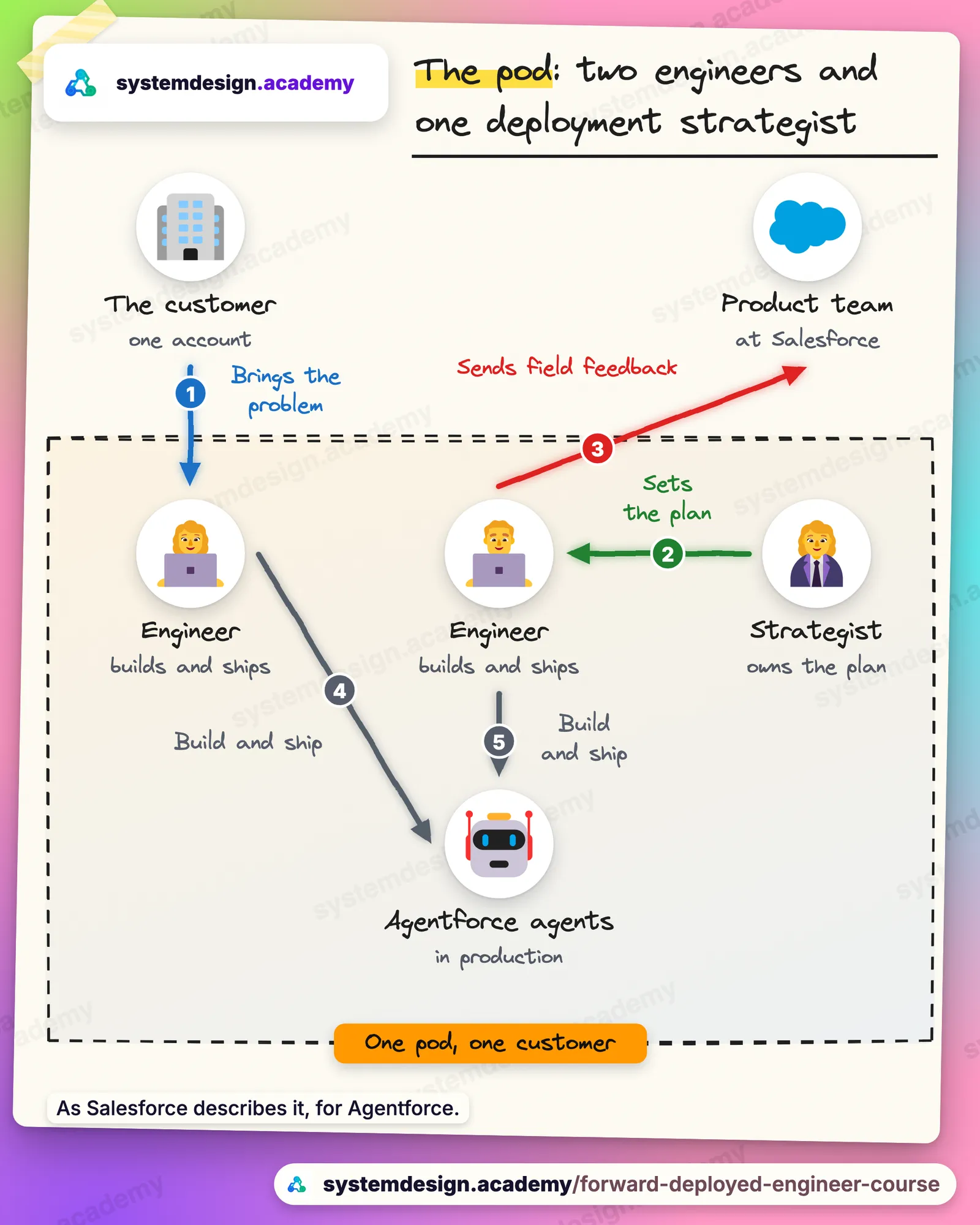
A deployment strategist is the partner of the forward deployed engineer. The strategist owns the plan, the timeline and the relationships, while the engineers build. Salesforce's own posting for a Deployment Strategist asks for "Strong project and programme management skills", including the ability "to run multiple workstreams, manage stakeholder expectations, and keep delivery on track in ambiguous environments". A workstream is one separate line of work inside a project, such as the data feed or the training plan. An ambiguous environment is one where nobody has fully decided what is wanted yet.
Salesforce's posting for a forward deployed engineer (JR349466) says the engineer will "work alongside Senior Forward Deployed Engineers and a Deployment Strategist". The engineer owns technical components "from architecture choice to deployed, validated, and observable in production." Production is the live system that real people depend on every day, as opposed to a test copy or a demo. Observable means that the team can see what the running system is doing, from its logs, its measurements and its alerts.
The same blog post shows the second half of the job, the half that faces back toward the company. Because forward deployed engineers work directly with customers, "they provide real-time feedback to the product team and serve as the voice of the customer." Usman Nasir, a vice president in Salesforce's forward deployed engineering team, says: "I've seen where features have been moved up six months because of the urgency of what we're seeing in the field". What you learn at one customer is worth a great deal to the product team, if you write it down and send it back.
Ramp: always be scoping, and generalize when you can
Leo Mehr's post "Forward Deployed Engineering" on Ramp's engineering blog, from 5 August 2025, adds the most practical advice of the four. Ramp's team works with a customer through its whole life: "from when they are prospects in the sales funnel, to implementation and rollout, to long-tail support." A prospect is a company that has not bought yet, and long-tail support means the steady stream of smaller requests that keeps coming for years after launch.
Its first principle is about questioning what the customer asks for. A good tailor measures you and asks what the suit is for before cutting any cloth, because cloth that is cut cannot be put back. The post says: "Just like sales' 'always be closing', the main FDE mantra is 'always be scoping'." Scoping means agreeing exactly what will be built, and what will not, before you build it. The post gives an example. A customer in onboarding was blocked by a missing feature that Ramp's engineers estimated "would take ~3 days of eng work". Instead, they "hopped on a call with them and figured out a workaround right there". One conversation saved three days of building.
Its second principle pulls the other way, and the post says so openly. Ramp asks: "do I hack something together for a customer, or take more time to build something hundreds or thousands of customers will use?" It prefers the general feature, while admitting that this "is at odds with 'Always be Scoping'". This is the same decision Palantir described: build it into the product, or build it just for this customer. Ramp's answer is that judging this well is where a forward deployed engineer's taste shows.
Watch out: Do not start building the moment a customer asks for a feature. In Ramp's example the estimate was about 3 days of engineering work, and one call found a workaround instead. First ask what problem the feature is meant to solve.
Ramp's two principles seem to disagree. One says cut the work down to what this customer really needs, and the other says build the general feature. When does each one win?
Show the answer
The answer: C.
Scoping wins when a smaller answer, or a workaround, solves the customer's real problem, as in the three-day example. The general feature wins when many customers will need the same thing, so building it once in the product saves work for everyone later. Ramp says that choosing well between them is where a forward deployed engineer's taste shows.
How one engagement runs, from the first week to a second team
Idea: A real engagement runs in a fixed order: learn the customer's world, agree with them how success is measured, build, reach production, and then make the work repeatable.
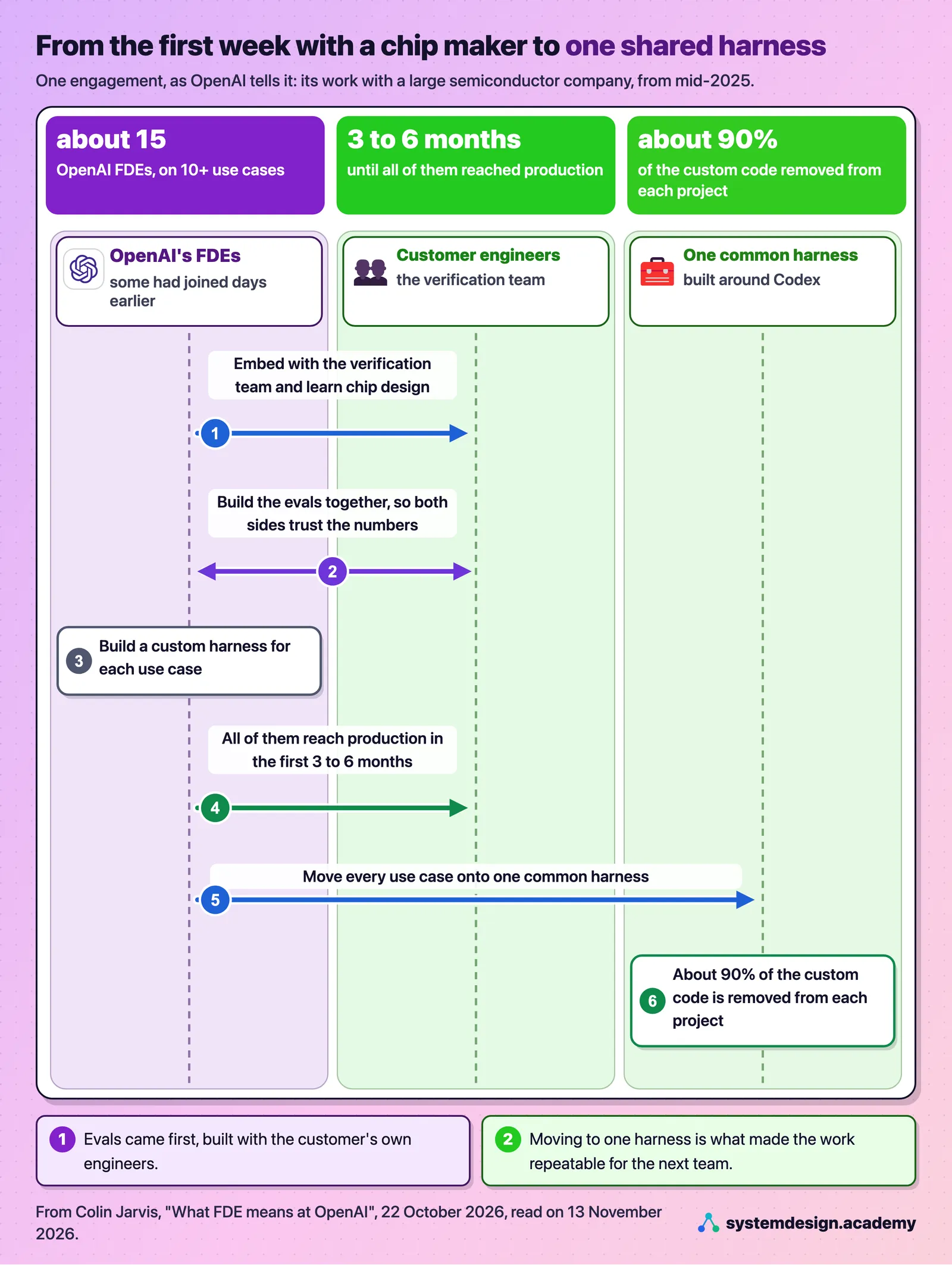
A description of a job is one thing. A real engagement shows the order in which the work happens. OpenAI's post gives the clearest example we found, from a large semiconductor company. An engagement is the whole piece of work with one customer, from the first meeting to the end.
The post says that in mid-2025 OpenAI "had around 15 FDEs working with a large semiconductor customer on 10+ use cases", with the aim of making the company's chip verification work "AI-native", which means building AI into the way the work is done rather than adding it on afterwards. Verification is the part of chip design that checks the design behaves correctly before it is manufactured. A use case is one task the AI is meant to help with. Here the post names three: writing the tests for a chip design, finding the root cause when a test fails, and an assistant for questions about the chip's architecture.
Step through it
One engagement, as OpenAI tells it
Step through OpenAI's work with a large semiconductor company from mid-2025, in the order the work happened.
Step 1 of 6
Go and learn the customer's world.
Some of the engineers had joined OpenAI just days earlier and had never worked in semiconductors. They embedded with the customer's verification team, studied chip design in their spare time, and built evals with the engineers.
- Around 15 FDEs worked with the customer on 10+ use cases.
Step 2 of 6
Agree how to measure success, with the customer.
The evals tested whether the AI could generate useful tests and correctly diagnose chip failures. They were built with the customer's engineers, so both sides trusted the numbers.
Step 3 of 6
Build what each use case needs.
Alongside that learning, the team built a custom harness for each use case: the code around the model that feeds it the right inputs, calls the right tools and checks its outputs.
Step 4 of 6
Reach production.
Over the first 3 to 6 months, all of the use cases reached production and early user adoption.
Step 5 of 6
Make it repeatable.
Each use case still needed too much custom integration to extend to another team. So the team moved the use cases onto one common harness built around Codex, and removed roughly 90% of the custom code from each project.
Step 6 of 6
Start the next team quickly.
The post gives this as a separate example from August 2026: the initial deployment took two months, and extending the solution to a second team took one day.
Follow the steps in order, because the order is the lesson. One everyday picture helps with step 2. A driving test works because the examiner and the learner agree on the route and the marking sheet before the drive starts. A spin around an empty car park proves very little. An eval is that agreed marking sheet, and a demo is the empty car park.
- Go and learn their world. Some of the engineers had joined OpenAI "just days earlier and had never worked in semiconductors." They "embedded with the customer's verification team, studied chip design in their spare time, and built evals with the engineers".
- Agree how to measure success, with the customer. An eval, short for evaluation, is a set of test cases with known right answers that you run the AI against to measure how often it is right. Here the evals tested "whether the AI could generate useful tests and correctly diagnose chip failures." They were built with the customer's engineers, so both sides trusted the numbers.
- Build what each use case needs. "Alongside that learning, we built custom harnesses for the individual use cases." A harness here is the code around the model that feeds it the right inputs, calls the right tools and checks its outputs. It works like the frame a carpenter clamps around a piece of wood, so that every cut lands in the right place.
- Reach production. "Over the first 3-6 months, all of them reached production and early user adoption."
- Make it repeatable. Each use case still "required too much custom integration to extend to another team." So the team moved the use cases onto one common harness built around Codex, OpenAI's coding agent, and "were able to remove roughly 90% of the custom code from each project".
- Start the next team quickly. The figure ends at the shared harness, because the post gives this result as a separate example from August 2026, not as part of the semiconductor story. In that example, "the initial deployment took two months. Extending the solution to a second team took one day."
Two other engagements in the same post show why evals come before production. OpenAI had already built a customer-service system with a large telecom company, and the customer wanted to extend it to phone calls. "During scoping, our model scored around 60% on the key evals we used to assess whether it could do the job in production." OpenAI told the customer, brought in its Research team, and "Over six months, performance on the key evals rose from around 60% to 80% and then 90%+, reaching the levels needed for production." In a tax pilot with Thrive Holdings, automating one difficult kind of tax return, the return for rental property, took "six weeks of engineering and practitioner review to reach 90% precision and recall". Precision is how often the system was right when it gave an answer, and recall is how many of the cases it should have caught it really did catch. In both cases, the eval number decided whether the system was ready. The impression a demo made did not.
Watch out: Do not let a good demo stand in for an eval. Colin Jarvis warns that "An impressive demo can go a long way before anyone asks whether it works in the real world." The telecom model scored around 60% on the agreed evals during scoping, and it went into production only when the same evals passed 90%.
A demo of a claims assistant impresses Bramfield's head of claims. Is that enough reason to put it into production?
Show the answer
The answer: A.
No. In OpenAI's telecom example, the model scored around 60% on the agreed evals during scoping, and it reached production only when the same evals passed 90%. An eval agreed with the customer is the evidence. A demo only shows what the system does on examples someone picked. The order of the work is: learn, measure, build, ship, and then make it repeatable. This course follows the same order with Bramfield Mutual.
What a real week looks like
Idea: Most weeks mix a couple of days at the customer with ordinary engineering back at the office, and many postings ask you to spend a quarter to a half of your time at customer sites.
Think of a visiting nurse. Some days she is in patients' homes. The rest of the week she is at the clinic, writing notes and planning the next visits. The work in the homes is still nursing, not chatting. A forward deployed engineer's week has the same two halves.
The posts above describe whole engagements. What does an ordinary week feel like? Palantir's "Dev versus Delta" post asked its engineers exactly that. Dyon, a forward deployed engineer in Palantir's Abu Dhabi office, answered:
"Most weeks, I spend a couple of days working at the customer premises, some of that time in meetings with technical or business stakeholders and the rest of the time monitoring, debugging, deploying, or configuring our software for that customer. Back in the office, I spend some time writing minor code changes, reviewing pull requests, and researching/planning customer solutions. The remainder of my time is spent communicating via email or VTC with our internal support and product development teams, and with my direct reports who are based in a number of remote offices."
VTC means video teleconference, a video call. A stakeholder is anyone at the customer who has a say in, or is affected by, what you build.
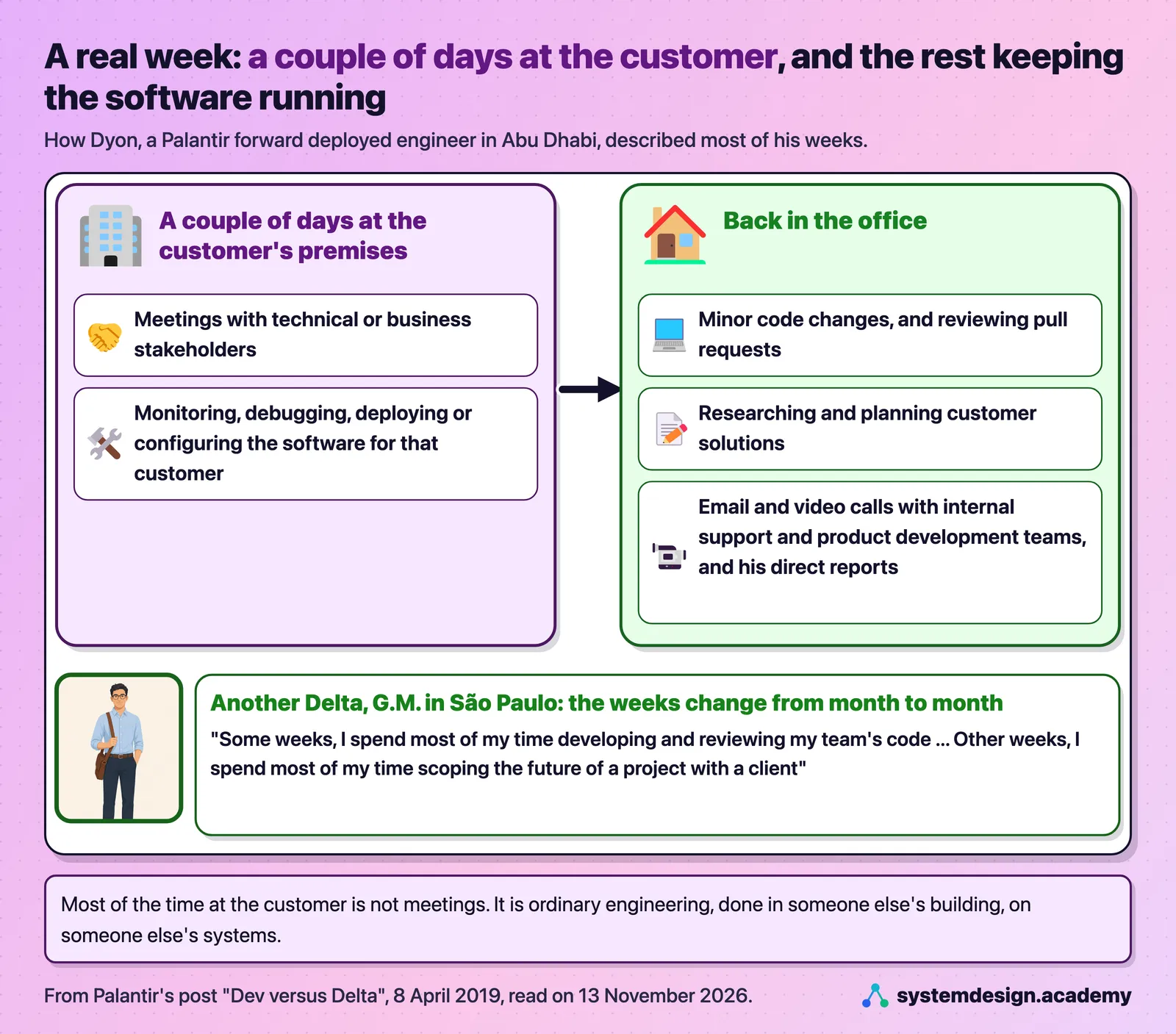
Notice how much of the time at the customer is not meetings. It is "monitoring, debugging, deploying, or configuring our software", which is ordinary engineering done in someone else's building, on someone else's systems. Another Delta in the same post, G.M. in São Paulo, describes a rhythm that changes month to month: "Some weeks, I spend most of my time developing and reviewing my team's code, like a typical Software Engineer. Other weeks, I spend most of my time scoping the future of a project with a client, or working with users to make sure the things we've built meet their needs."
How much travel the postings ask for
Being at the customer often means traveling to them. Of our 41 postings, 28 mention travel to customer sites. Here is what some of them say, exactly as stated where we quote, and with ranges written out in words:
| Company and posting | What it says about travel |
|---|---|
| Palantir, Forward Deployed Software Engineer, New York | "Ability and interest to travel up to 25%, as needed to client sites, but flexible based on personal preferences." |
| Palantir, Forward Deployed Software Engineer, New Grad | 25 to 50% travel, "depending on team and location" |
| OpenAI, Forward Deployed Software Engineer, San Francisco | "Travel up to 50% is required." |
| Anthropic, Forward Deployed Engineer, London | travel frequently, 25 to 50%, "to customer sites to build in person with customers" |
| Salesforce, Forward Deployed Engineer (JR349466) | "You're excited to travel ~25% of the time, working directly alongside customers." |
| Databricks, Senior Forward Deployed Engineer, Bengaluru | "Travel to customers 20% of the time" |
| Ramp, Software Engineer, Forward Deployed, AI Solutions | "Willingness to travel up to ~50%, flexible based on project and customer needs." |
So in these postings, spending a quarter to a half of your time at customers is common, and the amount varies by company, team and customer.
Worked example: what a travel percentage means in days. A percentage is easier to plan around once it is turned into days.
- A working week has 5 days.
- "Up to 25%" means at most 0.25 times 5, which is 1.25 days a week at customer sites, on average.
- "Up to 50%" means at most 0.5 times 5, which is 2.5 days a week, on average.
- So "25 to 50%" means roughly one to two and a half days a week away, on average. A posting gives a share of your time, not a schedule, so ask the recruiter how the travel is spread.
- The same arithmetic works for the postings themselves: 28 of 41 mention travel, and 28 divided by 41 is about 0.68, which is about two postings in every three.
Watch out: Read each posting's travel line before you apply. OpenAI's San Francisco posting says "Travel up to 50% is required", while Databricks' Bengaluru posting says 20%. The same title can mean very different weeks.
A posting says you must be willing to travel up to 50%. On average, at most how many days of a five-day week is that at customer sites?
Show the answer
The answer: B.
Two and a half days. Half of a five-day week is 0.5 times 5, which is 2.5 days, on average across the year. The posting does not say how those days are spread, so some weeks may be spent entirely at the customer and others entirely at home.
What the job postings ask for most
Idea: The postings ask first for shipping software to production and for owning problems nobody has fully defined, and they name specific tools far less often.
Imagine reading 41 shopping lists and counting how many mention bread. You learn what people write down most often. You do not learn what they enjoy most, and you miss the salt that everyone has at home and nobody writes down. Counting skills in job postings works the same way.
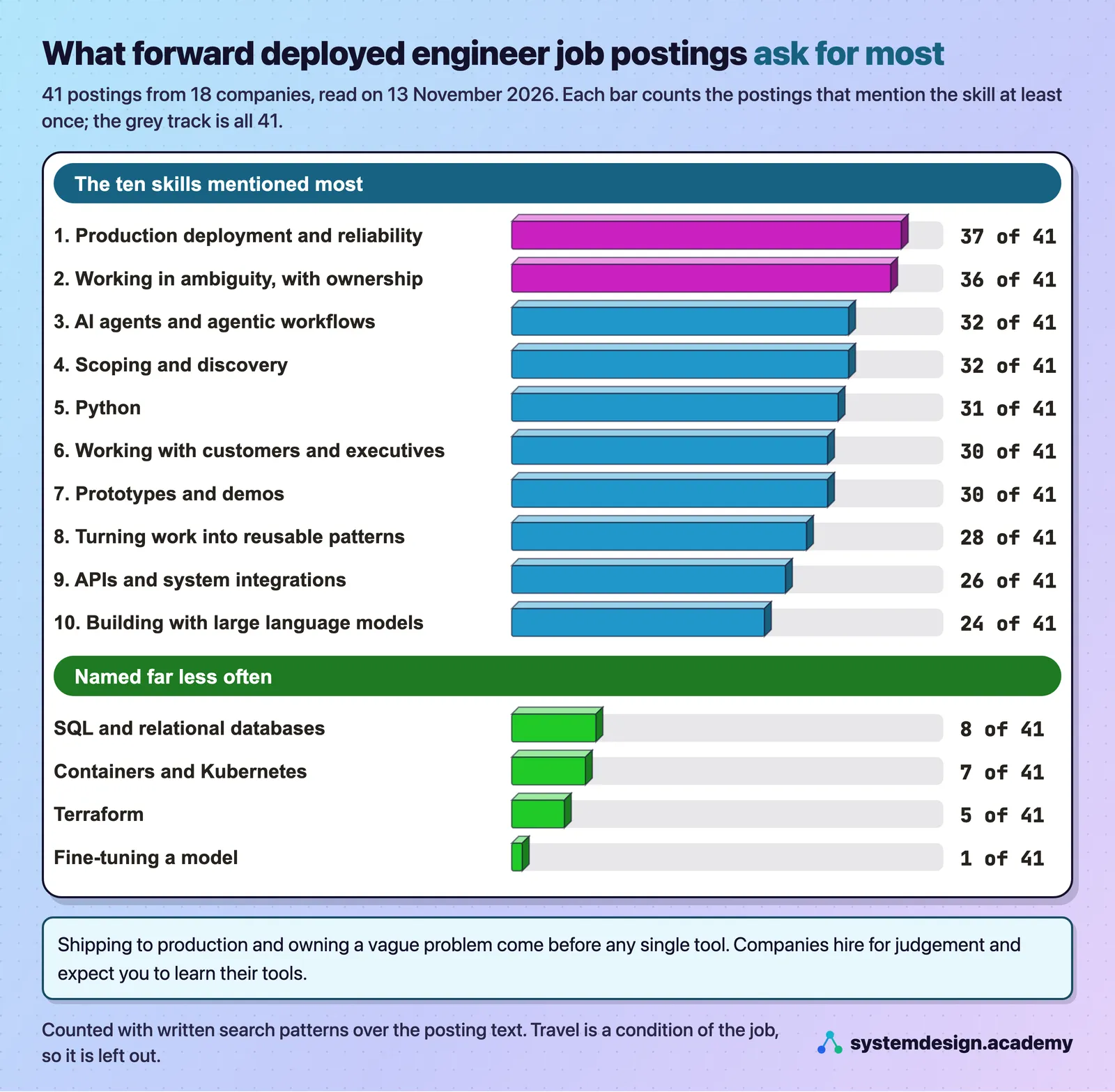
The posts tell you how companies think about the job. The postings tell you what they actually hire for. On 13 November 2026 we read the public job boards of the companies that hire forward deployed engineers, and picked 41 postings from 18 companies, so that one company with a hundred near-identical postings could not decide the result. We left out managers, recruiters and internships. Then we counted how many postings mention each skill at least once. To do that, we wrote down, for each skill, the words and phrases to search for in the posting text, such as "Python" or "in production". Travel is left out of the chart, because it is a condition of the job, not a skill.
Three things stand out.
- The job is mostly delivery. Putting software into production and keeping it reliable is mentioned in 37 of the 41 postings, by all 18 companies. Owning a problem that nobody has fully defined, which postings call "ambiguity" and "ownership", is in 36. Fine-tuning a model, by contrast, appears in only 1 posting of the 41.
- AI is now central, but as something you build with. AI agents appear in 32 postings and building with large language models in 24. A large language model, or LLM, is the kind of AI model behind ChatGPT and Claude, which reads and writes text. An AI agent is a program in which such a model decides which steps and tools to use to finish a task.
- Specific tools are named less often than you might expect. Python is the exception, in 31 postings. Terraform appears in 5, containers and Kubernetes in 7, and SQL and relational databases in 8. Companies hire for judgement and expect you to learn their tools.
The postings also show how wide the experience range is. Gushwork in Bengaluru asks for "1 to 2 years of experience building or delivering software for customers". Prodigal asks for "2+ years experience in Product backend / AI engineering". Anthropic's London posting asks for "4+ years of experience in a technical, customer facing role". OpenAI's San Francisco posting asks for "7+ years of professional full stack engineering experience (excluding internships)". Google's posting for state and local government asks for "8 years of experience building and shipping production-grade AI-driven solutions". So there is a way in at almost every level of experience, but what you are expected to bring changes with the level.
Worked example: turning a count into a share. "37 of 41" is easier to compare once it is a percentage.
- Production deployment appears in 37 of the 41 postings.
- 37 divided by 41 is about 0.902.
- Times 100, that is about 90 percent: nine postings in every ten.
- Terraform appears in 5 postings. 5 divided by 41 is about 0.122, about 12 percent, or roughly one posting in eight.
- So production is named about seven times as often as Terraform, because 37 divided by 5 is 7.4.
Do they write production code?
Yes, and the postings say so plainly. Salesforce's Agentforce Orchestration posting says: "You will write production code". Composio's says: "you ship production code, not demos." Google's public sector team says "our engineers don't just advise; they actively code, debug, and co-build bespoke agentic workflows directly alongside our customers." And OpenAI's posting asks its engineers to work "coding side-by-side to drive projects to completion on their infrastructure", meaning on the customer's own systems.
Watch out: Do not read the chart as a ranking of importance. A count shows what companies wrote down. SQL appears in only 8 of the 41 postings, yet almost every engagement needs it, because almost every customer keeps its data in a database.
Only 5 of the 41 postings name Terraform, a tool that sets up cloud servers from written files. Does that mean a forward deployed engineer will rarely meet it?
Show the answer
The answer: D.
Not necessarily. A count only shows what a company bothered to write down. Many customers already run their systems with tools like Terraform, and you learn whatever the customer uses. The postings ask for delivery and judgement first because the tools change from one customer to the next.
How the job differs from nearby jobs, in brief
Idea: Nearby jobs differ in two ways that are easy to check: who the work is for, and whether you write production code; a forward deployed engineer serves one customer and ships code.
Think of everyone around a new house. An architect draws a design that is used for many houses. A surveyor writes one report and leaves. A builder stays until the family moves in. A site manager keeps the schedule. The salesperson in the show home helps the family decide to buy. Each one matters, and each one does a different job.
People often confuse this job with four others. The next lesson in this part, "How the job differs from solutions engineer, consultant and product engineer", compares them in depth. Here is the short version, drawn only from what the posts and postings say. In the house picture, the product engineer is the architect, the consultant is the surveyor, the forward deployed engineer is the builder, the deployment strategist is the site manager, and the solutions engineer is the salesperson in the show home.
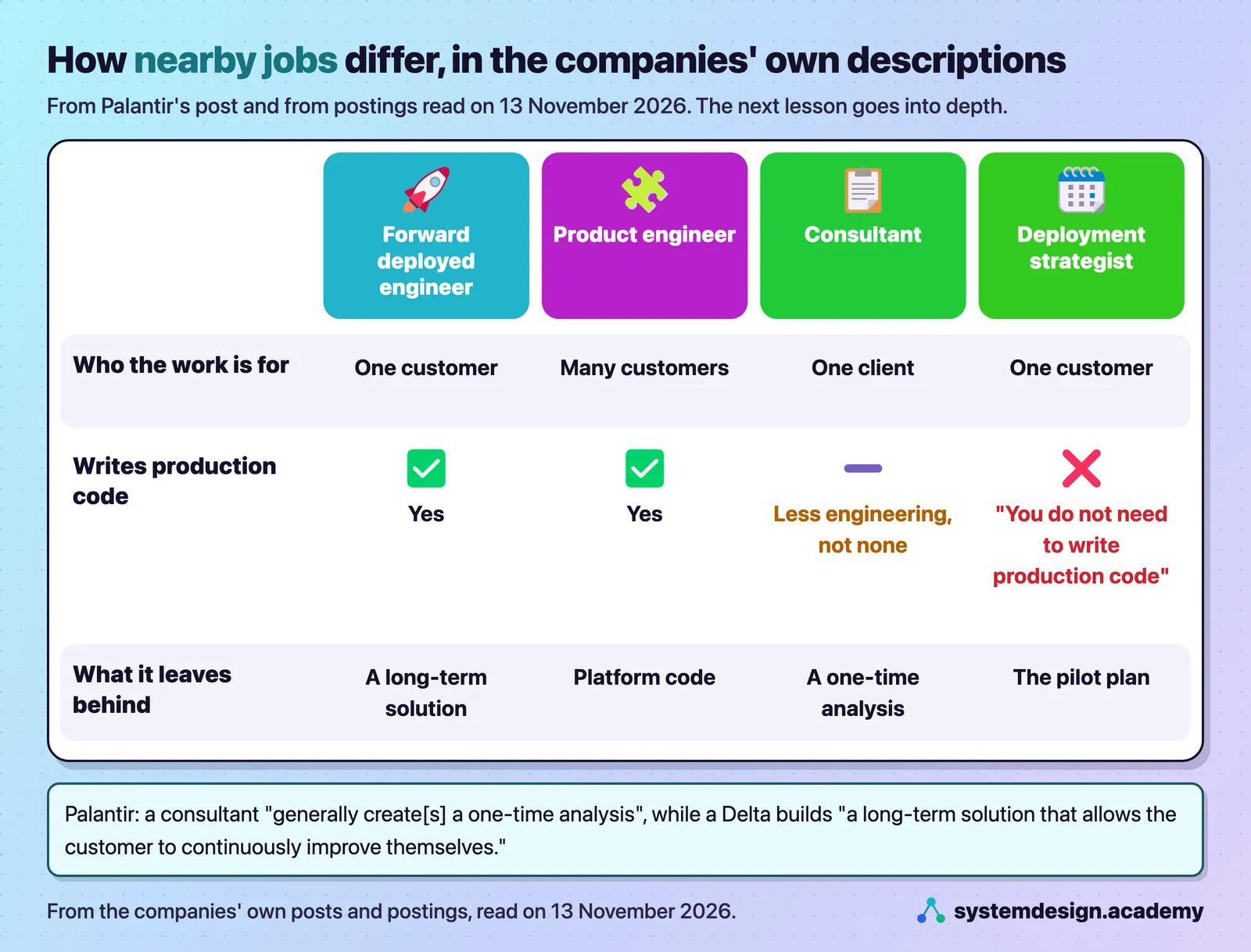
- A product engineer builds the product that ships to every customer. This is Palantir's "one capability, many customers".
- A consultant, in Palantir's words, "generally create[s] a one-time analysis, recommendation, or solution to a specific problem", while a Delta works with the customer "to build a long-term solution that allows the customer to continuously improve themselves." Another Delta in the post adds that "A Delta does significantly more engineering and technical work than a consultant". That is why the grid gives the consultant a partial mark for production code: less engineering, not none.
- A deployment strategist owns the plan and the people around the engineers. Sarvam's posting for this role in Bengaluru says it plainly: "You do not need to write production code, but you should be able to argue with an engineer about an integration approach".
- A solutions engineer usually helps a customer see how the product fits before or around the sale, and sits on the same account. OpenAI's posting says its forward deployed engineers "collaborate closely with Sales, Solutions Engineering, Solutions Architects, and Customer Success Managers who work on the same account." Gushwork's posting speaks to solutions engineers who want to move across: it is for someone who has "worked as a solutions engineer, implementation engineer, or in a similar delivery role, and you now want to build the product, not just configure it".
Watch out: A posting called "Deployment Strategist" is not a coding job, even when it sits on the same team as the engineers. Sarvam's posting says "You do not need to write production code". Read the duties, not only the team name.
A role works with one customer, owns the plan and the timeline, and does not write production code. Which job in this lesson is it closest to?
Show the answer
The answer: B.
A deployment strategist. It works with one customer, like a forward deployed engineer, but it owns the plan and the people rather than the code. Sarvam's posting for the role says "You do not need to write production code", and Salesforce pairs one strategist with two engineers in each pod.
How this course follows the same job
Palantir's "one customer, many capabilities" is the shape of this whole course. You work with one fictional customer, Bramfield Mutual, and you build many things for it: you get into its old systems safely, clean its data, build an AI agent that helps its adjusters, prove with evals that the agent works, put it into production in Bramfield's own Amazon Web Services (AWS) account, and hand it over. The order follows OpenAI's semiconductor story: learn the customer's world, agree how to measure success, build, ship, then make it repeatable for the next team. Along the way you keep Ramp's habit of scoping before you build, and you write the field report that Salesforce's engineers send back to their product team.
What an FDE writes down
Idea: Every part of this job ends in something written, because scope, evals and field feedback only help when someone else can read them.
A ship's captain keeps a logbook, so that the next watch knows what happened without having to ask. Working notes and a decision log do the same for an engagement.
Every company in this lesson ties the job to something written. Ramp's scoping ends in an agreement about what will and will not be built, and that agreement only helps if it is written where everyone can read it. OpenAI's evals are a written set of test cases with a score the customer agreed to. Salesforce's field feedback reaches the product team only when someone writes it down with the evidence. In this course you keep the same habit from the first day, in three documents: working notes, a decision log and a daily update. The lesson "Working notes, a decision log and a daily update" shows each one.
Watch out: A decision agreed in a meeting or a chat, and never written down, is easily lost or remembered differently a month later. Write it in the decision log the same day, with who agreed and why.
Salesforce says features have been moved up six months because of what its forward deployed engineers saw in the field. What has to happen before a finding from the field can change the product team's plans?
Show the answer
The answer: A.
Someone writes it down with the evidence and sends it back. Field feedback reaches the product team only as a written finding: which customers need the change, what they do today without it, and what it costs them. A spoken complaint, or a finding that stays in one engineer's head, is easy to ignore.
Questions people ask
- What is a forward deployed engineer?
A forward deployed engineer is a software engineer who works directly with one customer, often at the customer's own site, to get a piece of software working in that customer's real systems and producing a real result. Palantir, which created the role, sums it up as "one customer, many capabilities", and says forward deployed engineers measure success "in terms of impact on the customer's goal". In the postings we read in November 2026, most of these roles are about putting AI into production for a customer: 32 of the 41 mention AI agents.
- Is a forward deployed engineer the same as a solutions engineer?
No, although they often work on the same account. In the postings we read, the forward deployed engineer writes and owns production code on the customer's systems, while solutions engineering is named as a separate team they work alongside. OpenAI's posting, for example, says its forward deployed engineers "collaborate closely with Sales, Solutions Engineering, Solutions Architects, and Customer Success Managers who work on the same account." The next lesson in this part compares the two in depth.
- What skills does a forward deployed engineer need?
In 41 postings from 18 companies, read on 13 November 2026, the skills mentioned most were production deployment and reliability (37 postings), working in ambiguity with ownership (36), AI agents (32), scoping and discovery (32), Python (31), working with customers and executives (30), and prototypes and demos (30). Specific tools such as Terraform or Kubernetes were named in fewer than a fifth of them.
- Do forward deployed engineers write production code?
Yes. Salesforce's Agentforce Orchestration posting says "You will write production code", and Google's public sector team says its engineers "don't just advise; they actively code, debug, and co-build" with customers. The related deployment strategist role is the one that usually does not: Sarvam's posting for it says "You do not need to write production code".
- How much do forward deployed engineers travel?
The postings we read that mention travel mostly ask for about 20% to 50% of your time at customer sites. Palantir's New York posting says up to 25%, OpenAI's San Francisco posting says "Travel up to 50% is required", Anthropic's London posting says 25 to 50%, and Databricks' Bengaluru posting says 20%. A Palantir engineer in Abu Dhabi described spending "a couple of days working at the customer premises" most weeks.
- How much do forward deployed engineers earn?
This course does not quote salaries, because they change by company, level and country and the numbers go out of date quickly. Our free career guide at systemdesign.academy/forward-deployed-engineer copies the ranges that live postings state, word for word, with the date they were read.
The one-minute summary
A forward deployed engineer works for one customer and uses whatever it takes to reach that customer's goal. Palantir, which started the role, calls this "one customer, many capabilities". OpenAI's engagements run in a fixed order: learn the customer's world, agree evals, build, reach production, then make it repeatable. An eval agreed with the customer decides when the work is ready, not the impression a demo makes. Most weeks mix a couple of days at the customer with ordinary engineering, and many postings ask for 25 to 50% travel. The postings ask first for production delivery and ownership of vague problems, and name specific tools far less often. Scoping, evals and field feedback all count only when they are written down.
Revision sheet
| Idea | The one line to remember | The number or example that proves it |
|---|---|---|
| One customer, many capabilities | A forward deployed engineer owns one customer's result; a product engineer owns one part of the product. | Palantir, 2019: a Dev is "one capability, many customers", a Delta "one customer, many capabilities". |
| What the companies say | Sit with the customer, start from the outcome, work in a small team, and scope before you build. | Ramp: one call with the customer saved about 3 days of engineering work. |
| How an engagement runs | Learn, measure, build, ship, then make it repeatable. | OpenAI removed about 90% of the custom code per project; a later second team started in one day. |
| A real week | A couple of days at the customer, and the rest ordinary engineering. | 28 of 41 postings mention travel; 50% travel is 2.5 days of a five-day week. |
| What the postings ask for | Delivery and ownership come before any single tool. | Production in 37 of 41 postings (about 90%); Terraform in 5 (about 12%). |
| Nearby jobs | The forward deployed engineer serves one customer and writes production code. | Sarvam's strategist posting: "You do not need to write production code". |
| What an FDE writes down | Scope, evals and field feedback help only when written. | Salesforce: features "moved up six months" from field feedback. |
Knowledge check
Tap an answer to see straight away whether it is right, and why. You can try the whole check again at the end.
- Question 1
Palantir describes a product engineer's focus as "one capability, many customers". How does it describe a forward deployed engineer's focus?
- Question 2
In OpenAI's semiconductor engagement, what did the forward deployed engineers build together with the customer's engineers early on, before the use cases reached production?
- Question 3
After the use cases reached production, OpenAI moved them onto one common harness. What does the post say this changed?
- Question 4
A customer asks for a feature that your team estimates would take about three days to build. What does Ramp's "always be scoping" principle suggest you do first?
- Question 5
In the 41 postings we read, which of these was mentioned in the most postings?
0 of 5 right so far, 0 of 5 answered.
Checks in this lesson: 0 of 7 answered, 0 right. The rest are in the lesson above.
Going deeper, for working engineers and staff engineers
You can skip this part and lose nothing you need for the next lesson.
How the counts were made, and what they cannot tell you. The 41 postings were chosen from the public job boards on 13 November 2026, with a cap per company, so Databricks' 118 and Palantir's 95 matching titles could not swamp the sample. Each skill was counted with a regular expression, which is a written text pattern that a program searches for. The patterns ran over the posting text after each company's standard "about us" and benefits text had been cut out. A count says a posting mentions a skill, not how much weight it gives it. A posting that says "Python preferred" and one built entirely around Python count the same. Some skills are under-counted for the opposite reason. Debugging (9 postings), identity and access (9) and SQL (8) are rarely written into postings, yet almost every engagement needs them, and this course keeps them in its labs for that reason. Read the chart as "what companies bother to write down", not as a ranking of importance.
Build it into the product, or build it for this customer. All three companies that wrote about it name the same tension. Palantir frames it as a decision Deltas make "frequently". Ramp says its two principles are "at odds". OpenAI deals with it by doing both, one after the other: build custom first to reach production and learn what matters, then replace the custom parts with a common harness once the shape is clear. At staff level this is one of the decisions you will be judged on. Four questions help here. The first is whether a second customer will need this within the year. The second is whether the product team agrees that it belongs on their roadmap. The third is what the custom version will cost to maintain if the product never takes it in. The fourth is whether you can design the custom version so that the product can take it in later, behind the same interface.
Evals as the contract. OpenAI's telecom story is worth reading as a contract negotiation as much as an engineering story. A model that scored "around 60%" on the agreed evals during scoping was not shipped. The number was shared with the customer, the gap was given to Research, and production came when the same evals passed 90%. The engineering lesson is that evals agreed with the customer before you build turn arguments about quality into measurements. The course builds a golden set with Bramfield's claims lead for exactly this reason: a list of real claims, each with the answer the claims lead agrees is right.
The field report is part of the job. Salesforce's leaders describe features "moved up six months" because of what forward deployed engineers saw. That only happens when field learning arrives at the product team as evidence: which customers need it, what they do today without it, and what it costs them. A request that says "customer X wants Y" is easy to ignore. A report that says "three insurers lose an average of N days on this step, here are the logs" is not. The lesson "The field report back to product" shows how to write one.
Titles are not stable across companies. Palantir uses "Forward Deployed Software Engineer". Scale AI's postings say "Frontier Agents Engineer (Forward Deployed Engineering)". Ema calls the role a "Forward Deployed Builder" and says the ideal one "is a composite. Not a software engineer, not a product manager, not a solutions architect or a salesperson", but someone able to draw on any of them. When you search for roles, search for the duties in this lesson, not only the title.
Words from this lesson
| Word | What it means |
|---|---|
| forward deployed engineer (FDE) | a software engineer who works directly with one customer until software does a real job in that customer's systems |
| Delta and Dev | Palantir's internal names for its forward deployed engineers and its product engineers |
| deployment strategist | the partner of the forward deployed engineer who owns the plan, the timeline and the relationships |
| pod | Salesforce's name for the team of two forward deployed engineers and one deployment strategist |
| the deployment gap | OpenAI's name for the distance between what models appear able to do and what people can reliably use |
| engagement | the whole piece of work with one customer, from the first meeting to the end |
| use case | one task an AI system is meant to help with, such as writing tests for a chip design |
| scoping | agreeing exactly what will be built, and what will not, before building it |
| technical decomp | Palantir's phrase for breaking a business problem down to the lines of code that solve it |
| eval | a set of test cases with known right answers, used to measure how often an AI system is right |
| harness | the code around a model that feeds it inputs, calls its tools and checks its outputs |
| stakeholder | anyone at the customer who has a say in, or is affected by, what you build |
| large language model (LLM) | the kind of AI model that reads and writes text, such as the models behind ChatGPT and Claude |
| AI agent | a program in which a language model decides which steps and tools to use to finish a task |
What to keep
A forward deployed engineer works for one customer and uses whatever it takes to reach that customer's goal: Palantir's "one customer, many capabilities". OpenAI's engagements show the order of the work: learn the customer's world, agree evals with them, build, reach production, then make it repeatable so the next team starts in days. A real week mixes a couple of days at the customer with ordinary engineering, and the postings ask first for production delivery, ownership of vague problems, AI agents and scoping.
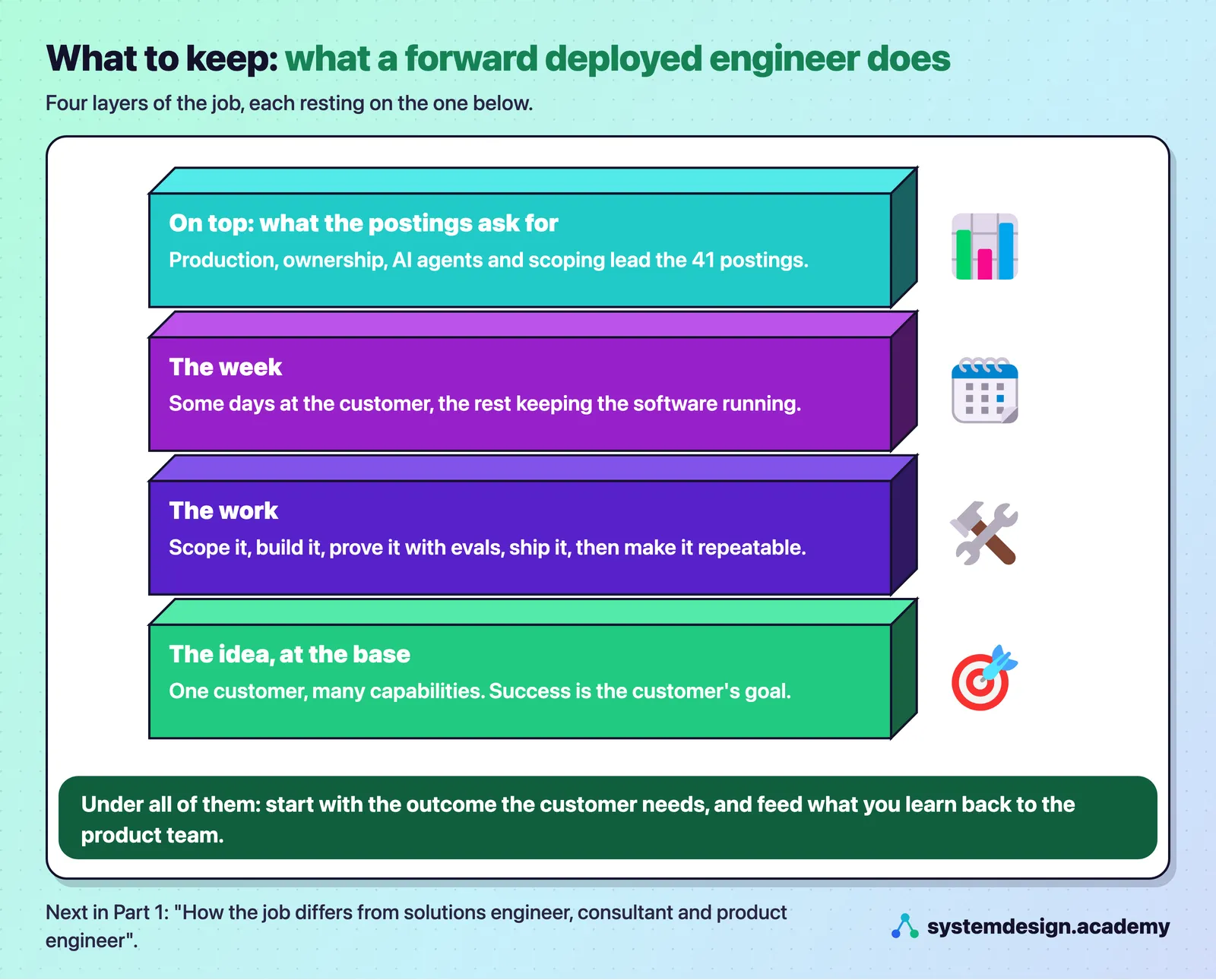
The next lesson in Part 1, "How the job differs from solutions engineer, consultant and product engineer", compares those roles in depth from real job postings. After it, "Meet Bramfield Mutual, the customer in this course" introduces the customer you will work with for the rest of the course.
Sources
Every source below was read and saved on 13 November 2026.
First-party posts by the companies
- Palantir Blog, "Dev versus Delta: Demystifying engineering roles at Palantir", 8 April 2019: https://blog.palantir.com/dev-versus-delta-demystifying-engineering-roles-at-palantir-ad44c2a6e87
- OpenAI, "What FDE means at OpenAI", by Colin Jarvis, Head of Forward Deployed Engineering, 22 October 2026: https://openai.com/index/forward-deployed-engineering-means/
- Salesforce careers blog, "Back to Build: Why Agentforce Inspired 3 FDEs to Return to Salesforce", by Dani Laven, 15 November 2025: https://www.salesforce.com/blog/fdes-back-to-build-agentforce/
- Ramp Builders blog, "Forward Deployed Engineering", by Leo Mehr, 5 August 2025: https://engineering.ramp.com/post/forward-deployed-engineering
Job postings quoted in this lesson
- Palantir, Forward Deployed Software Engineer, New York: https://jobs.lever.co/palantir/dab396d4-2f14-4796-aac0-0d82883dccf0
- Palantir, Forward Deployed Software Engineer, New Grad, Commercial: https://jobs.lever.co/palantir/2e6b0ac8-83e9-4be5-a3aa-cf319f751728
- OpenAI, Forward Deployed Software Engineer, San Francisco: https://jobs.ashbyhq.com/openai/00207abc-49b7-465c-a219-f7c1140f8047
- Anthropic, Forward Deployed Engineer, London: https://job-boards.greenhouse.io/anthropic/jobs/5423029008
- Salesforce, Forward Deployed Engineer (FDE) (Mid/Senior Level), JR349466: https://salesforce.wd12.myworkdayjobs.com/External_Career_Site/job/California---San-Francisco/Forward-Deployed-Engineer--All-Levels-_JR349466
- Salesforce, Forward Deployed Engineer (FDE), Agentforce Orchestration, JR357427: https://salesforce.wd12.myworkdayjobs.com/External_Career_Site/job/Georgia---Atlanta/Forward-Deployed-Engineer--FDE----Agentforce-Orchestration_JR357427
- Salesforce, Deployment Strategist (Mid/Senior Levels), JR349467: https://salesforce.wd12.myworkdayjobs.com/External_Career_Site/job/California---San-Francisco/Deployment-Strategist--All-Levels-_JR349467
- Google, Forward Deployed Engineer, State and Local Government, Google Public Sector: https://www.google.com/about/careers/applications/jobs/results/90749541141095110-forward-deployed-engineer-state-and-local-government-google-public-sector
- Databricks, Senior Forward Deployed Engineer, Bengaluru: https://databricks.com/company/careers/open-positions/job?gh_jid=8629999002
- Ramp, Software Engineer, Forward Deployed, AI Solutions: https://jobs.ashbyhq.com/ramp/b614563f-3ce6-4dca-b5ba-0e5a6c8bda27
- Sarvam, Deployment Strategist, Bengaluru: https://jobs.ashbyhq.com/sarvam/48c228f1-0762-4d4e-9d83-ae8f751ce19d
- Gushwork, Forward Deployed Engineer, Bengaluru: https://jobs.lever.co/gushwork/bf544796-090e-47fd-b05d-79b0b5339f92
- Prodigal, Forward Deployed Engineer, AI Agents, Bengaluru: https://job-boards.greenhouse.io/prodigal/jobs/5260510007
- Composio, Forward Deployed Research Engineer: https://jobs.ashbyhq.com/composio/018e087b-d1cf-4761-8fbd-fc3f2e5aac81
- Ema, Forward Deployed Builder: https://jobs.ashbyhq.com/ema/b6114740-f6a9-4d98-8d2c-6c6017ba9417
The skills counts
- 41 postings from 18 companies (Anthropic, Cohere, Composio, Cursor, Databricks, ElevenLabs, Ema, Glean, Google, Gushwork, Neuron7, OpenAI, Palantir, Prodigal, Ramp, Salesforce, Sarvam and Scale AI), read from the companies' public job boards (Greenhouse, Ashby, Lever, Salesforce's Workday search, and Google's careers site) on 13 November 2026. The full list with every URL, the search patterns and the counts are kept with the course research, and the number of matching titles per company (Databricks 118, Palantir 95, OpenAI 39) is from the same pull.