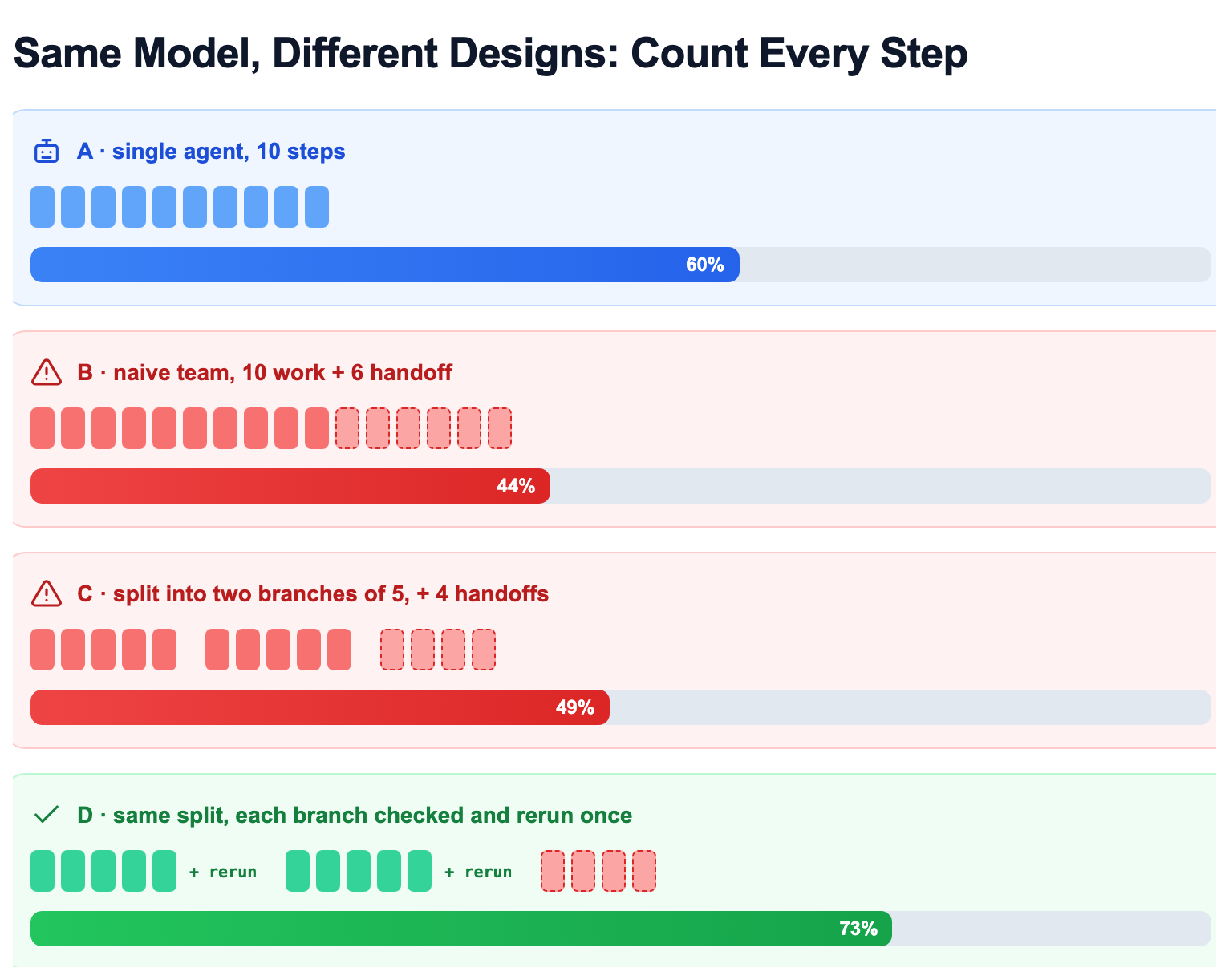
Most multi-agent designs fall into one of two shapes.
The first is the orchestrator with subagents, sometimes called orchestrator-worker. The orchestrator plans, then hands each subagent a narrow task with only the inputs it needs. Each subagent starts with a fresh context, does its part, and returns a short summary, not its full transcript. The orchestrator merges the summaries.
The orchestrator is best seen as a small state machine, not a fourth chatbot. It moves through plan, dispatch, gather and merge, then decides: is the goal met, or is another round needed? Because one component changes the state and one component decides "again or done", the run has a single spine you can trace and checkpoint. Durable execution then lets each branch be its own recorded, resumable unit.
The second is the swarm: a group of peer agents with no single leader, which read and write a shared state directly. It looks flexible. In practice it is where multi-agent systems fall apart, for reasons covered below.