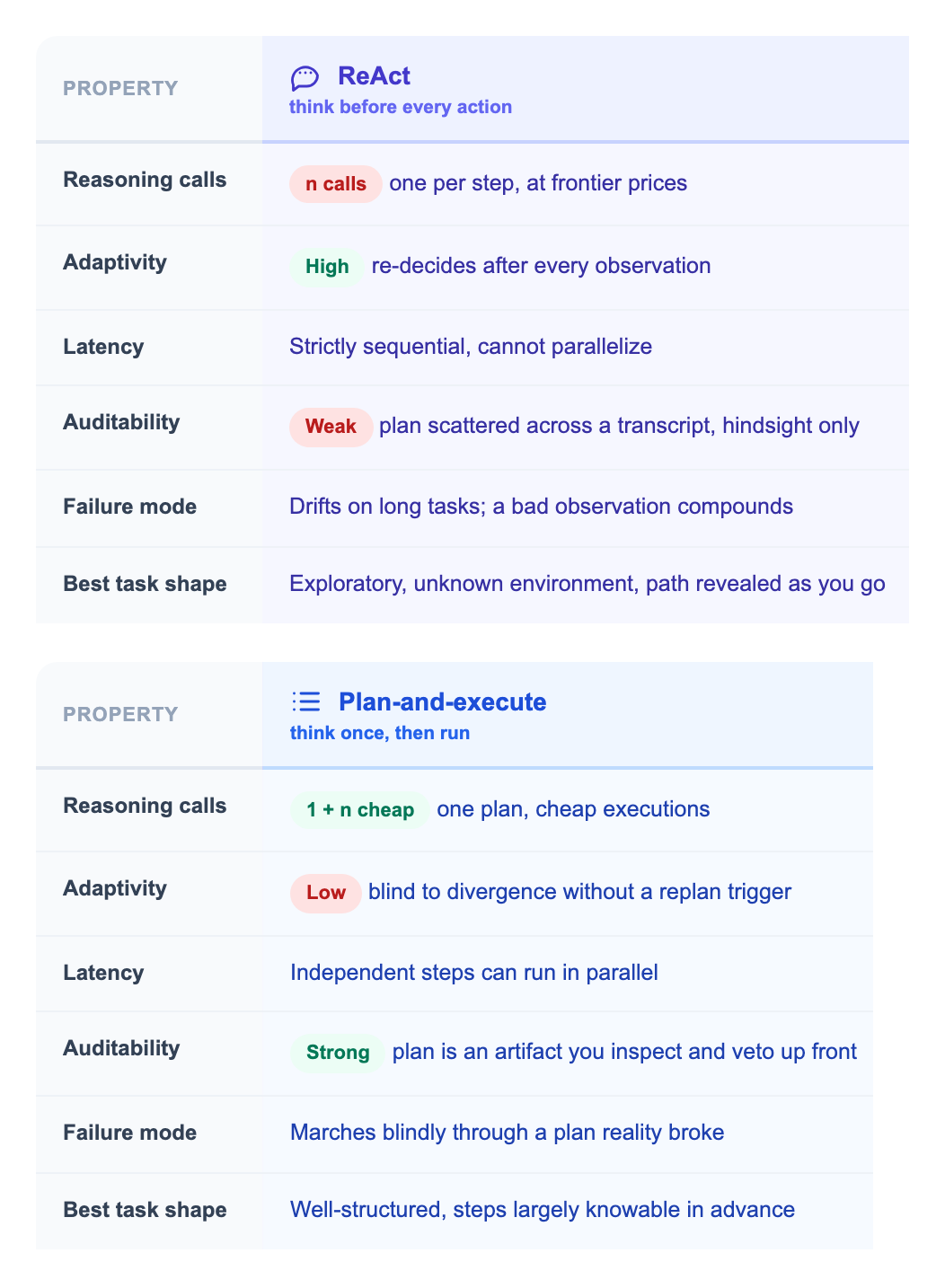
Adaptivity is not free. Two costs stack up.
First, the call count. A task of n steps needs n reasoning calls. Each one usually goes to a large, capable model, because the whole idea of ReAct is that a smart model reasons at every step.
Second, the growing context. The context is everything the model sees on a call. In ReAct, each call replays the whole transcript so far: every thought, action and observation. So the input tokens climb step after step. Late in a long task, one step reasons over far more text than the first step did, and pays full price to do it.
There is a latency cost too. Step k cannot start until the model has seen the result of step k minus one. So the steps run strictly one after another and cannot run in parallel.
Long transcripts also hurt quality, not just cost. A model reads a very full window worse than a short one. That effect is called context rot, and the context rot lesson measures it.