System design interview guide
Design a News Aggregator like Google News: Feeds, Dedup, Story Clustering and Ranking
Two courses by the author of this page:
770 lessons · 18 free to read
₹499 in India · $49 elsewhere, once
Get System DesignYou own this course
204 lessons · 10 free to read
₹999 in India · $49 elsewhere, once
Get AI EngineeringYou own this course
A news aggregator reads articles from thousands of news sites and shows them in one place, grouped by story. Take 200,000 feeds checked every 5 minutes: that is about 670 requests every second, all day, to other people's servers. Say they bring in 1 million new articles a day. Many of those are copies of one wire story, and many more are different articles about one event. A news story is worth most in its first few hours. So the system has three jobs: notice new articles fast without overloading anyone, collapse copies and group the rest into stories, and rank stories so fresh and important ones come first, for 100 million readers.
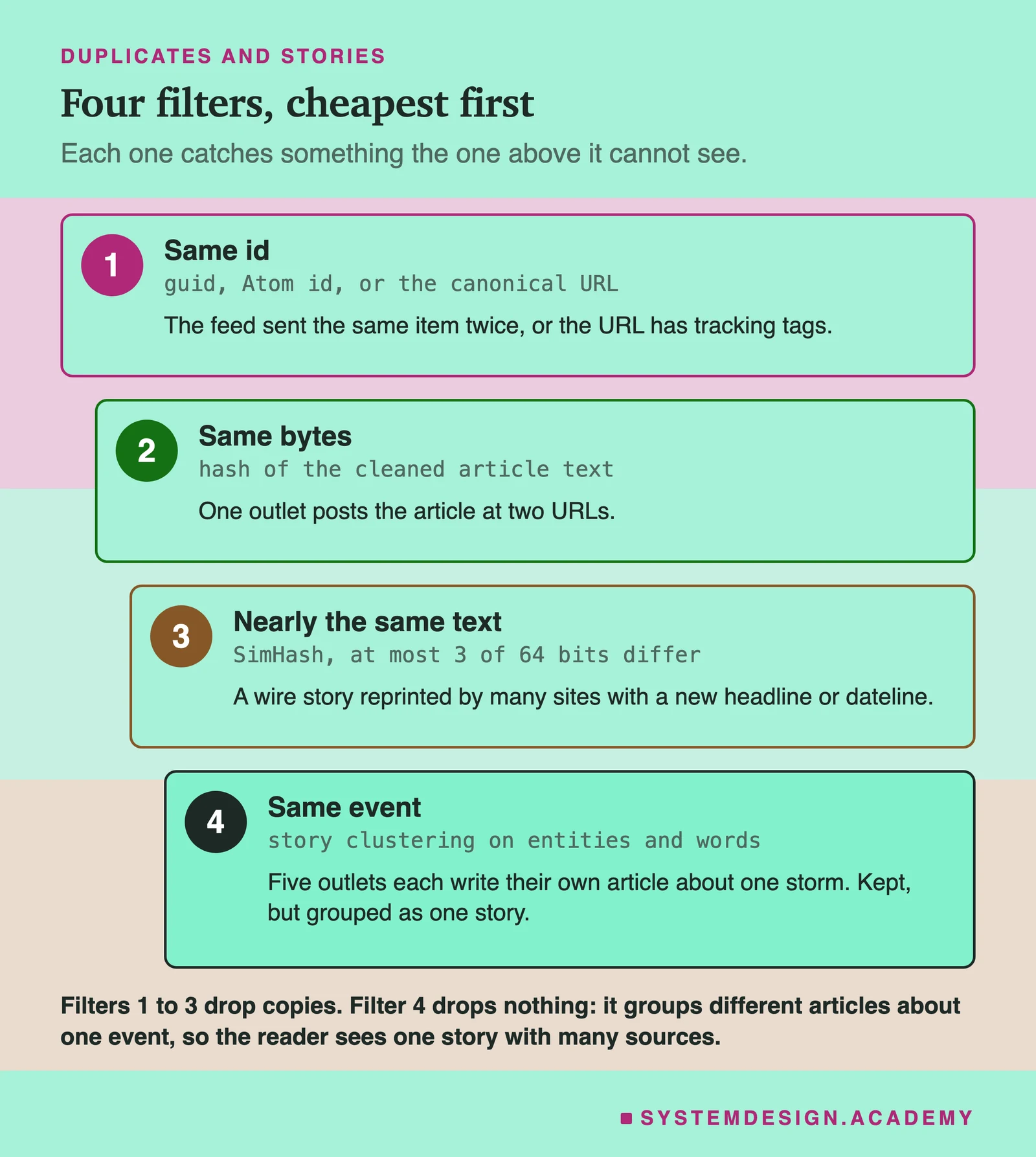
A news aggregator such as Google News works as a pipeline. First, fetchers collect new articles from publishers. A publisher's feed is a small file (RSS or Atom) that lists its newest articles. The fetchers poll each feed on a schedule. To poll is to ask again and again whether anything changed. Where a publisher supports WebSub, a hub pushes new items to us instead. The fetchers obey robots.txt, a file in which each site lists what crawlers may fetch, and limit how often they hit each site. Second, each article is cleaned and checked for duplicates in four steps, from cheapest to most costly: same id or URL, same text hash (a short code computed from the text, equal only for equal texts), nearly identical text (SimHash, a 64-bit fingerprint where copies differ in at most 3 bits), and same event. The last step, story clustering, keeps every article but groups those about one event into a single story. Third, a ranking job scores each story about once a minute. A good score mixes freshness (score halves every few hours), importance (how many publishers cover it) and location and language. It writes one ranked list per edition and section to a cache. Fourth, each page view reads those shared lists and re-ranks a few hundred candidates for the reader, using their interests. Signed-out readers get a cached global page. Copying every story into each reader's own feed would cost trillions of writes a day, so the design ranks shared lists once and personalizes on read.

Where it shows up
A news aggregator is a common practice problem in system design interview preparation, under names such as 'design Google News' or 'design a news feed aggregator'. It also sits inside other questions: design a web crawler, design a news feed, design a recommendation system, design a search engine. Google described the personalization behind Google News in a 2007 paper, and Google engineers described their near-duplicate check for web pages in another 2007 paper. Both are on this page.
Spec sheeta News Aggregator
- 01Feed checks
- about 670 requests a second
- 02New articles
- about 12 a second, peaks near 60
- 03Article storage
- about 10 GB a day
- 04Fingerprint index
- 240 MB, fits in memory
worked through below, with the maths
Why this question is asked
This question tests four skills at once, and each one hides a trap. The first is pulling data from systems you do not own. Publishers are slow, change formats, go down, and can block you, so you have to be polite and patient. The second is deciding when two things are the same. An exact match catches very little, because copies differ by a headline or a dateline. A candidate who knows near-duplicate fingerprints, and who also knows that a copy and a different article about one event are two separate problems, stands out. The third is trading freshness against importance in one score, with numbers. The fourth is the fan-out question, and it is the one that most often goes wrong. Many candidates bring the social feed answer, which writes each new post into every follower's feed. News has a different shape: every reader in a region draws from one pool of a few thousand fresh stories. Spotting that, and ranking shared lists once, is what the interviewer most wants to hear.
This page is the free part.
The course goes deeper on the News Aggregator design
₹499 in India$49 everywhere elseonce, for the whole course
The System Design course covers the News Aggregator design across a run of lessons, not one page. These 4 alone are about 70 minutes of step-by-step reading, every one with a quiz.
- Polling
The simplest way to check for new data, ask repeatedly until something changes.
- Webhooks
Don't call us, we'll call you, server-to-server event notifications over HTTP.
- Pub/Sub Pattern
One publisher, many subscribers, the pattern that powers event-driven systems at scale.
- Message Queues
Decouple producers from consumers with a buffer that holds messages until they're processed.
all part of
System Design Masterclass
770 lessons · about 283 hours · 18 free to read
₹499in India, by UPI
$49everywhere else, by PayPal
The concepts were explained in a clear and structured way, with practical examples that made even complex system design topics easier to understand. I especially liked the focus on real-world architecture, scalability, trade-offs. The content was well designed, engaging, and highly useful for anyone looking to strengthen their system design skills. Highly recommended for software engineers preparing for system design interviews or wanting to build a stronger foundation in designing scalable systems.
You own this course
Continue with Pollingpay once,
yours for life
Live from the course bench
Before you design News Aggregator like Google News, try the questions it rests on.
Real interview questions, live diagrams and measured lab results, pulled at random from the lessons. A new set every time you come back.

Requirements
Always clarify these in the first 5 minutes of the interview. Do not start drawing boxes until both lists are agreed.
Functional requirements
- Collect new articles from publisher feeds (RSS and Atom) and, where a publisher offers it, from WebSub push notifications
- Fetch the full article page when the feed holds only a summary, while obeying each site's robots.txt
- Drop exact and near-exact copies of an article, so a reprinted wire story appears once
- Group different articles about one event into a story, and pick a lead article for it
- Put each story in one or more sections (World, Business, Technology, Sports and so on) and tag its language and region
- Show top stories per edition (a region plus a language, such as US English) and per section
- Show a personal 'For you' feed to signed-in readers, based on topics they follow and stories they clicked
Non-functional requirements
- Freshness: an article appears on the site within minutes of the publisher posting it
- Politeness: never overload a publisher, and back off when a site slows down or returns errors
- Fast reads: a feed page in well under a second, with personalization in a few hundred milliseconds of that
- High availability for reading: if ingestion stops, readers still see the last good lists
- Copies collapse reliably, while two different articles about one event are never thrown away
- Scale to hundreds of thousands of feeds, a million articles a day and a hundred million daily readers
Back-of-envelope scale estimates
Show your math. Pulling numbers from thin air signals you have not thought about the load.
Feed checks
about 670 requests a second
Assume 200,000 feeds (many publishers have one feed per section), each checked every 5 minutes on average. 200,000 / 300 seconds = 667 requests a second, or 57.6 million a day. These are interview assumptions: say them out loud first. Most checks find nothing new and return a short 304 Not Modified answer with no body.
New articles
about 12 a second, peaks near 60
Assume 1,000,000 new articles a day. 1,000,000 / 86,400 seconds = 11.6 a second on average. When big news breaks, assume 5 times that: about 58 a second. As a write rate this is small. The cost is the work done on each article: fetching the page, cleaning it, fingerprinting it and clustering it.
Article storage
about 10 GB a day
Assume 10 KB per article for the cleaned text plus its metadata (title, URL, times, fingerprint, story id). 1,000,000 x 10 KB = 10 GB a day, or 3.65 TB a year for one copy. With 3 copies for safety, about 11 TB a year. Images are not stored; the page links to the publisher's own.
Fingerprint index
240 MB, fits in memory
Keep SimHash fingerprints (8 bytes each) for the last 30 days: 30 x 1,000,000 x 8 bytes = 240 MB. The fast lookup in the deep dive files each fingerprint under 4 keys, so about 960 MB of keys, which still fits on one machine. Each lookup finds about 30,000,000 / 65,536 = 458 candidates per key, so about 1,831 cheap bit comparisons per new article.
Feed page views
about 5,800 a second, peaks near 17,400
Assume 100 million daily readers, each opening the feed 5 times a day: 500 million page views a day. 500,000,000 / 86,400 = 5,787 a second on average. Assume the busiest hour is 3 times the average: 17,361 a second.
Personalize on read
about 8.7 million scores a second at peak
Each signed-in page view re-ranks about 500 candidate stories. 17,361 x 500 = 8.7 million story scores a second at peak. Each score is a few multiplications on data already in memory, spread over all the feed servers.
Precompute every reader instead?
111,000 feed builds a second
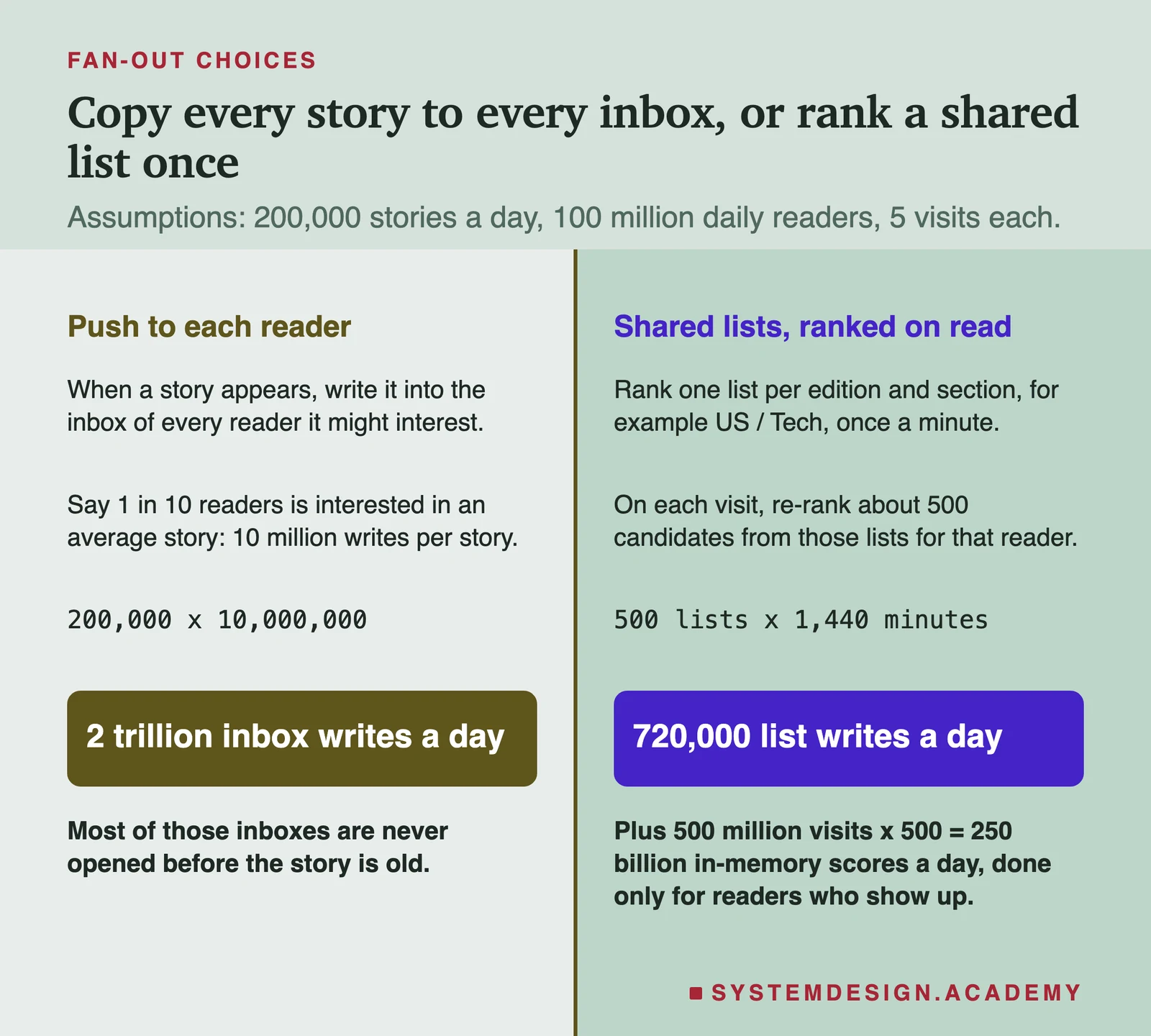
Rebuilding all 100 million personal feeds every 15 minutes is 100,000,000 / 900 = 111,111 builds a second. That is 6.4 times the peak page-view rate, and most of those feeds would never be opened before they went stale. This number is the main argument for ranking on read.
Shared top-story lists
500 lists, under 1 MB in total
Assume 50 editions x 10 sections = 500 lists. Each holds 200 story ids of 8 bytes: 1.6 KB. 500 x 1.6 KB = 800 KB. Rebuilt once a minute, that is 500 x 1,440 = 720,000 list writes a day, which is tiny.
High-level architecture
Draw two halves. The left half collects and understands articles, and it never stops. The right half serves readers, and it works only when someone opens the page. Between them sit two stores. On the left, a feed scheduler keeps a list of every feed and the time each one is next due. It hands due feeds to a pool of fetchers. Fetchers are grouped by host, the website's domain name, so one host only ever gets a small, fixed number of requests at once. A fetcher sends a conditional request: it asks for the feed only if it changed since the last visit. If the feed changed, the fetcher reads the new items, and fetches the full article page when the feed holds only a summary. It checks robots.txt before fetching any page. Publishers that support WebSub push new items to a callback URL of ours, which joins the polling path. Every new item is written to an article log: Apache Kafka, a durable, ordered list of messages that many workers can read at their own pace. The log decouples fetching from processing. If processing falls behind during breaking news, items wait in the log and nothing is lost. Processing workers read the log. Each one cleans the article text, detects the language, and runs the duplicate checks: exact id, exact text hash, then a SimHash near-duplicate check. Unique articles go to the story clusterer, which either adds the article to an existing story or starts a new one. A classifier, a model trained to sort articles, assigns sections. The results are saved in the article store, a database sharded by article id (split across machines by a hash of the id). The story store holds each story's articles, counts and scores. On the right, a ranking job runs about once a minute. For every edition and section it scores the fresh stories and writes a ranked list of story ids to Redis, an in-memory key-value store. The feed API servers, which answer the app's and website's requests, keep a copy of each list in their own memory. A signed-out reader gets the global page, which a CDN (content delivery network, servers near readers that cache pages) can serve for a few seconds at a time. For a signed-in reader, the feed API takes a few hundred candidates from the relevant lists, re-ranks them with that reader's interest profile, and returns the page. Clicks flow back through a second log into a job that updates each reader's profile.
In a real interview, sketch this on the whiteboard before diving into any single box.
One article, from a publisher to a reader's screen
Follow a single article through the system. This is a good order to explain it in an interview.
- 1
Due
The scheduler sees that the Technology feed of a news site is due. Its last check, 6 minutes ago, saved the feed's ETag, a version tag the server sent back.
- 2
Checked
A fetcher for that host sends GET with If-None-Match and the saved ETag. The feed changed, so the server returns 200 with the new file. Had nothing changed, it would return 304 with no body.
- 3
Item found
The fetcher reads one new item. It has a guid, the RSS item id, so the fetcher checks a fast 'seen ids' set. It is new. The fetcher checks robots.txt and fetches the full article page.
- 4
Logged
The raw item and page go into the Kafka article log, keyed by host. The fetcher's work is done.
- 5
Cleaned and checked
A worker strips menus and ads, detects English, and hashes the text: no exact match. Its SimHash differs from an article seen an hour ago in only 2 of 64 bits, so it is a reprint of a wire story. It is linked to the original and not shown on its own.
- 6
Clustered
A second outlet's own article about the same event is not a copy. The clusterer finds a story from the last 48 hours that shares its people, places and key words, and adds it there. The story now has 12 publishers.
- 7
Ranked
Within a minute the ranking job scores the story: high importance (12 publishers), high freshness (one hour old). It enters the US English Technology list and the US top-stories list in Redis.
- 8
Served
A signed-in reader opens the app. The feed API reads both lists from memory, adds candidates from topics the reader follows, re-ranks about 500 stories with the reader's profile and returns the top 30. The story is near the top.
- 9
Learned from
The reader taps the story. The click goes into the click log, and the profile job raises the weight of Technology for that reader.
Core components
Walk through each service. The interviewer wants to hear what each one owns, not just the names.
Feed registry and scheduler
Holds every feed: its URL, its publisher, its saved ETag and Last-Modified values, its current poll interval and the time it is next due. A busy feed is checked more often and a quiet one less often. The scheduler hands due feeds to fetchers, grouped by host.
Fetchers (the polite part)
Workers that download feeds and article pages. All requests to one host go through one queue, so the per-host limit holds even with many workers. They cache robots.txt per host, send conditional requests, and slow down when a host answers slowly or with errors.
WebSub subscriber
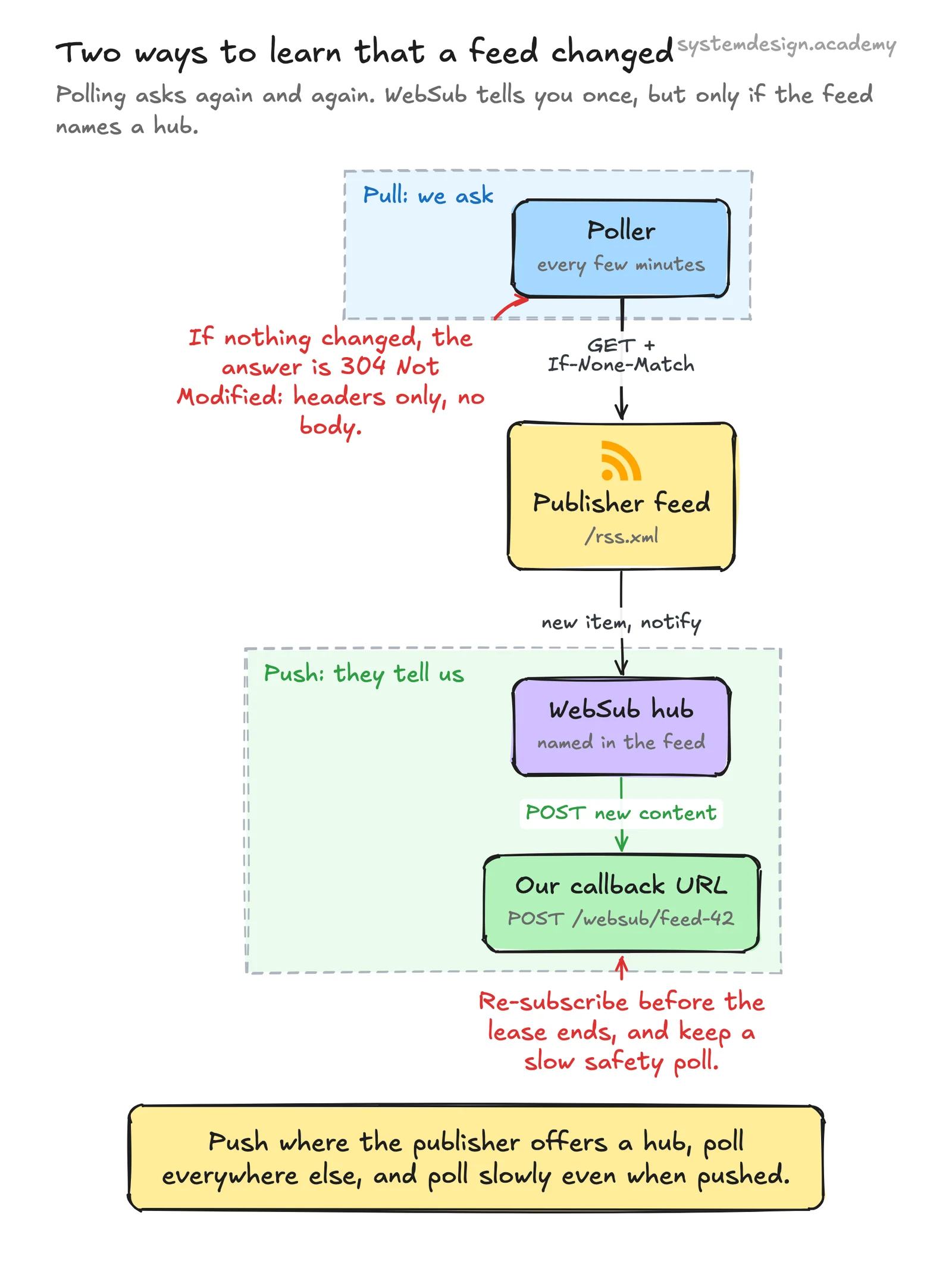
A web endpoint that receives pushed updates. WebSub is a W3C standard with three roles: the publisher, a hub that the feed names, and a subscriber (us). We subscribe at the hub, prove we own our callback URL, and then receive new content as POST requests. Subscriptions have a lease, a time limit, so a job renews them before they expire.
Article log (Kafka)
A durable, ordered log between fetching and processing. It absorbs bursts: when a huge story breaks, the log grows for a few minutes and the workers catch up. Workers can be added or restarted without losing articles. Messages can be read more than once after a crash, so every later step must be safe to repeat.
Dedup service
Runs the duplicate checks from cheapest to most costly: a set of seen ids and canonical URLs, an exact hash of the cleaned text, and a SimHash index for near-copies. A copy is linked to the original article, so its publisher can still be counted, but it is not shown as a separate item.
Story clusterer
Groups different articles about one event into a story. It compares a new article with stories from the last day or two that share its people, places, organisations and key words, joins the best match above a threshold, or starts a new story. A slower background job later merges stories that should be one.
Classifier
Gives each article one or more sections, a language and a region. It uses hints from the publisher (the feed it came from, the RSS category element) and a text model trained on labelled articles. A story takes the sections most of its articles have.
Ranking job and top-story cache
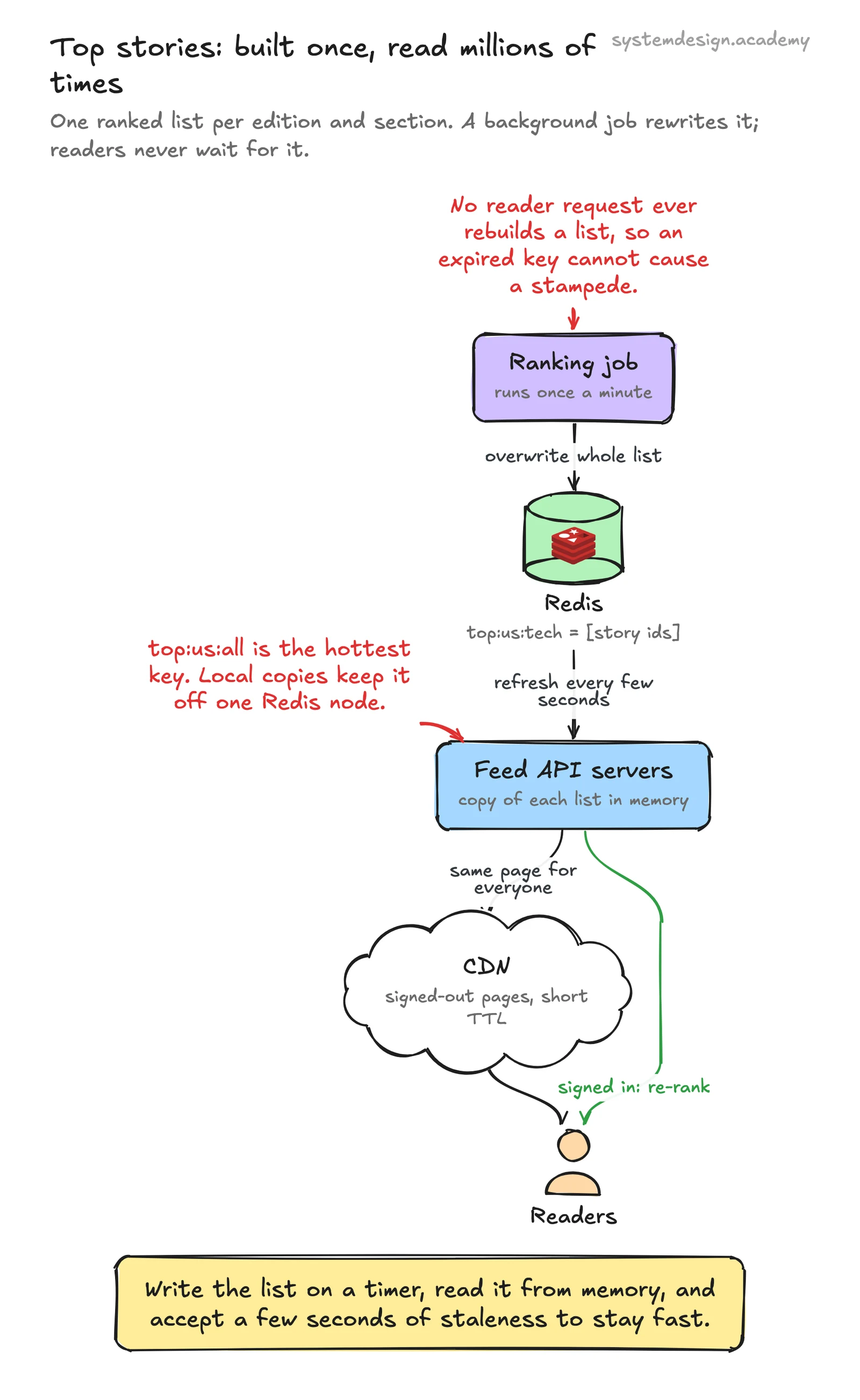
Once a minute, scores the fresh stories for each edition and section and writes a ranked list of story ids to Redis. Readers never trigger a rebuild, so a list never goes missing under load. The feed servers keep their own in-memory copy of each list.
Feed API and profile service
Builds the page. Signed-out readers get the shared list for their edition. Signed-in readers get a few hundred candidates re-ranked with their profile: topic weights learned from their clicks, sources they follow or hide, and stories they already read.
Data model
Pick the right store per table. Justify each choice with the access pattern, not by reflex.
feedsfeed_idurlpublisher_idetaglast_modifiedpoll_interval_snext_due_atwebsub_hublease_expires_atOne row per feed. The scheduler reads the rows whose next_due_at has passed. Saving etag and last_modified is what makes most checks cheap. The websub fields are empty for feeds that do not name a hub.
articlesarticle_id (hash of canonical URL)guidpublisher_idtitlesummarybody_textpublished_atfirst_seen_atlangsimhash (64-bit)duplicate_ofstory_idSharded by article_id. Using a hash of the canonical URL as the key makes writes safe to repeat: a replayed message writes an identical row again. published_at comes from the publisher and can be wrong or missing, so ranking uses first_seen_at, the time we first saw it.
storiesstory_idlead_article_idfirst_seen_atlast_article_atarticle_countpublisher_countsectionsregionlangaverage word weightsOne row per cluster of articles about one event. publisher_count counts different publishers, so one site posting five times does not look like five sources. When two stories are merged, the old id points to the new one, so cached lists and shared links keep working.
top_lists (Redis)key: top:{edition}:{section}value: ranked story idsbuilt_atWritten whole by the ranking job about once a minute. Only ids are stored. Titles and images are fetched for the 30 or so stories on screen, usually from a cache.
user_profilesuser_idtopic_weights (decayed)followed_sourceshidden_sourcesrecent_story_idsUpdated from the click log. Weights decay over time, so last week's clicks count more than last year's. recent_story_ids lets the feed hide stories the reader has already opened.
Deep dives
These are the conversations the interviewer is steering you toward. Practice each one until you can talk through it without notes.
Ingestion: polling feeds, WebSub push and polite fetching
Most publishers offer a feed. RSS 2.0 and Atom are the two common formats. Both are small text files, written in a format called XML, that list the newest articles with a title, a link, a summary and a date. The simplest way to learn about new articles is to poll: download the feed on a timer and look for items not seen before. Polling 200,000 feeds every 5 minutes is about 670 requests a second, so each request must be cheap. HTTP conditional requests make it cheap. On each visit, save the ETag (a version tag) and the Last-Modified time the server sent. Next time, send them back in If-None-Match and If-Modified-Since. If nothing changed, the server answers 304 Not Modified, and by the HTTP standard a 304 carries no body. Next, choose the poll interval per feed. A wire service's main feed may change every minute; a small blog's changes once a week. A simple rule works well: halve the interval when a check finds new items, grow it by half when it finds none, and keep it between 2 minutes and 1 hour. RSS also lets a publisher give hints. The ttl element is the number of minutes a feed may be cached before it is checked again, and skipHours and skipDays name times an aggregator can skip. Push is the alternative. WebSub is a W3C Recommendation (W3C is the body that writes web standards). A feed names a hub; we send the hub a subscription request with our callback URL. The hub checks that we really asked by sending a random challenge string, which we must echo back. After that, when the publisher tells the hub about new content, the hub POSTs it to our callback. We can give a secret, and the hub then signs each delivery with an HMAC (a keyed hash) in the X-Hub-Signature header, so we can reject fakes. Subscriptions expire after the lease, so we must renew them. Push is fast, but a lost push is silent, so keep a slow poll running behind every subscription. Finally, politeness. Feeds often hold only a summary, so the fetcher downloads the article page too. Before fetching any page on a host, it reads that host's robots.txt. RFC 9309 says a crawler should not use a cached copy for more than 24 hours. If robots.txt returns a 4xx error (a client error such as 404 Not Found), the crawler may fetch anything; if it returns a 5xx error (the server itself failed), the crawler must assume it may fetch nothing. Put all requests for one host in one queue, so the limit per host holds however many workers you run. Google's crawlers apply a crawl capacity limit per site: when a site slows down or answers with 5xx or 429 (too many requests), the limit goes down. Retry a failed fetch after a wait that doubles each time (exponential backoff), and stop after a few tries, so a broken site never gets a storm of retries from us. The web crawler walkthrough on this site covers the URL frontier and politeness queues in more depth; a news aggregator needs a much smaller version of it, because it knows its sources in advance.
MIN_S, MAX_S = 120, 3600  # 2 minutes to 1 hour

def next_interval(current_s, new_items, ttl_min=None):
    if new_items > 0:
        nxt = current_s / 2    # busy feed: come back sooner
    else:
        nxt = current_s * 1.5  # nothing new: back off
    if ttl_min:                # RSS <ttl>: cache this long
        nxt = max(nxt, ttl_min * 60)
    return int(min(MAX_S, max(MIN_S, nxt)))

print(next_interval(600, 3))      # 300
print(next_interval(600, 0))      # 900
print(next_interval(600, 3, 60))  # 3600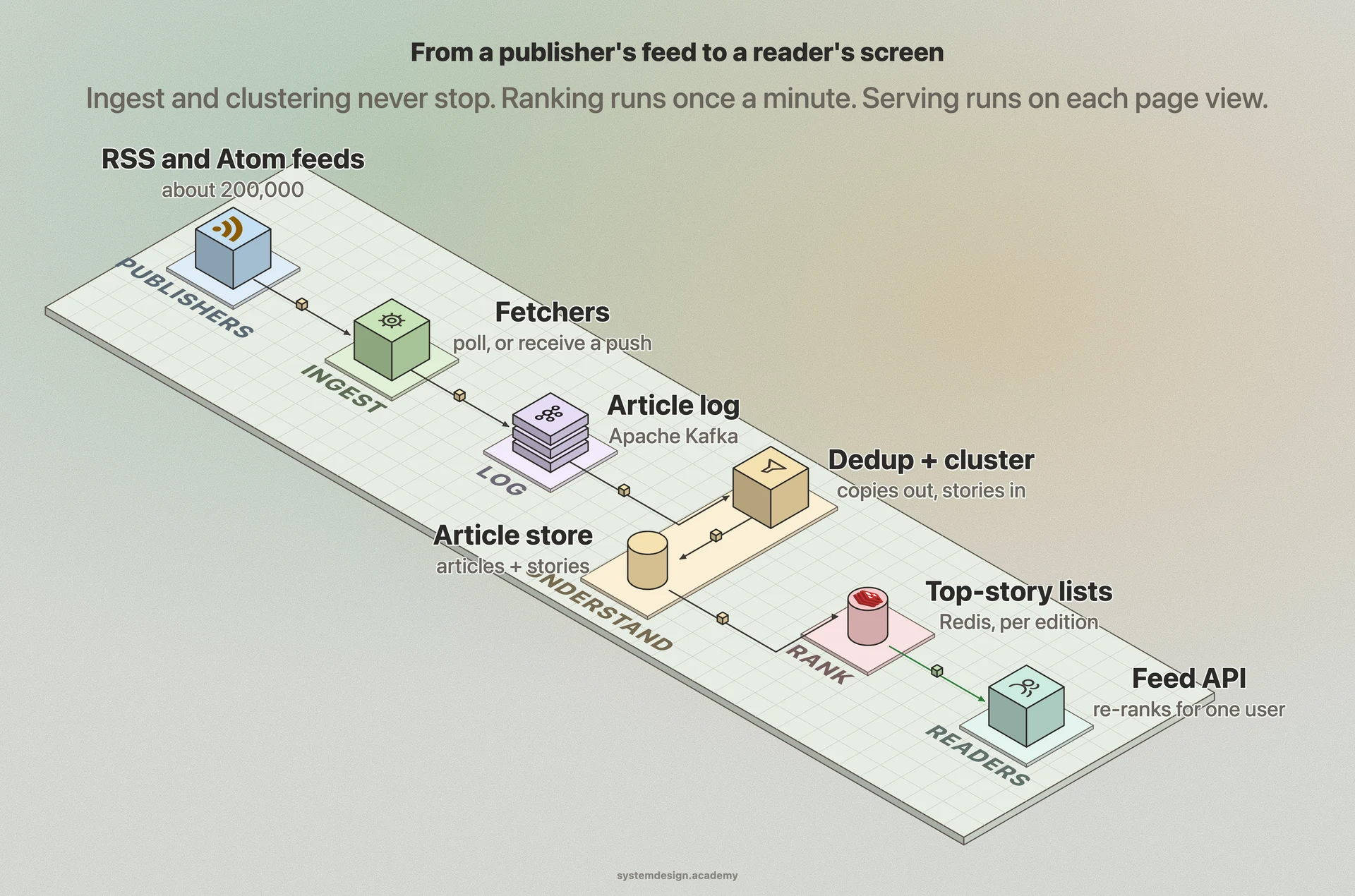
Giving each article one identity
Before you can find copies, you need to know when two items are the very same article. That is harder than it looks. In RSS 2.0 every element of an item is optional, including the guid, the item's unique id. When a guid is present, the spec says an aggregator may use it to decide whether an item is new. Atom is stricter: every entry must have exactly one id, a permanent and unique identifier. So the rule is: use the guid or Atom id when there is one, and fall back to the article URL. URLs need cleaning first. Remove tracking parameters such as utm_source, lower-case the host, drop the fragment after #, and follow the page's canonical link (a tag in the page that names the preferred URL). The article_id is then a hash of that canonical URL. Using it as the database key makes every write safe to repeat. Kafka can deliver a message twice after a crash, and writing a row twice changes nothing. To make the first check fast, keep the ids seen in the last few days in a set in memory, or in a Bloom filter, a compact structure that answers 'definitely new' or 'probably seen' using a few bits per item. A 'probably seen' answer is then confirmed in the database. Timestamps need care too. The publisher's published date can be missing, wrong, or in another time zone, and some sites re-date old articles. Store it, but rank on first_seen_at, the time this system first saw the article, which you control.
Near-duplicate detection with SimHash
News is full of near-copies. A wire service sends one story to hundreds of sites, and each site prints it with its own headline, a dateline, or a line at the end. An exact hash of the text sees these as different. We need a fingerprint where similar texts get similar fingerprints. Two classic tools do this. Broder's shingling (1997) cuts a document into shingles, runs of a few words in a row, and measures how much two documents' shingle sets overlap; MinHash estimates that overlap from small samples. Charikar's SimHash (2002) builds a short fingerprint where the number of differing bits tracks how different two documents are. Google engineers tested SimHash for finding near-duplicate pages during web crawling. Manku, Jain and Das Sarma (WWW 2007) concluded that for 8 billion web pages, 64-bit fingerprints with a limit of k = 3 differing bits are reasonable. The method is short. Split the text into features (here, 3-word shingles). Hash each feature to 64 bits. Keep 64 counters. For each feature, add 1 to counter i if bit i of its hash is 1, and subtract 1 if it is 0. At the end, bit i of the fingerprint is 1 if counter i is positive. Small edits change only a few features, so only a few counters cross zero. The code below shows it. A dateline added to a 62-word story changed 3 bits; a different story changed 33. Finding matches among 30 million fingerprints needs one more idea. If two 64-bit fingerprints differ in at most 3 bits, then after cutting them into 4 blocks of 16 bits, at least one block is identical in both, because 3 differences can touch at most 3 blocks. So file each fingerprint under 4 keys, one per block. A new article looks up its 4 blocks, gets a few hundred candidates per block, and compares each one in full: an XOR (a bit operation that marks every bit where two numbers differ) and a count of the marked bits. The 2007 paper builds its sorted, permuted tables on this idea. One warning matters in an interview. The 3-bit limit was tuned on long web pages. News articles are shorter, and in the test below one changed word gave 4 bits. Tune the limit on labelled pairs of your own articles, and for short texts consider a smaller shingle size or MinHash.
import hashlib

def simhash(text, bits=64):
    w = text.lower().split()
    sh = [" ".join(w[i:i+3]) for i in range(len(w)-2)]
    v = [0] * bits
    for s in sh:
        d = hashlib.md5(s.encode()).digest()
        h = int.from_bytes(d[:8], "big")
        for i in range(bits):
            v[i] += 1 if (h >> i) & 1 else -1
    return sum(1 << i for i in range(bits) if v[i] > 0)

def distance(a, b):
    return bin(a ^ b).count("1")  # differing bits

# copy = "WASHINGTON " + wire
# distance(simhash(wire), simhash(copy))  -> 3
# distance(simhash(wire), simhash(other)) -> 33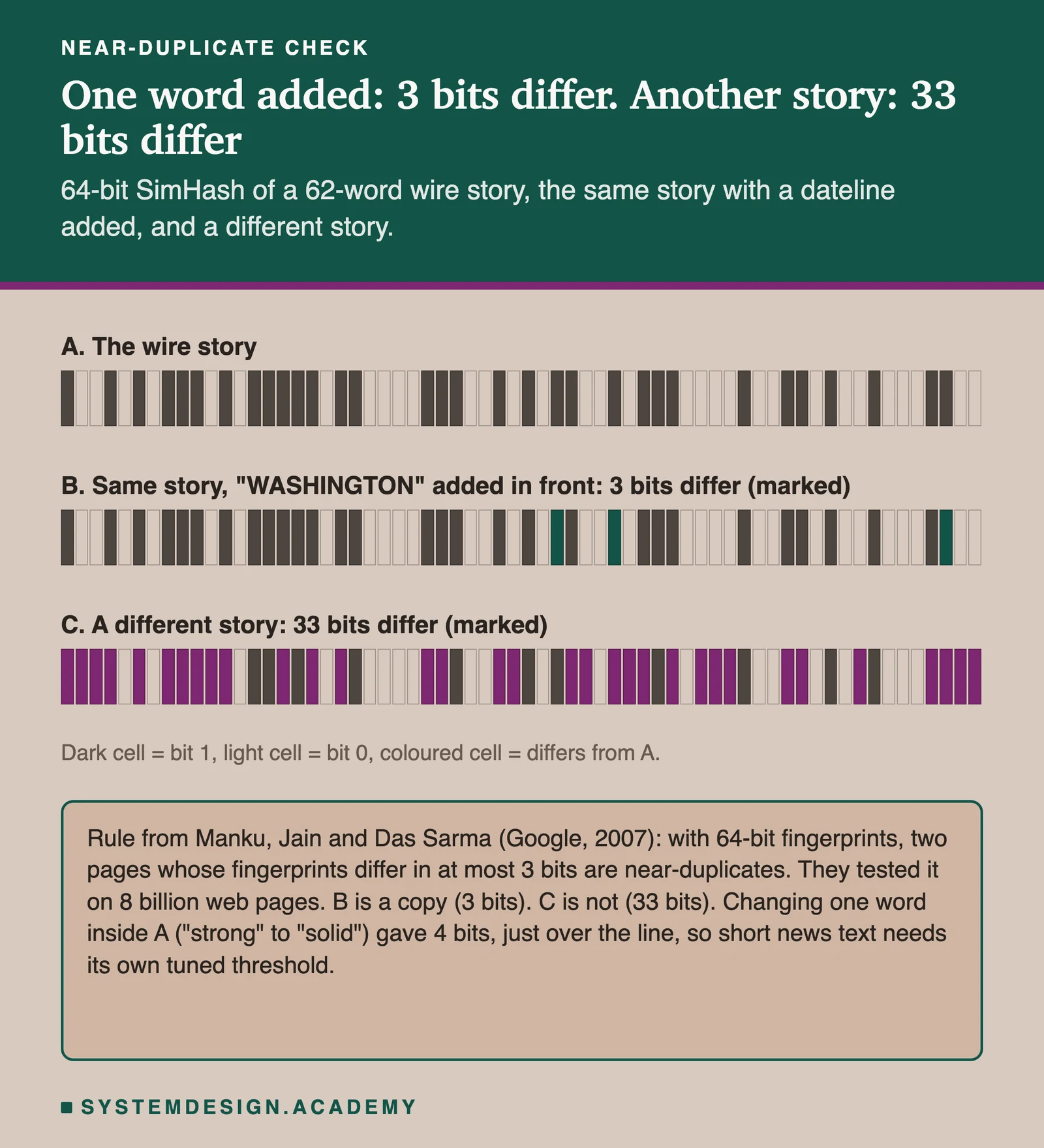
Story clustering: grouping different articles about one event
After copies are gone, many different articles about one event remain: five newspapers each write their own report on one storm. They share few sentences, so SimHash calls them different, and they are. Readers still want to see one story with five sources, so the next step is clustering: putting articles about one event in one group. Do it as each article arrives, so new stories show up fast. First, describe the article. Pull out named entities (people, places, organisations) and weight the other words with TF-IDF, a score that is high for words common in this article and rare across all articles. An embedding can be used as well: a list of numbers, made by a language model, that captures what a text means. Second, find candidates. Keep an inverted index, a lookup table from each entity or key word to the stories that contain it, covering only stories active in the last 48 hours. Looking up the new article's entities returns a handful of candidate stories, so you never compare it with everything. Third, decide. Measure cosine similarity (how closely two word-weight lists point the same way, from 0 to 1) between the article and each candidate's average. If the best score is above a threshold, join that story. If not, start a new one. Pick the threshold from pairs of articles that people have labelled. Online clustering makes mistakes in both directions. Two stories about one event can start apart and should later merge, and a story can grow so wide that it should split. Run a slower job every few minutes that re-clusters the last day of articles and fixes this. When two stories merge, keep the old id as a pointer to the new one, so cached lists and shared links never break. Watch for a race. Two workers can receive two articles about a brand-new event within one second, find no story, and each start one. Route articles by their main entity to one worker partition so they meet, and let the merge job catch the rest. Each story also needs a lead article, the one shown on top. Good signals are the first or most original report and the publisher's authority. Count publishers, not articles, so one site posting five updates does not look like five sources.
Categorization, language and region
Each story needs sections (World, Business, Technology and so on), a language and a region, because the front page is built per edition, which is a region plus a language. Start with the cheap hints. A publisher often has one feed per section, so an article from its technology feed is probably technology. RSS items can also carry category elements chosen by the publisher. Hints are noisy, so add a text classifier trained on labelled articles, and allow more than one section, because a story about a chip maker's results belongs in Business and in Technology. Detect the language from the text itself, not from the site, because many sites publish in more than one language. Region comes from the publisher's location and from the places named in the article; a local story belongs on local pages even when a national paper wrote it. A story takes the sections and region most of its articles agree on. Google's own help pages list location and language among the factors that rank Google News, next to relevance, prominence, authoritativeness, freshness and usability.
Ranking: freshness against importance
Two forces pull against each other. A story loses value every hour, so freshness must count. But the newest article is often a small one, and a major story from this morning should still beat it. So the score multiplies a strength by a freshness factor. Freshness as a half-life is easy to explain and tune: the factor halves every 6 hours, so it is 0.5 after 6 hours and 0.25 after 12. Strength comes from signals you can count. The number of different publishers covering the story is a strong one, because editors around the world have voted with their own articles. Use its logarithm, so going from 1 to 10 publishers counts as much as going from 10 to 100. Add the authority of the sources, the story's velocity (how fast new articles are joining) and, for a reader, how well the story matches their topics. Figure 5 shows a property that surprises people. When both stories decay at one rate, their order never changes after both exist. A new story beats an older one only if its strength is higher than the older one's strength, halved once for every 6 hours between them. So the strength must keep updating as publishers join: a story picked up by 30 more outlets has to be able to climb. Source quality matters as much as volume: a network of copycat sites or a content farm should add little, so keep a per-publisher authority score and a block list. Two more rules keep the list useful. Limit how many stories from one publisher appear near the top. And keep a small slot for stories that are fresh but not yet proven, so new events can be discovered before they have many publishers. Every weight here is a starting guess. Google's 2007 paper chose its weights by running live experiments and comparing clicks, and that is how you should tune them too.
import math

HALF_LIFE_H = 6.0  # a first guess; tune with live tests

def story_score(publishers, age_h, topic_match=0.0):
    strength = 1 + math.log1p(publishers) + 2 * topic_match
    freshness = 0.5 ** (age_h / HALF_LIFE_H)
    return strength * freshness

print(round(story_score(40, 6), 2))      # 2.36
print(round(story_score(4, 0), 2))       # 2.61
print(round(story_score(4, 0, 1.0), 2))  # 4.61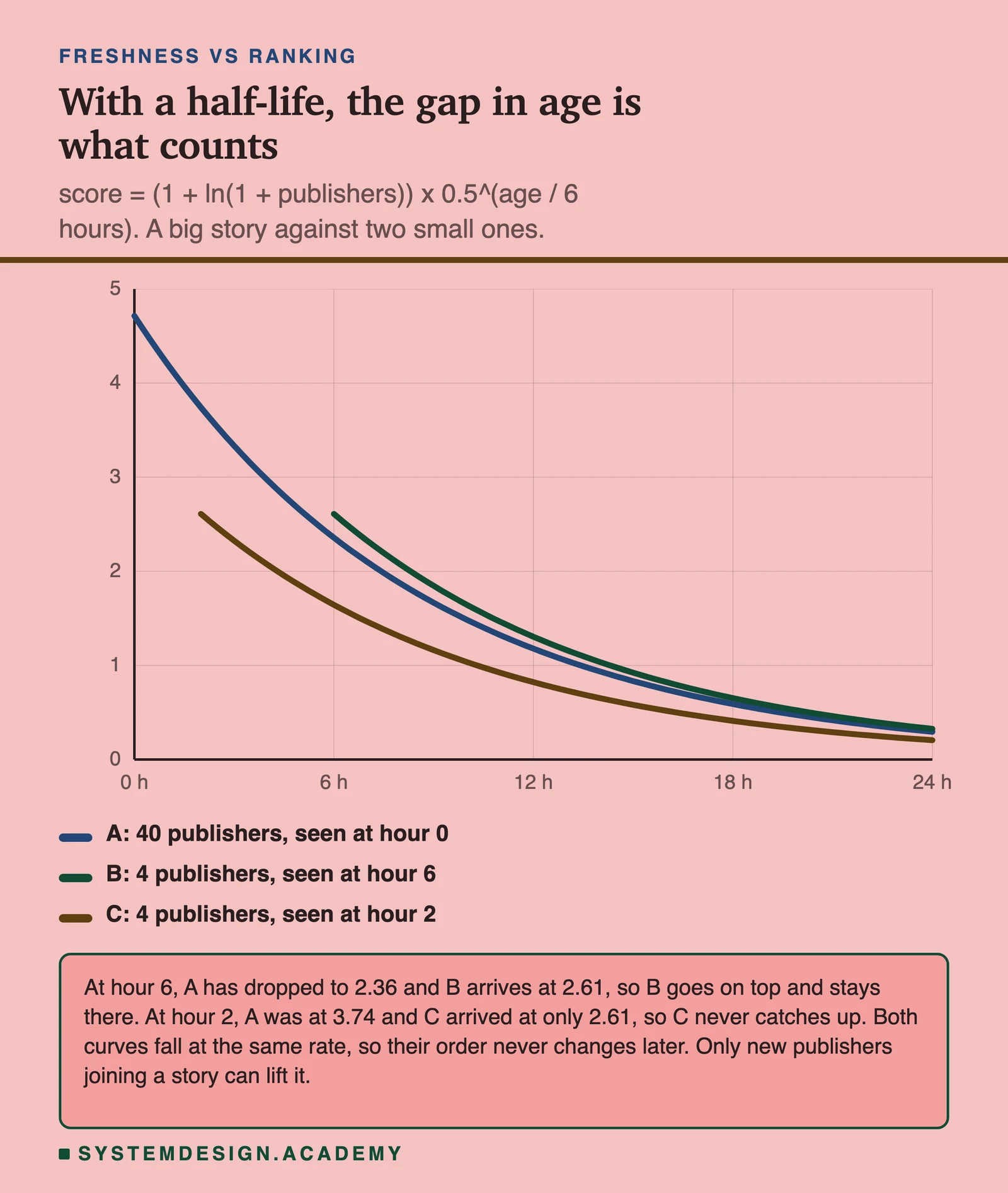
Personal feed vs global feed: fan-out and when to compute
Fan-out means sending one thing to many places. A social network usually fans out on write: when you post, your post is copied into the feed of each follower, so reading a feed is a quick lookup. The Meta news feed walkthrough on this site explains that design and its limits. Copy it onto news and the numbers break. Assume 200,000 stories a day (1 million articles, about 5 per story) and say 1 reader in 10 is interested in an average story. That is 200,000 x 10,000,000 = 2 trillion inbox writes a day, mostly for readers who will never open the app before the story is old. Precomputing each reader's whole feed on a timer is not much better: 100 million readers every 15 minutes is 111,111 feed builds a second, 6.4 times the busiest page-view rate. News has a different shape from a social feed. Each person follows different people, but every reader in an edition draws from the same few thousand fresh stories. So compute the shared part once and the personal part on read. The ranking job writes one list per edition and section once a minute. On each page view, the feed API takes a few hundred candidates from the lists that matter to this reader (their edition's top stories, the sections and topics they follow), drops sources they hid and stories they read, and re-ranks the rest with their profile. That is about 500 small score calculations per page view, done only for readers who show up. Google's 2007 paper describes this split. The news front end could supply the candidate stories, chosen by edition, language and freshness, and the recommender scored them within a few hundred milliseconds. The profile itself is updated in the background from clicks, with counts that decay over time so recent interest counts more. A new reader with no clicks yet gets the edition's top stories plus any topics they pick at sign-up, and the profile fills in as they read. One precompute is still worth it: a small 'For you' candidate list per heavy reader, refreshed when they click, so the read path has less to gather.
Caching top stories per region and section
The front page for one edition is the same for every signed-out reader there, and it is the most-read thing in the system. Cache it in layers. The ranking job writes each list whole, as one Redis value under a key such as top:us:tech. Each feed API server copies every list into its own memory and refreshes them every few seconds. All 500 lists together are under 1 MB, so this costs nothing. Signed-out pages can also be cached by a CDN for a few seconds, so most of those requests never reach our servers. This layout avoids two classic failures. The first is a cache stampede: a popular key expires, and thousands of requests miss at once and all try to rebuild it, overloading the database. Here no reader request ever rebuilds a list. A timer does, and if the ranking job fails, readers keep getting the last good list, a minute or ten minutes old, which is far better than an error. The second is a hot key: the US front page is read by everyone, and a single Redis machine holding it could be overwhelmed. Because every API server holds its own copy, that key is read from local memory, not from one Redis node. For signed-in readers, cache the parts that are shared (lists, story details) and compute only the final re-ranking per request. When an editor or a legal request must remove a story at once, publish a removal event that every server applies to its copy right away, without waiting for the next refresh.
Breaking news, bursts and failure modes
The hard minutes are the ones when something big happens. Hundreds of publishers post within minutes, feeds change on every check, and readers arrive at the same moment. Several things protect the system. The article log absorbs the burst on the write side: fetchers keep writing, and workers catch up a few minutes later without losing anything. Watch the lag, the number of messages written but not yet processed, and add workers when it grows. One story becomes very hot in the clusterer, because every new article matches it. Make the join step a cheap append, and update the story's counts in small batches, so one busy story does not become a lock that everything waits on. Back-pressure, slowing down the producer when the consumer is behind, should apply per host on the fetch side: a publisher whose site is struggling under its own readers should get fewer requests from us, never more. On the read side, the shared lists and their copies in memory carry the load, and the CDN absorbs signed-out readers. Other failures to name: a publisher's feed breaks or changes format (alert when a big feed stops producing items, and keep serving its old articles); a WebSub lease expires unnoticed (the safety poll covers it); a bad clustering threshold merges two unrelated events (the background re-clustering job and a split tool for editors fix it); and the ranking job crashes (readers see slightly old lists, and an alert fires when the lists' built_at time gets too old). The Back Pressure lesson in the course explains how a slow consumer can push back on a fast producer step by step.
Trade-offs to discuss
Every senior interviewer expects you to surface at least 3 of these. Pick the decisions, state the alternatives, and justify your choice.
Poll feeds vs receive WebSub push
Polling works with every feed and is under your control, but new items wait until the next check, and each check costs a request. Push delivers within seconds, but only for feeds that name a hub, and a lost push makes no noise. Use push where offered, poll everywhere, and keep a slow poll behind every push.
Feed summary only vs fetching the full article
Using only the feed's title and summary is cheap and polite, but dedup and clustering work far better on full text. Fetching the article page doubles the requests and must obey robots.txt. A common middle path: fetch full text, keep only what clustering needs, and send readers to the publisher's own page.
Strict vs loose near-duplicate threshold
A strict limit (few differing bits) never hides a real article but lets some reprints through, so readers see repeats. A loose limit hides more repeats but sometimes hides a genuinely different article, which is worse. Start strict and tune on labelled pairs; story clustering catches the reprints that slip through, because they land in the same story anyway.
Cluster as articles arrive vs in batches
Clustering on arrival makes new stories appear within a minute, but it makes greedy choices that are sometimes wrong. Batch clustering over the last day gives better groups but is slow. Do both: online for speed, a background job every few minutes to merge and split.
Precompute personal feeds vs re-rank on read
Precomputing makes each read a lookup, but at 100 million readers it costs 111,111 builds a second if refreshed every 15 minutes, mostly wasted. Re-ranking a few hundred shared candidates on read spends work only on readers who visit and is always fresh. For news, re-rank on read.
Short vs long freshness half-life
A short half-life keeps the page lively but pushes a big story down while it is still developing. A long one keeps important stories up but makes the page feel stale. Many systems use different half-lives per section (fast for breaking news, slow for features), tuned by live tests.
One global ranking vs per-edition lists
One global list is simple, but a story that matters in one country rarely ranks high everywhere. Per-edition and per-section lists cost a little more ranking work (500 small lists a minute) and give local relevance. That cost is tiny, so build per-edition lists.
Free PDF · 18 pages
Get the free System Design Interview Cheat Sheet
The interview in seven stages, the numbers worth knowing by heart, and twelve classic systems on one page each, every line linked to the lesson it comes from.
Follow-up questions to expect
After the main design, the interviewer usually picks one part and asks more. Here is what to say.
A big publisher's site starts answering slowly. What does the system do?
The fetchers for that host lower their request rate, because all its requests go through one queue with a per-host limit. On 5xx or 429 answers they back off further, the way Google's crawlers lower their crawl capacity limit for a struggling site. If robots.txt itself returns a 5xx error, RFC 9309 says to assume nothing may be fetched until it recovers.
How do you find near-duplicates among 30 million fingerprints quickly?
Cut each 64-bit fingerprint into 4 blocks of 16 bits and file it under all 4. Two fingerprints within 3 bits share at least one whole block, so a new article looks up its 4 blocks, gets a few hundred candidates each, and compares them in full with an XOR and a bit count.
What is the difference between deduplication and story clustering?
Dedup finds copies of one article, such as a wire story reprinted with a new headline, and hides the extras. Clustering groups different articles about one event, such as five papers' own reports on a storm, and keeps them all as sources of one story.
Why rank on first_seen_at instead of the publisher's date?
The publisher's date can be missing, in the wrong time zone, or reset when an old article is edited. first_seen_at is set by your own system, so it cannot be gamed and is always present.
How would you add breaking-news push notifications?
Watch story velocity, the rate at which new articles and publishers join a story. When it crosses a threshold in an edition, send one notification for that story to readers who opted in for that edition or topic, through a notification service with its own rate limits so no reader gets a flood.
Two stories about one event never merged. How do you fix it?
A background job re-clusters the last day of articles every few minutes and merges stories whose articles are close. The old story id becomes a pointer to the new one, so cached lists and shared links keep working.
How a News Aggregator actually does it
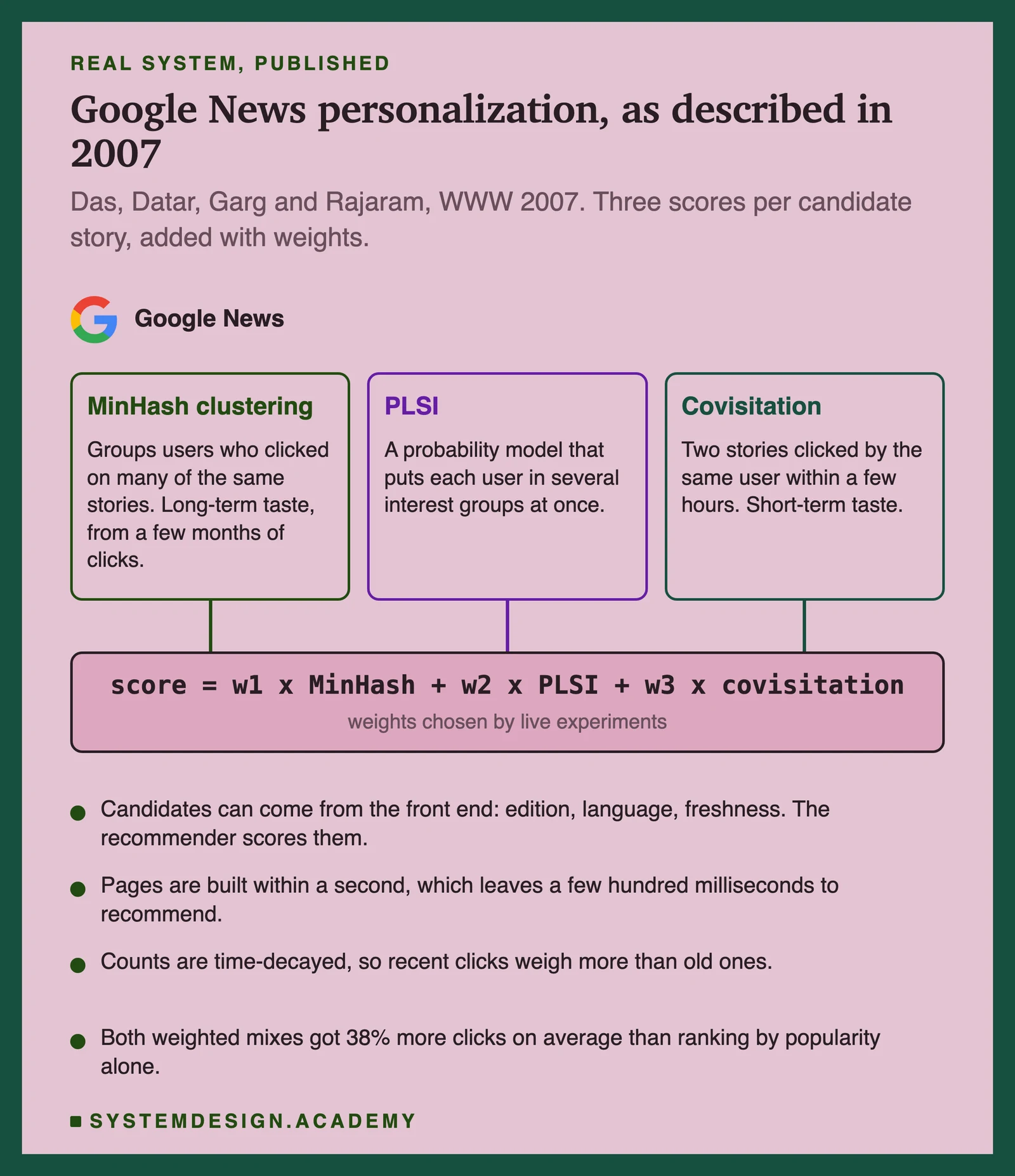
One of the few detailed public descriptions of a large news aggregator's personalization is Google's 2007 paper by Das, Datar, Garg and Rajaram. At the time Google News had several million unique visitors over a few days and several million stories, where a story is a cluster of news articles. Three methods scored each candidate story: MinHash clustering of users by the stories they clicked, PLSI (a probability model of user interests), and covisitation, which counts two stories clicked by one user within a few hours. Scores were added with weights chosen by live experiments. The candidates could come from the news front end, based on the edition, the reader's language and story freshness. Pages were generated within a second, which left the recommender a few hundred milliseconds, and its counts were time-decayed so recent clicks weighed more. In a test over 5 to 6 months, both weighted mixes got 38% more clicks on average than ranking by popularity alone. For near-duplicates, Manku, Jain and Das Sarma at Google showed in 2007 that Charikar's SimHash, with 64-bit fingerprints and up to 3 differing bits, is reasonable for a store of 8 billion web pages, and showed how to keep those fingerprints in permuted, sorted tables so each lookup is fast. Broder's 1997 paper on resemblance and shingles is the root of the MinHash family. On the ingestion side, the standards are public: RSS 2.0 (every item element optional, a ttl hint in minutes), Atom (RFC 4287, exactly one permanent id per entry), WebSub (a W3C Recommendation with publisher, hub and subscriber roles, leases and signed deliveries), HTTP conditional requests and 304 Not Modified (RFC 9110), and robots.txt (RFC 9309, cache at most 24 hours, a 5xx means fetch nothing). Google's crawling docs describe the politeness rule this page uses: crawl less when a site slows down or returns 5xx or 429. Google's help pages say Google News ranking is done by algorithms using relevance, prominence, authoritativeness, freshness, usability, and location and language, with some sections personalized.
Sources
- Das, Datar, Garg, Rajaram: Google News Personalization, Scalable Online Collaborative Filtering (WWW 2007)
- Manku, Jain, Das Sarma: Detecting Near-Duplicates for Web Crawling (WWW 2007)
- Charikar: Similarity Estimation Techniques from Rounding Algorithms (STOC 2002)
- Broder: On the Resemblance and Containment of Documents (1997)
- RSS 2.0 Specification (RSS Advisory Board)
- RFC 4287: The Atom Syndication Format
- WebSub (W3C Recommendation)
- RFC 9309: Robots Exclusion Protocol
- RFC 9110: HTTP Semantics (conditional requests, 304 Not Modified)
- Google crawling docs: crawl budget and crawl capacity limit
- Google News Publisher Center: how news is ranked
- Google News Help: how Google News stories are selected
Lessons to study before this interview
If any of these topics are fuzzy, the interviewer will catch it. Each lesson is 15 to 60 minutes with diagrams, code, and a quiz.
Polling
intermediate / messaging event systems
Webhooks
intermediate / messaging event systems
Pub/Sub Pattern
intermediate / messaging event systems
Message Queues
intermediate / messaging event systems
Message Deduplication
intermediate / messaging event systems
Fan-Out/Fan-In
intermediate / messaging event systems
Data Deduplication
advanced / consistency models
Bloom Filters
intermediate / database types storage
Inverted Index
intermediate / database types storage
Cache-Aside Pattern
foundation / caching strategies
Cache Stampede Prevention
foundation / caching strategies
Cache Invalidation
foundation / caching strategies
Time To Live (TTL)
foundation / caching strategies
Content Delivery Network (CDN)
foundation / load balancing proxies
Database Sharding
foundation / database fundamentals
Rate Limiting for Resilience
advanced / reliability resilience
Retry Patterns
advanced / reliability resilience
High Availability
advanced / reliability resilience
Back Pressure
intermediate / microservices architecture
Stream Processing
advanced / stream batch processing
Design Twitter/X Feed
capstone / capstone
Design Google Search
capstone / capstone
Frequently asked questions
Practice with 770 system design lessons
Lifetime access for ₹499 in India or $49 elsewhere. Interactive diagrams, quizzes, and 20 capstone projects to practise on.