System design interview guide
Coinbase System Design Interview: How Crypto Deposits and Withdrawals Work
Short answer
A good scenario to practise for a Coinbase system design interview is how customers deposit and withdraw crypto. We have no public source that Coinbase asks it. The key idea is to keep two records in agreement. One is the public blockchain. The other is Coinbase's internal ledger of who owns what. In this design the chain is read through a ChainStorage-style read replica. ChainStorage is Coinbase's open-source chain data layer, and it streams added and removed blocks. A deposit is credited only after enough confirmations, meaning blocks on top of it. Coinbase uses 2 for Bitcoin and 14 for Ethereum. A withdrawal is debited from the ledger first, then signed by a hot wallet and sent. Coinbase keeps over 99% of customer assets in cold storage, offline.
Two courses by the author of this page:
770 lessons · 18 free to read
₹1,111 in India · $35 elsewhere, once
Get System DesignYou own this course
219 lessons · 10 free to read
₹1,333 in India · $35 elsewhere, once
Get Generative AI and Agentic AIYou own this course
Save your progress and get the interview checklist PDF
Coinbase reported $377 billion in assets on its platform on 30 September 2026. In November 2026 it wrote that over 99% of customer assets sit in cold storage, offline. The rest sits in hot wallets so withdrawals can go out. Every deposit must be read from a public blockchain. Every withdrawal must be signed without one person ever holding a key.
Designing crypto deposits and withdrawals at Coinbase is about two records that must agree. One is the public blockchain, which Coinbase does not control and which can rewrite its recent past. The other is Coinbase's own internal ledger, which records who owns what. A deposit moves money from the first to the second, but only once the chain is deep enough to trust. A withdrawal moves it back: the ledger is debited first, then the send is signed and broadcast. Around this sit the wallets. A small hot wallet signs everyday withdrawals. Over 99% stays in cold storage, refilled into the hot wallet under strict limits.

Where it shows up
A common type of question for backend, infrastructure and security roles at crypto exchanges and fintech companies. We have no public source that Coinbase uses this exact question. This guide is built from Coinbase's own blog, help centre and SEC filings, so you can reason with real numbers.
Spec sheetCoinbase
- 01Assets on the platform
- $377B
- 02Value in hot wallets, estimated
- under ~$3.8B
- 03Monthly transacting users
- 9.2M
- 04Deposits and withdrawals per second, assumed
- ~14 avg
worked through below, with the maths
Coinbase in its own numbers
Every figure below is quoted from Coinbase's own engineering writing. Tap a source to check it.
$377B
assets on platform, 30 September 2026
Coinbase blog, Nov 202699%+
of customer assets kept in cold storage
Coinbase blog, Nov 20269.2M
monthly transacting users, 2025 average
Coinbase 10-K for 20252 / 14
confirmations before Coinbase credits a BTC / ETH deposit
Coinbase help centre, read Nov 20261 to 2 s
ChainStorage data freshness on Ethereum
Coinbase blog, 202375.2%
lower Bitcoin fees after batching withdrawals
Coinbase blog, 2020
Why this question is asked
This question tests whether you can keep money correct when an outside system is not fully reliable. A blockchain can reorganise, which means recent blocks are replaced and a payment you saw can vanish. A candidate who credits a deposit the moment it appears has lost money. The question also tests security thinking. Keys that can move billions must never sit on one server or with one person. Finally, it tests whether you know where the ledger ends and the chain begins.
What the interviewer asks
“Design how customers deposit crypto into Coinbase and withdraw it again. A customer sends bitcoin to their Coinbase address and later sends it out to another wallet. Focus on correctness and on keeping the keys safe. You have about 45 minutes. Spend 5 clarifying, 5 on numbers and 10 on the architecture. Then spend 20 on reorgs and withdrawals, and 5 on trade-offs.”
Ask these back before you draw
- 1.Which chains? (Start with Bitcoin and Ethereum; the design must add more chains without a rewrite.)
- 2.When may a deposit be spent or traded? (After a set number of confirmations per asset.)
- 3.Does each customer get their own on-chain wallet, or is it pooled? (Coinbase, Inc. holds trading assets pooled, or omnibus, meaning many customers share one wallet. A ledger records who owns what.)
- 4.How fast must a withdrawal leave? (Seconds to a minute is fine; safety comes first.)
- 5.Is the order book and trading engine in scope? (Not here; this is the money in and out.)
This page is the free part.
The course goes deeper on the Coinbase design
₹1,111 in India$35 everywhere elseonce, for the whole course
The System Design course covers the Coinbase design across a run of lessons, not one page. These 4 alone are about 90 minutes of step-by-step reading, 1 of them with code you run in the browser, all with a quiz.
- Idempotency Keys
Safely retry failed API requests without causing duplicate side effects.
- Idempotent Consumer
Design consumers that produce the same result whether a message is processed once or ten times.
- Transactional Outbox Pattern
Guarantee that your database write and message publish either both happen or neither does.
- Event Sourcing
Store events instead of state, rebuild any point in time from the log of what happened.
all part of
System Design Masterclass
770 lessons · about 290 hours · 18 free to read
₹1,111in India, by UPI
$35everywhere else, by card or PayPal
It is really nice and good Please join the course
You own this course
Continue with Idempotency Keyspay once,
yours for life
Live from the course bench
Before you design Coinbase, try the questions it rests on.
Real interview questions, live diagrams and measured lab results, pulled at random from the lessons. A new set every time you come back.

01Requirements
Requirements
Always clarify these in the first 5 minutes of the interview. Do not start drawing boxes until both lists are agreed.
Functional requirements
- Each customer gets a deposit address per chain
- A deposit is shown as pending when it appears on the chain
- A deposit is credited to the customer's balance after the required confirmations
- A customer can withdraw to any external address, and sees the fee and status
- Many chains are supported, and a new chain can be added without changing the ledger
- Operations staff can pause sends and receives for one asset, or for everything
Non-functional requirements
- Correctness first: never credit a deposit twice, never pay a withdrawal twice
- A reorganised chain must never leave a customer with money that does not exist
- No single person, laptop or server can sign a transaction or rebuild a private key
- Most funds offline: Coinbase keeps over 99% of customer assets in cold storage
- Every balance can be reconciled against the blockchains
- Survive sudden traffic spikes, because crypto prices move fast
02Scale estimates
Back-of-envelope scale estimates
Show your math. Pulling numbers from thin air signals you have not thought about the load.
Assets on the platform
$377B
Coinbase's own figure for 30 September 2026, from its November 2026 post. Its 10-K reported $376 billion at the end of 2025. This total includes Coinbase's custody business for institutions, so the trading wallets hold less than this.
Value in hot wallets, estimated
under ~$3.8B
Coinbase keeps over 99% of customer assets in cold storage. So less than 1% is hot. 1% of $377 billion is about $3.8 billion, as a ceiling. Custody balances are counted in the $377 billion, so the real hot balance is lower. Its 10-K states a looser target: no more than 2% of assets under custody in hot wallets.
Monthly transacting users
9.2M
The 2025 average from the 10-K. A transacting user did at least one transaction, active or passive (for example earning rewards), in a rolling 28-day window. Not all of them deposit or withdraw, so treat this as an upper bound for these paths.
Deposits and withdrawals per second, assumed
~14 avg
This is our assumption, not Coinbase data. Assume each of 9.2 million users makes 4 deposits or withdrawals a month. That is about 37 million a month. A month has about 2.6 million seconds, so about 14 a second on average. Plan for 10 to 20 times that in a price spike: a few hundred a second.
Time to credit a Bitcoin deposit, estimated
~20 min
Coinbase requires 2 confirmations for Bitcoin. A Bitcoin block is created every 10 minutes on average, as Coinbase's 2020 batching post says. 2 x 10 minutes is about 20 minutes, and longer when blocks come slowly.
Bitcoin withdrawal batches per day, estimated
1,440+
Coinbase wrote in 2020 that it batched Bitcoin withdrawals at least once per minute. 60 x 24 is at least 1,440 batches a day; busy minutes can need more than one. Bundling many sends into each transaction is what cut its daily transaction count by 95%.
03Architecture
High-level architecture
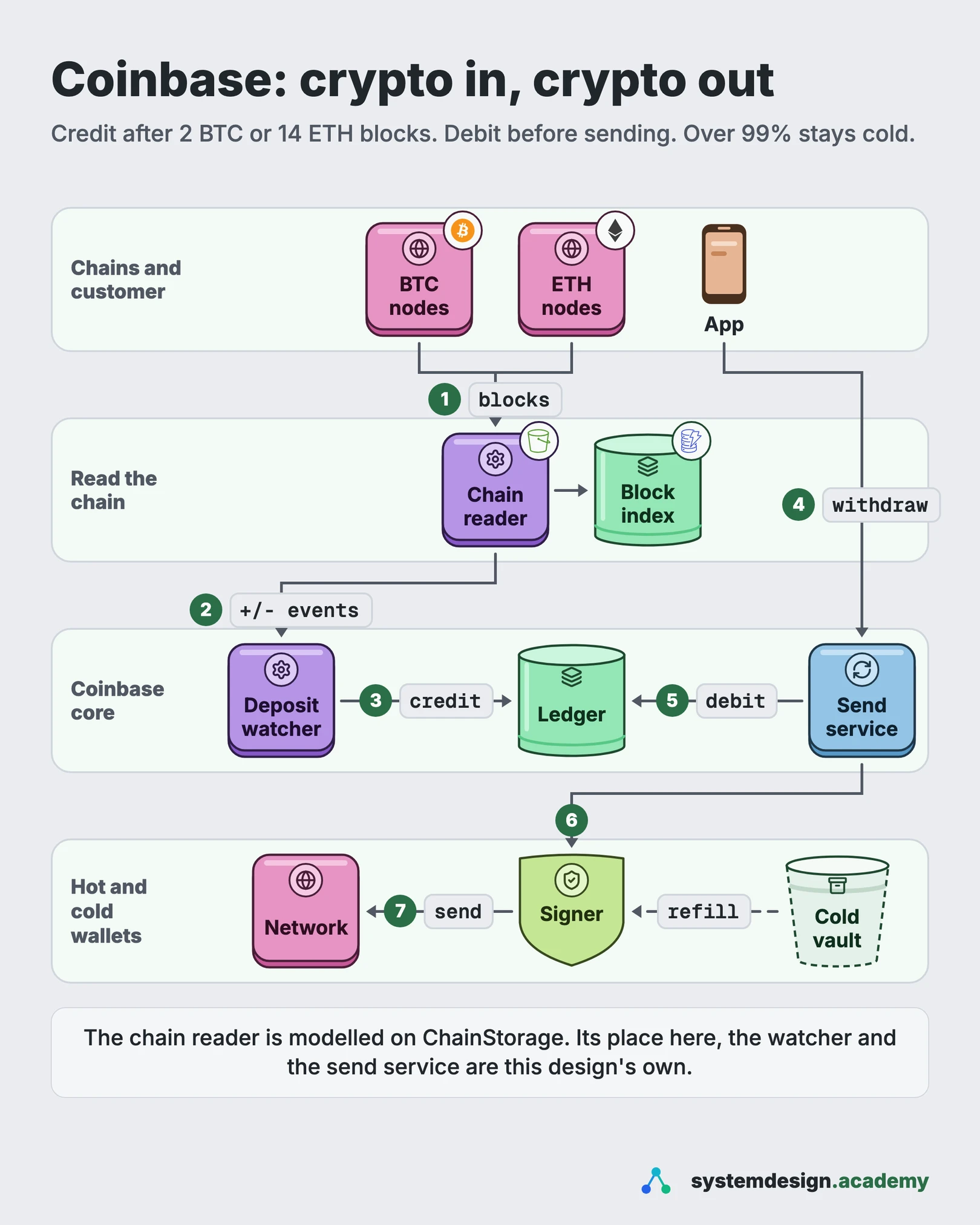
Draw four layers. At the top are the blockchains, reached through a pool of load-balanced nodes. A node is a server that runs the chain's software and keeps a copy of it. Under them sits a layer that reads the chains. In this design that layer is modelled on ChainStorage, an open-source read replica of blockchains that Coinbase described in 2023. Coinbase has not said whether its deposit system reads from it. The layer stores every block and turns the chain into an ordered stream of events. That includes events that remove blocks when the chain reorganises. In the core sits Coinbase's internal ledger. On chain, Coinbase, Inc. holds trading assets in pooled (omnibus) wallets, and the ledger records which customer owns what. A deposit watcher reads the event stream, waits for enough confirmations and credits the ledger once. A sweeper moves deposited coins into the pooled wallets. A withdrawal service debits the ledger first, then queues the send. At the bottom are the wallets. A hot wallet signing service signs and broadcasts queued sends. Cold storage holds over 99% of assets offline and refills the hot wallet under rate limits. Reconciliation jobs keep checking the ledger against the chains.
In a real interview, sketch this on the whiteboard before diving into any single box.
04One request
One deposit and one withdrawal, step by step
Coinbase has published the pieces of this path in different posts. The deposit watcher, the sweeper, the send queue and ChainStorage's place on the deposit path are this design's own.
- 1
Blocks are read
A pool of nodes follows each blockchain. In this design a ChainStorage-style reader pulls every new block, checks it and stores it. Coinbase reported 1 to 2 seconds of freshness for ChainStorage on Ethereum in 2023.
- 2
The deposit is seen
The deposit watcher reads the event stream. It finds a payment to one of our deposit addresses and records a pending deposit. The customer sees it as pending.
- 3
The chain gets deeper
Each new block on top is one more confirmation. If a reorg event removes the block, the deposit stays pending until it is mined again.
- 4
The ledger is credited
At 2 confirmations for Bitcoin, or 14 for Ethereum, the watcher credits the ledger. The credit is keyed by the on-chain payment: transaction hash plus output or log index. So a retry cannot credit twice, and one transaction paying two customers credits both.
- 5
A withdrawal is debited
Later the customer asks to send. The withdrawal service checks limits and risk, then debits the ledger and puts the send in a queue.
- 6
Sign and broadcast
For Bitcoin, Coinbase wrote in 2020 that it batched queued sends at least once a minute. In this design, each Ethereum send is its own transaction. The hot wallet signs and broadcasts, and the watcher follows the send until it confirms.
05Components
Core components
Walk through each service. The interviewer wants to hear what each one owns, not just the names.
Blockchain nodes
A cluster of nodes for each chain, behind a load balancer. ChainStorage fails over between node sources so one bad node does not stop reading.
ChainStorage (the chain reader in this design)
Coinbase's blockchain read replica, open source on GitHub and described in a 2023 post. It stores each block as a file in S3 with metadata in DynamoDB. It offers batch reads and a stream of add and remove events. Workflows on Temporal, a workflow engine, poll new blocks, backfill old ones and stream changes. Using it for deposits is this design's choice.
Deposit watcher
In this design, a consumer of the chain event stream. It matches payments to deposit addresses, counts confirmations, handles reorgs and credits the ledger exactly once per on-chain payment.
Sweeper
In this design, it moves funds from customer deposit addresses into the pooled hot or cold wallets. In general, on Bitcoin, deposit outputs can be spent directly as inputs to the next batch. On Ethereum, a deposit address needs a little ETH for the gas fee before its tokens can move. Some exchanges use forwarder contracts instead. Sweeps are on-chain transactions, so they are tracked and reconciled like withdrawals.
Internal ledger
The record of who owns what. Coinbase's 10-K says trading assets are held in an omnibus manner on the blockchain. They are recorded separately in a ledger system. In this design every movement is a double-entry pair, so the books always balance.
Withdrawal service and send queue
Checks the request (limits, address, risk), debits the ledger, then queues the send. A request id makes the whole path idempotent, which means a repeated request has the same effect as one. A retry finds the first attempt instead of paying twice.
Hot wallet signing service
Signs and broadcasts sends. Coinbase wrote in 2026 that no single person has standing production access to it, and changes need several people. Kill switches can take its keys offline.
Cold storage
Over 99% of customer assets, with keys offline. Coinbase wrote in 2026 that cold keys are split into pieces and never rebuilt, even to sign. Refills to the hot wallet are rate limited, and unusual volume is held for review.
Reconciliation
Coinbase's 10-K says it reconciles Coinbase wallets against third-party blockchain data. In this design a job compares the ledger total for each asset with what our addresses hold on chain. Any gap raises an alert.
06Data model
Data model
Pick the right store per table. Justify each choice with the access pattern, not by reflex.
deposit_addressesaddress (primary key)chaincustomer_idmemo or tag (shared-address chains)created_atIn this design, one address per customer per chain, so an incoming payment tells you who it is for. On Ethereum one address receives ETH and every token. Read on every block, so the watcher keeps it in memory or a fast cache.
deposits(chain, tx_hash, output_index or log_index) uniqueaddressassetamountblock_hashblock_heightstatus: pending | credited | reversedThe unique key is the on-chain payment, so the same deposit can be recorded only once. A Bitcoin payment is an output; an Ethereum token transfer is an event log. The block hash is stored so a reorg can find the deposits that sat in a removed block.
ledger_entriesentry_idjournal_idaccount_idassetamount (+ or -)reference (deposit or withdrawal id)created_atAppend only. A journal is one business event, such as one deposit. Its entries sum to zero per asset. That is double-entry bookkeeping. A balance is the sum of an account's entries. It is usually kept in a balances table, updated in the same database transaction.
withdrawalswithdrawal_id (idempotency key)customer_idassetto_addressamountstatus: requested | held | queued | broadcast | confirmed | failedtx_hashnonce (account chains)A state machine. The ledger debit happens on the move to queued. A send is marked failed only once it can never confirm. On Bitcoin, its inputs were spent by another transaction. On Ethereum, its nonce was used by another transaction. Only then is the debit reversed, with a new journal. A send stuck on a low fee is sped up, never reversed. A send that a reorg removes goes back to broadcast, not to failed.
07Deep dives
Deep dives
These are the conversations the interviewer is steering you toward. Practice each one until you can talk through it without notes.
Reading the chain: ChainStorage, a read replica of every blockchain
Coinbase wrote in 2023 that its teams had been building their own indexers. Each one pulled data from archive nodes, which store the whole history of a chain. Those nodes were costly, and pulling from them was slow and unreliable. So from 2021 Coinbase's Crypto Data Foundation team built ChainStorage. It acts like a read replica of the blockchain. It pulls raw blocks from a cluster of load-balanced nodes. It stores each block as a file in S3, with metadata in DynamoDB. Parsing happens later, so raw data is kept as it came. It checks blocks with Merkle hashes: it recomputes a block's summary hash from its transactions, to prove nothing was altered. It can fail over between node sources. Downstream systems use batch reads or a streaming API. Coinbase reported 1 to 2 seconds of data freshness on Ethereum. Scaled to about 1,000 blocks a second, it could rebuild Etherscan's database in an hour or less. Etherscan is a public website for looking up Ethereum blocks. Coinbase has not said its deposit system reads from ChainStorage. In this design it does, because the interview point is to separate reading the chain from acting on it. The deposit watcher should not talk to nodes directly.
When is a deposit final? Confirmations and reorgs
A transaction has one confirmation when it is in a block. Each block on top adds one more. Coinbase's help centre lists 2 confirmations for Bitcoin, 14 for Ethereum and ERC-20 tokens, and 3,000 for Ethereum Classic. ERC-20 is the standard for tokens that run on Ethereum. Why so different? Because a chain can reorganise. A reorg replaces recent blocks with a different set, and a payment in a replaced block can disappear. In 2019 Coinbase described an attack on Ethereum Classic. It saw 15 reorgs, 12 with double spends, worth 219,500 ETC (about US$1.1 million). The deepest replaced 123 blocks. A double spend means the attacker paid someone, then rewrote history so the same coins went elsewhere. Coinbase paused ETC sends and receives, and no Coinbase accounts were affected. ChainStorage, as Coinbase described it in 2023, never overwrites a block. It logs an ordered stream of events, each a block added or removed, with a sequence number. In April 2022 Coinbase lowered its counts for Bitcoin, Ethereum, Litecoin and Ethereum Classic. As general knowledge: since the Merge in September 2022, Ethereum also has protocol finality. A block is finalized after about two epochs, roughly 13 minutes. A design can wait for a block count, for finality, or both. Coinbase's help centre states a count.
REQUIRED = {"BTC": 2, "ETH": 14}

def on_block_added(tip_height):
    for dep in deposits.pending():
        if tip_height - dep.block_height + 1 >= REQUIRED[dep.asset]:
            ledger.credit_once(key=dep.payment_id, to=dep.customer, amount=dep.amount)
            dep.mark_credited()

def on_block_removed(block):
    for dep in deposits.in_block(block.hash):
        if dep.credited:
            ledger.reverse_credit(dep)  # deep reorg: new journal
            alert(dep)
dep.mark_pending() # may be mined again in another blockTwo chain models: UTXO and accounts
This part is general blockchain knowledge, not something Coinbase has written about. Bitcoin uses the UTXO model. UTXO means unspent transaction output: coins are outputs of earlier transactions, waiting to be spent. A payment is identified by its transaction hash plus its output index. Ethereum uses an account model. Balances live on addresses. A token transfer is recorded as an event log, so it is identified by transaction hash plus log index. ETH sent by a contract appears only in execution traces, the detailed record of what a transaction did. So the watcher needs a parser for each model. ChainStorage, as Coinbase described it, keeps one generic block format with a parser plug-in per chain. The model also changes withdrawals. A Bitcoin wallet can pay many people in one transaction. An Ethereum account sends one transaction per withdrawal. Each one carries a nonce, a counter that must go up by one each time. If one transaction is stuck, every later one waits. Some chains, such as XRP and Stellar, use one shared address with a memo or tag that names the customer.
The internal ledger: omnibus wallets, double entry, credit once
Coinbase does not give every customer a separate wallet on chain for trading. Its 10-K says Coinbase, Inc. holds crypto in an omnibus manner on the blockchain and records it separately in a ledger system. Omnibus means pooled. So the ledger, not the chain, says who owns what. That makes the ledger the most important table in the system. In this design, every change is a journal of entries that sum to zero, which is double-entry bookkeeping. A deposit debits a "crypto held" account and credits the customer. Entries are never edited, only added. Coinbase's payments team wrote in 2021 that a retry must never cause a double charge or a double payout. The answer is idempotency: the same request, repeated, has the same effect as doing it once. For deposits, the natural key is the on-chain payment, the transaction hash plus output or log index. For withdrawals, it is a request id chosen when the customer clicks send. Finally, reconcile. Coinbase's 10-K says it reconciles its wallets against third-party blockchain data. For each asset, the ledger total should match what our addresses hold on chain.
Withdrawals: debit first, then batch
Debit the ledger before anything touches the chain. If you broadcast first and the debit fails, the coins are gone and the customer still has a balance. Broadcast means sending a signed transaction to the network's nodes. Then queue the send. Coinbase started batching Bitcoin withdrawals in March 2020. Before, every customer send was its own transaction. After, many sends shared one transaction, built at least once per minute. Coinbase's 2020 example shows why this saves money. A satoshi is one hundred-millionth of a bitcoin. Virtual bytes measure a transaction's size for fees. Three separate sends of 140 virtual bytes each cost 1,400 satoshis each, at 10 satoshis per virtual byte. One batched transaction with the same three payments is 202 virtual bytes and 2,020 satoshis. That is 673 satoshis per send, 52% less. By August 2020 Coinbase batched 100% of consumer sends, cut fees by 75.2% and made 95% fewer transactions a day. Batching also eased an older problem. A change output is the leftover a transaction pays back to the sender's own wallet, like change from a note. A hot wallet often waits for its last change output to confirm before it can spend again. Coinbase hit this as early as 2013. With 95% fewer transactions there were fewer change outputs to wait on, and related alerts fell by about 78%. Coinbase's batching posts cover Bitcoin only.
Hot and cold wallets: keep almost everything offline
A hot wallet's keys can sign online, so withdrawals go out fast. A cold wallet's keys are kept offline. Coinbase wrote in November 2026 that over 99% of customer assets are in cold wallets. Hot wallet balances are watched and topped up as demand changes, and excess goes back to cold storage. The controls matter more than the split. Coinbase sets strict limits on how fast assets can move from cold to hot. If withdrawal volume trips an alarm, its wallet operations team investigates before the transfer goes ahead. It has kill switches. Some take the signing keys offline entirely, so no system can sign until access is restored on purpose. Its 10-K adds that a withdrawal needing cold funds is released by a geographically distributed team. All of them have enhanced background checks. In an interview, size the hot wallet to expected demand, not to the worst day. Then say what happens when it runs low: withdrawals wait for a reviewed, rate-limited refill.
Signing without one key: threshold signing (MPC)
A private key signs a transaction. Whoever has it can move the funds. Threshold signing is a form of multi-party computation (MPC): several parties compute one result without showing each other their secrets. Coinbase's 2021 post on its Threshold Signing Service explains how it avoids one full key. The post describes it for cold keys and for Ed25519 signatures. So treat it as Coinbase's cold-key signer, not necessarily the hot wallet's. At key creation, the key is split with Shamir Secret Sharing. This splits a secret into shares, and only a set number of them together can recover it. Then the full key is deleted. Each share goes to a different party. Earlier, signing meant putting the shares back together, so Coinbase used each address only once. Threshold signing changed that. Each party signs with its own share and uploads a partial signature. The partial signatures are combined into one valid signature, and the key is never rebuilt. Each party's own keys live in hardware security modules, devices that keep a key from being used without physical access. Every signing share is encrypted to the party that holds it. A central server passes messages and any party can halt the protocol. Signing needs both human and server parties. The two rounds are asynchronous, because a human approver may take hours.
Surviving the spikes: streams, databases and predicted traffic
None of these three posts is about deposits or withdrawals. They show how Coinbase handles load in general, which you can borrow for the watcher and the ledger. Crypto traffic arrives in bursts when prices move. First, events. Kafka is a system that stores streams of events so many services can read them. Coinbase wrote in 2021 that it runs Kafka on AWS MSK, after moving from Kinesis. It ingested billions of events a day. The median end-to-end latency was under 10 milliseconds for payloads up to 100 KB. Second, databases. Coinbase began as a Ruby on Rails app on MongoDB. In 2020 connection storms during deploys hit almost 60,000 connections in a minute. It built mongobetween, a connection proxy, and cut connections about 20 times. Third, prediction. Coinbase wrote in 2024 that adding a database replica can take over two hours. Each shard, one slice of the data, also has a single writer. So it scales databases before a spike. A model uses crypto price swings to predict spikes 60 minutes ahead. The scale target can rise to 2 times its current level. For deposits and withdrawals, this means the watcher and the ledger must be ready before a busy market, not after.
Common mistakes candidates make
The first mistake is crediting a deposit when it first appears. On a reorg the coins can vanish, and the customer may already have traded or withdrawn them. Say instead: show it as pending, credit only at the asset's confirmation count, and handle remove events. The second mistake is treating the chain as the ledger. With omnibus wallets, the chain cannot tell you which customer owns a coin. Say instead: the internal ledger is the record of ownership, and reconciliation checks it against the chain. The third mistake is broadcasting before debiting, or reversing a send that only looks failed. A dropped transaction can still be mined later, which pays twice. Debit first, with a unique request id, and reverse only when the send can never confirm. The fourth mistake is one hot wallet with one key on one server. Say instead: keep most funds cold, split keys so none is ever whole, and rate limit refills. The fifth mistake is one design for every chain. Confirmation counts, fees and the UTXO or account model differ. Keep chain-specific parts in plug-ins. How to spend 45 minutes: 5 clarifying, 5 on numbers and 10 on the architecture. Then 20 on reorgs and withdrawals, and 5 on trade-offs.
08Trade-offs
Trade-offs to discuss
Every senior interviewer expects you to surface at least 3 of these. Pick the decisions, state the alternatives, and justify your choice.
Fewer confirmations vs more confirmations
Fewer confirmations credit customers faster. More confirmations make a reorg less likely to undo a credit. Coinbase sets the number per asset and changes it over time. Its help centre lists 2 for Bitcoin, 14 for Ethereum and 3,000 for Ethereum Classic.
Omnibus wallets with a ledger vs one on-chain wallet per customer
Separate wallets make ownership visible on chain, but every internal move costs a fee and a wait. Omnibus wallets let trades settle in the ledger instantly. The cost is that the ledger must be right, and must be reconciled with the chain. Coinbase's 10-K describes omnibus wallets for trading and separate dedicated addresses for its custody business.
Batch withdrawals vs send each one at once
Sending at once is a little faster for the customer. Batching adds a short delay but cut Coinbase's Bitcoin fees by 75.2% and its transactions by 95% in 2020. It also left fewer change outputs waiting to confirm. In general, on account chains like Ethereum, batching needs a contract, so plain sends are one per withdrawal.
A bigger hot wallet vs a smaller hot wallet
A bigger hot wallet rarely runs dry, so withdrawals never wait. A smaller one limits what an attacker can take. Coinbase keeps over 99% cold and rate limits refills, accepting that a busy day may slow some withdrawals.
Threshold signing vs rebuilding the key to sign
Rebuilding a key from shares is simpler, but the full key exists for a moment. Threshold signing never rebuilds it and lets addresses be reused, which staking needs. Staking means locking coins to help run a chain in return for rewards. The cost is a more complex protocol and slow human approvals.
A shared chain reader vs each team running its own nodes
Each team with its own indexer repeats costly work on archive nodes. One shared read replica, like ChainStorage, is built and run once, with reorg handling done once. The cost is a central dependency every team relies on.
Free PDF · 18 pages
Get the free System Design Interview Cheat Sheet
The interview in seven stages, the numbers worth knowing by heart, and twelve classic systems on one page each, every line linked to the lesson it comes from.
09Follow-ups
Follow-up questions to expect
After the main design, the interviewer usually picks one part and asks more. Here is what to say.
A deposit was credited, and then the chain reorganised deeper than your confirmation count. What now?
This is the case the confirmation count is meant to make rare. The watcher sees remove events for an already credited deposit. Reverse the credit with a new journal; if the customer has spent it, their balance goes negative. Freeze their withdrawals of that asset and alert a person. Then pause the asset, as Coinbase paused Ethereum Classic in 2019, and review its confirmation count.
The hot wallet is running low on a very busy day. What happens?
Withdrawals wait in the send queue; none are lost, because the ledger debit and the queue entry are already stored. A refill is requested from cold storage. Coinbase rate limits refills and holds unusual volume for review, so the wait is a deliberate trade for safety. Tell customers that sends are delayed rather than failing them.
A withdrawal has been stuck for an hour. Do you cancel it and refund the customer?
No. In general, a transaction that is not mined can still be mined later, so a refund could pay twice. Speed it up instead. On Bitcoin that means replace-by-fee, a new version with a higher fee. Or it means child-pays-for-parent, a second transaction that pays for both. On Ethereum it means the same nonce at a higher fee. Reverse the debit only when the send can never confirm.
Why not on-chain multisig instead of threshold signing?
Multisig means the chain itself requires several signatures. It is easy to audit. But its support and fees differ on every chain, and it shows the signing policy on chain. Threshold signing produces one ordinary signature, so the chain sees nothing special. The cost is a complex protocol you must trust and audit yourself.
Some chains use one shared address with a memo or tag. How do you attribute a deposit?
The memo or destination tag names the customer, so it becomes part of the deposit key. A deposit with a missing or wrong tag goes to a manual recovery queue instead of being credited. Other chains then use the same ledger and state machine; only the parser changes.
10In production
How Coinbase actually does it
Every fact about Coinbase on this page comes from Coinbase's own writing and filings. The estimates and anything marked 'in this design' or 'assume' are ours. Cold storage, rate-limited refills, kill switches and the $377 billion are from Coinbase's November 2026 post on protecting customer assets. Users, omnibus wallets, the ledger system, reconciliation and the 2% hot wallet target are from the 10-K for 2025. ChainStorage is from the 2023 post and its GitHub repository. Confirmation counts are from the help centre and the April 2022 post. The Ethereum Classic reorgs are from the January 2019 post. Batching numbers are from the two 2020 posts, and the change-output problem also from a 2013 post. Threshold signing is from the 2021 post. Kafka, MongoDB and predictive scaling each have their own post. Coinbase has not published its deposit watcher, sweeper, ledger schema or withdrawal state machine. It has not said whether deposits read from ChainStorage. Those parts of the page are this design. The UTXO and account models, Ethereum finality, nonces, fee bumping and memo tags are general blockchain knowledge. Older posts describe the system at that date, so give the year when you quote a number.
Sources
- Coinbase blog: How Coinbase protects customer assets (Nov 2026)
- Coinbase Global, Inc. Form 10-K for 2025 (SEC, Feb 2026)
- Coinbase blog: Part 1, ChainStorage, the enterprise blockchain data availability layer (2023)
- GitHub: coinbase/chainstorage
- Coinbase help centre: Confirmations (read Nov 2026)
- Coinbase blog: Announcing new confirmation requirements (2022)
- Coinbase blog: Deep chain reorganization detected on Ethereum Classic (2019)
- Coinbase blog: Coinbase rolls out Bitcoin transaction batching (2020)
- Coinbase blog: Reflections on Bitcoin transaction batching (2020)
- Coinbase blog: Unconfirmed transactions (2013)
- Coinbase blog: Production Threshold Signing Service (2021)
- Coinbase blog: How we build payments systems at Coinbase (2021)
- Coinbase blog: How we scaled data streaming at Coinbase using AWS MSK (2021)
- Coinbase blog: Scaling connections with Ruby and MongoDB (2020)
- Coinbase blog: How Coinbase is using machine learning to predict traffic and scale databases (2024)
Lessons to study before this interview
If any of these topics are fuzzy, the interviewer will catch it. Each lesson is 15 to 60 minutes with diagrams, code, and a quiz.
Idempotency Keys
intermediate / api design protocols
Idempotent Consumer
intermediate / messaging event systems
Transactional Outbox Pattern
intermediate / messaging event systems
Event Sourcing
advanced / distributed systems core
Finite State Machine
advanced / distributed systems core
Change Data Capture (CDC)
intermediate / data replication distribution
Merkle Trees
intermediate / database types storage
Hardware Security Module (HSM)
intermediate / security architecture
Rate Limiting
intermediate / api design protocols
Capstone: Design a Payment System
capstone / capstone
System design interviews at companies in the US, UK, Canada and Singapore
41 walkthroughs of real systems at well-known companies, each built from that company's own engineering blog, talks or filings, with the numbers cited.
Banking, payments and trading
- Monzo system design (UK)
- Wise system design (UK)
- Stripe system design
- PayPal system design
- Robinhood system design
- Coinbase system design (this page)
Commerce and delivery
Rides and maps
- Grab system design (Singapore)
- Uber system design
Feeds, social and messaging
Streaming and media
AI labs and big tech
Developer and collaboration tools
11FAQ
Frequently asked questions
Go deeper
This guide is built on these 6 lessons. Each one teaches one piece of the Coinbase design above, step by step.
- Idempotency KeysSystem Design · api design protocols · 18 min
- Idempotent ConsumerSystem Design · messaging event systems · 20 min
- Transactional Outbox PatternSystem Design · messaging event systems · 22 min
- Event SourcingSystem Design · distributed systems core · 30 min
- Finite State MachineSystem Design · distributed systems core · 25 min
- Change Data Capture (CDC)System Design · data replication distribution · 35 min
Practice with 770 system design lessons
Lifetime access for ₹1,111 in India or $35 elsewhere. Interactive diagrams, quizzes, and 20 capstone projects to practise on.

This one question is not enough for the interview.
Get all 200 questions in the System Design and Distributed Systems pack
Each question has why it is asked, a full answer, what the interviewer listens for, the follow-ups, the common mistakes and a diagram (268 diagrams in all). A PDF you keep, junior to staff level.
Pay by UPI, cards or netbanking through Razorpay. Pay by card or PayPal, in US dollars. Download at once from My packs.
NEWSystem Design Hands-On
Included in the System Design course: real systems, built live
Postgres Sharding: Complete Hands-On (PgBouncer + Citus). 2 h 36 min and 20 chapters: one PostgreSQL loaded until it breaks, then four shards behind a router you write, PgBouncer and Citus, with the 139-page slide deck. The first 15 minutes are free to watch.

Self-paced bootcamp · new class every week
System Design Interview Bootcamp
System design interview preparation in 14 recorded classes: the framework, estimation, the building blocks and 14 real designs, with two 1:1 mock interviews. Classes 1 to 4 are out, and its first 3 minutes are free.